
Category: Point of View

Our Azenby beacon is always on the lookout for all the latest news, views and happenings in the land of mobile. Here are some of our observations. Spotted anything else out there that we should talk, think and get excited about? Excellent! Drop us an email and let us know.

  • Review of the Raging Twenties (The 2020s!)

    It’s been customary for Azenby to write a year-end review of the mobile world but just for a change we are leaping forward to December 31st, 2029 to review the last decade. No, we haven’t found a way of time travel. We just thought that it would be stimulating to gaze into our Crystal Ball for a change instead of looking in the rear-view mirror and have a go at predicting what the mobile world might look like come 2030. Of course, it is pure fiction. Maybe!

    Standards Development Organisations

    Azenby-HT-MagGlass

    Geopolitical fallout at the beginning of the decade continued with the US imposing ever more restrictions on the use of technology from China in critical communication infrastructure and all underlying technology. An already fractious relationship between the two super-powers was intensified with the outbreak of the Coronavirus virus and the Covid-19 disease which changed the blueprint irrevocably for the decade to come. An argument that started with digital security concerns had become a full-blown new cold war on health and human security and that ramped up the stakes considerably.

    The US persuaded more allies in the west, beyond just the Five Eyes, to follow suit and similarly ban the use of Chinese vendors from their national infrastructure. The ban extended to the use of any software code used in any product by any OEM where the code was written in China. Similarly, any component from China met with the same restriction. Indeed, the restriction extended from China to include other countries thought to be hostile to western interests including Russia, North Korea, and Iran.

    The inevitable fall out from this was a realisation in the west that they had fallen behind China in this area of technology and there was a gap to bridge if they were to deliver to consumers and to industry the sort of communication services that 5G had promised at the dawn of the decade. This also brought home to roost that it was not only the manufacturing capability that was absent, which for too long had been blamed solely on the impact of the China price for 4G and 5G equipment eradicating incumbent traditional vendor market share, but also a gap in expertise and Intellectual Property had developed.

    Western governments pondered on this and came to the conclusion that their major Communication Service Providers (CSPs) and their home based OEMs, had more or less abandoned serious participation in the standard body behind 5G (and 3G and 4G before that) and left the development of the crucial standards – and the ownership of critical IP – to Chinese manufacturers who had swamped 3GPP for a number of years and completed a peaceful ‘coups d’état’. Operators and manufacturers alike had sleepwalked into this position. Regulators and governments hadn’t seen it coming; indeed, some had been actively courting better relationships and internal investment from China since the start of the new millennium. The unintended consequences of this had come home to roost.

    The answer, they decided, was to start a new standards body for communication standards to replace 3GPP. Led by hawks in the USA, determined to ensure that US-based manufacturing would be able to rebuild and gain a dominant position, they created the new 6th Generation SDO called ATIS6G and invited partners in the West to join. The first thing they did, which in hindsight was a master stroke, was to end backward compatibility. Controversial as this seemed at the time, it did take out a lot of complexity from the standard, reduced development cost and had a dramatic effect on the time to bring the standard to the market. It also meant the engineers could spend more time and focus on the major goals and benefits that had been identified and not to worry themselves about hard to resolve backward compatibility issues. The goals were identified as ever faster data speeds, lower latency, spectral efficiency, dispersed data storage, broadcast, one Operating System for device and network, and enhanced cyber security built in. They also followed up with an IoT variant of the standard but ignored the 5G URLCC option, believing at the time that it was fairly pointless in practice. Removing the complexity in the new standard caused by the need for backward compatibility, resulted in lower costs of wireless access points and together with the merging of mobile and fixed cores, meant the inevitable amalgamation of the new standards body with IEEE, and the consolidation of WiFi and Cellular standards.

    Meanwhile the EU bloc, sensing it could be vulnerable to the new standard, was also aware of the need to create an industrial advantage for its own manufacturing base and, hankering after the glory era of GSM, was determined to recreate the environment that made GSM a global success story and resulted in Nokia, Ericsson, Siemens, and Alcatel becoming dominant suppliers to Europe and beyond. The schism that emerged between France and Germany was inevitable as the French were determined that ETSI should be the SDO responsible for a new standard as they still regarded ETSI as their baby. But with ETSI still at the time being a part of 3GPP before its disintegration, that just wasn’t possible.

    Germany and the Nordic countries saw the need for a new dedicated European mobile standard and created the EU7G Programme. They agreed that backward compatibility would end at 6G and that ETSI would remain the standards body for 2G through 5G but have no involvement beyond that. One thing that both the new European and US standards bodies did agree upon was that there would be no IP carried forward from 2G-5G in the new standards. This was to encourage the industry to get radical about technology and be more inventive. They went even further and – taking a leaf out of the early days of Chinese OEM development book – ignored any Chinese patent claims for infringement of IP. This did inevitably mean of course that there was no hope for a vendor’s products in the Far East. In this way, the world Telecoms standards fragmented into regional systems.

    With 3GPP now falling apart as the organisational partners split, it was inevitable that the Chinese body, CCSA, would break away and focus on its own standards developments. That left a dilemma for TDA (Korea) and TTC (Japan) on where to go. Many doubted that they could work together in unison and would seek to cooperate as partners in both ATIS6G and EU7G but the realization that creating industrial capability was paramount, and as we were at the beginning of new standard wars, they concluded that they would instead have to work together and independently of other new and existing SDOs. That just left TSDSI and all the world focused on what India would do. It was seen as a vital jigsaw piece needed by all the new SDOs as India was the world’s second largest market for telecoms.

    The new SDOs were courting, persuading, even bribing India to join with them. Political pressure was being exerted. India pondered long and hard about going it alone and create an Indian Sub-Continent sphere of influence of its own but as that would have needed to include Pakistan it was seen as a step too far. So, given assurances from the USA about pooling and sharing IP, India decided to join forces with ATSI6G with the agreement that at least 30% of the standards development work would be done in India. And so, the stage was set for the battle to commence now between four standards bodies all determined to move the fastest and provide the most advanced and economical efficient communications infrastructure.

    Azenby-Mobiles-LoResIt took time for other countries and regions to decide what to do. Russia decided it was too weak to go it alone, despite failed attempts to do so, and threw its hand in with China to create what came to be known as the Red Standard. Latin America decided against tying itself to its historic relationships and most Lat Am countries, but not all, joined the Red Standard. Africa went more or less with the Red Block as well, making it the largest of the new SDOs, at least in terms of addressable market.

    The new SDOs did at least agree to work together on interoperability and interworking standards. This was driven by a forlorn hope from the dominant device and operating system owners that a single global market for them could be retained. Interoperability, however, was at the very heart of why the 3rd Generation Partnership Project was conceived in the first place and brought the leading SDOs together to create 3G. Consequently, it always looked impossible to achieve any significant degree of interoperability whilst the new four standards bodies were internally focused and also saw the need to be moving fast and certainly moving faster than the other SDOs. They didn’t want the handbrake effect of sorting out interworking. This would have seemed inconceivable in 2019 but in 2020 the world had stopped travelling and didn’t know when it would start again. A mobile device that worked everywhere in the world didn’t seem to be a priority at that time.

    We know now that this fragmentation ended the existence of a global standard for communications and device compatibility between different zones became limited to a small sub-set of functions and capability. Can we say that this was offset by the enhancements made in telecommunication technologies as various standard bodies competed with each other to produce the best in class? At the beginning of this decade a 5G device cost $1k and at the end of it a 7G device has been launched in three markets for less than $200 (at 2020 equivalent pricing).

    Device incompatibility has been overcome by content and data being separated from access to the extent that any device can access a user’s data and this, with the advent of cheap devices, meant that people no longer travel with their own devices and simply use freely available devices wherever they go, inserting their profiles into them with the click of a QR code. How we view devices now is so different from when the decade began, and nobody really sees the way it all happens today as a problem.

    We now see that effective competition between standards bodies increases the pace of technological change and that new technologies overcome the old interworking restrictions we encountered which lead the drive for a global single standard, 90% of compatibility is now provided by OTT apps which let the inter standard interworking happen at a very low ‘access’ level which proved to be relatively simple.

    Coverage
    Azenby-Router-LoRes

    The dichotomy between why a Wi-Fi access point was so cheap (and which users bought and installed themselves) and the cost of cellular access was suddenly becoming front of mind for the industry at the beginning of the decade. Different deployment models underpinned by different business models were becoming increasingly more difficult for customers to fathom. Other factors were also at play in why the two ways of access wireless communications were so different. One of these was the ‘gift’ of an abundance of licensed spectrum at 3.5GHz and that was turning out to be more of a headache to mobile operators. Getting devices to behave consistently over such a wide spectrum range from 700Mhz to 3.5Ghz was one issue but the real issue MNOs were grappling with was indoor coverage. Penetration of 5G and then 6G signals in higher frequency bands into buildings was causing a whole new wave of coverage issues for Communication Providers that they thought were something from a distant past.

    It became clear that cellular radio inside buildings had to be provided by radio access points on the inside. In fact, the industry had known this for some time but chose to ignore it. This could no longer be the case as something happened in the early part of the decade that they were just not expecting. Fibre in the ground was becoming prevalent with a number of players now exercising new business models and investing in putting fibre direct to homes and businesses in urban and suburban environments. The new economy of scale meant that broadband over fibre was competitive and it certainly had better performance characteristics. Consumers and businesses were quite prepared to pay for wireless distribution inside the building and with WiFi sharing becoming commonplace, were becoming less dependent on cellular macro coverage outdoors. The emergence of very cheap Wi-Fi only devices was fueling this.

    The market was changing and for CPs, selling 6G indoor access points to the customers who then sorted out their own backhaul had become the way to go.  Self-provision of cellular access points is now as common as buying a WiFi wireless router was at the start of the decade.

    So, the new era of CP mergers had begun and would reshape the industry for the decade to come. MNOs were buying into or merging with fixed broadband players and fixed broadband players were equally keen to buy cellular properties. As we have now seen, the most successful of this new breed of CPs were the ones that also knew they had to include content in their product offering. Content is where customers perceived the most value and it was content that they were more likely to spend their money on, rather than access. The way they accessed the content they wanted had become commoditized and they just wanted a low price, high bandwidth and no latency.

    This still left an issue for rural coverage. The problem being that although it often made up as much as 80% of the landmass of a market, it only equated to 10% of the population. It was a commercial problem for CPs and also a political problem for administrators and regulators who felt compelled to act to ensure this problem was addressed. Spectrum made available at 400Mhz helped enormously as range was increased from each base station meaning only one 400MHz base station was required to replace eight 800/1900 base stations but the amount of spectrum in this band was not enough to provide the capacity needed for the demand.

    Local ‘private’ 5G and 6G networks were built using newly deregulated frequency bands. These, then, became more widely accessible through neutral hosting in some cases and through national roaming in others. Nonetheless, the economics were still not working for effective competition in rural areas and regulatory intervention in the marketplace was going to be necessary to resolve this. Many differing yet similar schemes emerged around the world from having a state-owned infrastructure company provide the infrastructure through to dividing up areas between MNOs and enforcing national roaming in these areas.

    The bold experiment to use commercial networks for blue light services has been successful but not before going through birthing difficulties and early growing pains. Reserving and dedicating a relatively small amount of spectrum for blue light services together with more sophisticated prioritisation mechanisms proved to be an effective solution combined with commercial networks.

    From embedded SIM to software accreditation
    Azenby-Microchip-LoRes

    The evolution of the SIM has been closely coupled with developments in personal data privacy and security.

    Our accreditation to use services is no longer controlled by all the organisations we subscribe to or register with but is controlled from our personal keys that we keep in our trusted digital vaults and allow 3rd party access at our discretion. What used to be the SIM supplied and owned by the CP became subsumed by these personal keys. This means that we have gained access to services from all devices on one single authentication. Devices have become shareware and commodotised.

    Not only did this allow us to switch service providers quickly and simply but also to use our keys as our personal authentication to many other services, utilities, apps, financial services, and web sites.

    Software SIMs enabled a high degree of interoperability across the four SDO domains and networks deployed on different standards. Our profiles and personal keys are securely programmed into the software SIMs which one selects from a library depending on where in the world one is.

    The evolution of MNOs to Content Service Providers
    Azenby-PhoneChip-LoRes

    As we mentioned earlier the convergence of fixed and mobile kickstarted the search for the 3rd element, content. Since the advent of 2G there had been an uncomfortable juxtaposition of the operator and service provider roles. 2G did embed a set of services into the standard, voice calls, SMS, call forwarding etc. Nothing spectacular but a first set of essential services that 2G should support. Here the role of the operator and the service provider was clear and simple. Both the access to the services and the services themselves were provided by the operator of the network.

    One of the founding principles of 3GPP was that the standards body should only define the technology required to enable services. The Operators were very slow to see the long-term consequences of this and by the time they did, the services ship called OTT, had long since sailed. No services were defined in the emerging 3G standard. White Papers and examples of services were produced but it was decided that the Operators would devise their own services and the provision of services was where the competition should begin, and they would be determined by the operator.

    This meant that the operators now had two functions. To operate the network and also to now develop the services. The first aspect was part of their heritage and core competence. The latter was to be proven to be beyond them. The other crucial factor that 3GPP brought about was the opening up of the network interfaces to allow third parties to provide services. This followed the internet business model of the time. Operators thought that they would be able to control who offered services on their network, but this was just fallacy. The cat was out of the bag and the slippery slope to dumb pipe providers had begun.

    Customer money followed the services, predominantly though the application layer which was totally beyond the control of the network operator. This, for the first time, broke the dependency between revenues from services (or mainly subscriptions) and the investment required to build the networks and create the capacity required for the services being carried. We saw between 2000 and 2020 the impact this had on MNOs as the conventional business model was breaking and the need to dramatically reduce costs drove MNOs to share base station sites, sell towers, share RAN infrastructure and also participate on a round of consolidation and merges.

    In later stages of 4G and through 5G, technology evolution with software defined networks, network function virtualisation and network slicing led to most of the network being implemented in software and located in data centres and in the cloud. Apart from antennas, only RF generation and amplification remained at the physical cell sites.

    New spectrum bands up to millimetre waves, including shared and deregulated use of some of that spectrum in 5G, coupled with network virtualisation and slicing, drove a considerable level of diversity in the types of networks built and also a large degree of diversity in who operated them. There came a surge of private 5G networks for the Enterprise, as well as neutrally hosted local networks in rural areas.

    One thing was common in the 6G networks which emerged in the four SDO domains. Artificial Intelligence (AI) in network technology drove a huge change in network architectures whereby physical boundaries of networks disappeared and were replaced by logical boundaries. Conventional base stations disappeared and were replaced by self-managing devices. Content is now obtained and delivered locally. Devices negotiate amongst themselves the configuration and control of the ‘virtual’ 6G networks and the routing of content from source to destination a bit like how internet traffic is routed. This was the case for human users as well as ‘things’ which existed in the 6G world shaped by IoE, Internet of Everything.

    6G development, the self-provisioning of connectivity, and the fixed mobile convergence of infrastructure, changed the economics of the operator to be much more aligned to that of ISPs in the 1990s. Investment priorities moved more to fibre and backhaul. This also resulted in the operator becoming more involved in the service experience and buying into content that formed the major revenue generator. Content as part of the subscription bundle or sold as pay-per-view on top of the bundle became the major generator of revenues. This forced the second great shake out in the MNO sector. Those with access to content thrived and those that didn’t wilted and died. Markets were getting used to three or four dominant service providers supplying their mobile, broadband, internet and content. Independent content providers began to realise that to provide their own streaming services, they were going to have cooperate and work with carriers unless they wanted to invest in infrastructure themselves.

    The App Market Revolution

    Azenby-FIst-LoRes

    Why Android and iOS were unsustainable

    Once the US prevented Google and Apple from licensing Android and iOS to Chinese device manufacturers, China had no option but to develop their own operating system. In fact, the development of the OS became one of the key objectives of all the new SDOs. The OS was more than just the necessary firmware to allow a device to function, they were the gateway to the App eco system and the app eco system was where the money is generated.

    The unintended consequence of the US decision on iOS and Android, was that China did something it had only dabbled with previously, the need for its own OS that not only supported a very Far East centric App eco system including payment methods, but by the use of its soft power and political influence, ensured that much of Africa and Lat Am adopted this. The other clever thing they did was couple device OS with network OS and thus were able to dominate both the infrastructure and device markets.

    The new OS also meant it could produce 6G devices for $100 and this gave it extreme dominance in the developing and emerging markets. This badly wounded Google and Apple and broke their global supremacy of the App market. In Europe Symbian-2 failed badly and its own OS was seen as slow, cumbersome, expensive and costly and was eventually abandoned.

    Privacy and Data
    Azenby-Security-LoResThe advent of personal vaults in which we keep our data and we make it available to others at a price i.e. a complete reversal of the current situation.

    Solid was viewed by many as a pipe dream and some said that vested interest parties would lobby hard to destroy it. But Tim Berners Lee had one vital advantage. The trust of two generations who had grown up in the internet age. The concept of us all deciding where to store our data and who to allow access to it was probably the biggest game changer of the decade. As a new generation of users took much more interest in who had access to their data, where they were browsing, what they were searching, how they were being profiled and then decided that they should be the guardians of all this, the very business models that had made the Tech Giants, well, giants, was crumbling.

    Users chose what data to make available to third parties, on what conditions and what price. Tech Giants and Social Media service providers were now unable to mine data for free and sell it on at great profit. A new balance existed between the data owner and the data seller. The biggest users of personal data, advertisers, then discovered that people truly opting into what data they could access, actually gave them better results and more of their advertising expenditure was better targeted and yielded better responses and conversions to buy from consumers.

    Thus the business model of tech giants offering hitherto free use of search engines, blog sites, messaging and social media in return for unfettered access to customer data was seriously under threat and depended on their users agreeing to make available to them, at prices they could afford, the very data that they built their businesses on.

    The New Internet Age

    Azenby-WebCamera-LoResIt would have seemed implausible, even incredulous, at the beginning of the decade that by the end of it we would see a regulated internet. The uncontrolled, no rules and no holds-barred approach to how the internet existed and flourished became unsustainable. Partly due to interventions, attacks and destabilization by sovereign actors and partly due to the need for increased quality of service controls, the need for a ‘clean’ and safe internet became a necessity.

    The early moves by Roskomnazor (the Russia regulator) to successfully close down the internet in Russia except for internal communications was the first step towards a segregated internet. The official rationale was that Russia said it needed to ‘switch off’ the global internet to defend itself against Cyber-attacks from foreign agencies and all traffic was routed to their ‘eye’ for evaluation.

    Others saw this as an experiment to see if after cutting off the outside world, would web pages that are often made up of content that comes from scores of different sources and places and perhaps even from other jurisdictions, still work? Would crucial financial services, aviation systems, defense systems stop working in this scenario? Some say that this paved the way for those that believed the only sustainable way forward for internet services to continue was to have in effect two internets. The wild west version that it had become and a new regulated internet.

    And so, WWW 2.0 came into existence where only registered people and organisations could use it. This was the much-needed safe haven for financial transactions, health care systems, traffic and aviation systems could be deployed. Users are now safe from hackers and from manipulation and we now all feel confident that our data is not compromised.

    The wild west internet (v1) still exists though it is smaller, and very unreliable as those that do try and do business there are frequently subject to DDOS attacks, which make it feel like ‘the shops are closed 1 day out of three’.

    30th December 2029

    Azenby-RobotThinker-LoResWe’ll give ourselves marks out of ten at the end of the decade. Whether any of this comes to pass only time will tell. One thing we at Azenby are pretty sure about is that we will see a lot of changes over the next ten years and the pace of change in the ICT world is accelerating fast and maybe there will be new disrupters we have not even envisaged yet. One hope we have above all else is that Mobile Operators and other Communication Service Providers re-engage with the standards body work and exert more influence on making sure we focus on technology changes with firm financial business cases attached and end the mad rush for the next ‘G’ before we ever get near to payback on the last one. Without a doubt Service Providers also need to be a lot more careful about what they wish for as our industry has a tendency to throw up a lot of unintended consequences along the way.

    We hope you have enjoyed reading our review of the 2020 decade before it happened as much as we have enjoyed writing. Get in touch and give us your thoughts on the comments section here.
  • Where to now for Affirmed?

    A man walks into a bar with a newt on his shoulder. He asks for a coke and a mango juice for his newt, Tiny. The bartender asks, ‘Why is it called Tiny?’ And the man replies. ‘Because it’s my newt!’. Sorry. But in my defence this joke has generated a mirthful chuckle on more than one occasion. Possibly exactly two occasions.

    Microsoft announced the acquisition of 5G core software maker Affirmed Networks Inc on March 26th 2020. The deal valued Affirmed at $1.35 Billion. Affirmed has designed a range of NFV (network function virtualisation) solutions, including a virtualised EPC (evolved packet core). Reading Affirmed’s web site the business has developed all the software for a 5G core. Whether the solutions from Affirmed can truly yet compete with a Nokia, Ericsson or Huawei in the full and total provision of service to a national carrier such Vodafone or AT&T is I believe currently untested. No CTO has quite been prepared to give their network the green light to being the 1st major network to totally step away from the incumbents and into darkest terra incognito. However Affirmed is often included on procurement bid lists and has some great track record in 5G most certainly making a credible stalking horse. Stalking horse today may be stallion tomorrow?

    Where Affirmed’s NFV software is already attractive is as a 5G core for private 5G networks, a growing market segment and sweet spot in 5G. Whether building a private network to flood a logistic centre with 5G coverage or in other industrial settings where low latency and high bandwidth will be advantageous the Affirmed core has been used in the build out of sophisticated private networks. These highly complex, important mission critical networks will increasingly underpin our society and the Affirmed software has already found a place in these solutions.

     A Microsoft backed Affirmed looks on the surface to bring very powerful enhancements to the offering. Affirmed along with special hooks into Microsoft Azure’s cloud computing platform is a good story, before we even mention Microsoft’s acquisition of Metaswitch, which has a portfolio of 5G offerings as well as Cyber X with it’s software portfolio in the IOT space. From the outside this looks like a coherent strategy on Microsoft’s part to build a capability in 5G ahead of major deployments in 2021, 2022. And better still a strategy to focus in at the enterprise space, through IOT, 5G for enterprise and private networks.

    CIO’s of major industrial enterprises must be exhaustingly familiar with Microsoft. Even if their company uses another vendor of cloud computing the worlds laptop’s are mostly running the Microsoft suite on subscription, and is crucial IT infrastructure (most especially Microsoft Teams in these days of lockdown). So perhaps the burgeoning portfolio of 5G capability, most especially solutions for complex industrial solutions is a great entrée for Microsoft. However it’s really a newt based question. To any other company multiple billion dollar acquisitions represent a meaningful investment. Microsoft has more than $100billion in cash and over 140,000 people in a global organisation. Affirmed, Metaswitch, Github and 5G don’t represent a fly on the back of an elephant, rather a bacteria floating in the gut of the fly – they are minute investments given the momentum of Microsoft’s mainline business. That’s not to say Microsoft as a corporation isn’t without an ambition in 5G, but I wonder if Microsoft can amend it’s way of working to suit the demands of 5G to the enterprise sector let alone to the requirements of large network providers?

     Any 5G implementation be it at an enterprise level for private networks or part of a national network will require sophisticated project management, implementation and unique builds. Imagine a 5G private network implementation for liquified gas processing and storage facility with mega ships unloading mega quantities of gas and mega swarms of lorries and pipes distributing fuel ceaselessly day and night. It’s not going to be amenable to a hands off delivery where a half dozen 5g hotspots can be delivered by post and the software is downloaded and automatically installed. Not least a click yes to ‘you bought it so it’s all your fault anyways and we take no liability whatsoever’ contract might not entirely appeal to the CIO running this mission critical network. And if regulating a liquified gas plant isn’t mission critical, running the nation’s telephony and data services surely is.

    Perhaps an easier imagining for the future is Microsoft, via the Affirmed acquisition, reaching out to corporate users on mobile platforms through small off the shelf private networks fitting small and medium sized enterprises? In this scenario Microsoft is offering a value added alternative to that oh so nearly dead office desk phone. This thought came from a senior industry insider who also likes the combination of Azure, IOT, private networks and AI giving us some clever flexible yet engineered solutions for the future.

    Another point to consider is the need for global procurement to rebalance purchasing choices away from suppliers in embargoed countries. Many national carriers will be seeking new options and Microsoft (as well as Amazon and Google), so long as it learns to give project discounts and understands that a strategic deal is often a synonym for low-to- no-margin business, could easily be added to bid lists.

    Lastly we might gaze in our collective crystal balls and imagine what other acquisitions Microsoft intend to make so as to have full capability in the telco sphere. Vmware perhaps?

    Microsoft has made intelligent and coherent acquisitions toward establishing a bridgehead in 5G. The road from the bridgehead depends on figuring out how to surround those services with skills, resources and processes that go to meeting their customers needs which may be very different from existing ways of working. Minute and in detail, yes, but nevertheless very complicated.

    In Azenby we have expertise in solution specification, architecture and technical strategies for 5G NFV and experience of working with Affirm solutions and through the issues raised in this blog piece. Please contact us if you would like to discuss how we can support you in this space.

    Interesting places to read more

    https://www.bloomberg.com/news/articles/2020-03-27/microsoft-deal-said-to-value-affirmed-networks-at-1-35-billion

     https://www.owler.com/company/affirmednetworks

    https://www.affirmednetworks.com

    https://www.thestreet.com/technology/microsoft-to-buy-metaswitch-its-second-telecom-acquisition-this-year

    https://www.metaswitch.com/blog/metaswitch-announcement

    https://blogs.microsoft.com/blog/2020/06/22/microsoft-acquires-cyberx-to-accelerate-and-secure-customers-iot-deployments

  • Locked down, and safe at home, but there are still intruders and conspiracies!

    Well, most of us have been isolating over the last few months and staying safe in our homes. In our Village in Suffolk, just 180 houses, we’ve still seen people dying, two of whom I know personally. It’s not been too pleasant at all.

    Of course, the fraudsters have been quick to exploit the situation in order to gain their cash. I do find the mentality weird – let’s try and get money from someone by persuading them through deception, even though they are suffering mentally and physically. Sadly, as always, this is done from Jurisdictions who don’t seem to care or seem unable to follow up these crimes.

    We’ve also got used to phrases like ‘Zoom Bombing’ – who had heard about Zoom before January this year and thought about accidental visitors? The market seems to put a large value on it now, as with many of the tools and software we use – who has tried to buy a Webcam, they seem almost unavailable at any price.

    This leads to the thought that mobile phones have now proved themselves really useful to all those at being and working from home, for all types of communication. Has this affected the value chain, when we can still get ‘all you can eat’ data and communications’ for £30 a month? Is there any way this value can be put to use to increase company profits? A matter for further thought, as many parts of industry have now discovered that not all their employees need to be sitting in expensive offices anymore!

    So, what has been happening on the security front?

    David Rogers, of Copperhorse Ltd, has been keeping us up to date on twitter, and collecting information of the various scams:

    There have been false links in messages encouraging people to links mentioning the Covid 19 App – someone whom you came in contact with … please click on the lick and enter all your personal details. There have been similar messages in the USA and Sweden.

    David’s web site explains that the motivation is to get personal details, or money for donations of protective equipment[1].

    In the UK our Tax Authorities have issued warnings on Covid 19 messages that ask people to click on bogus links to get a refund[2], and there has been joint advice from the UK and USA Cyber authorities[3] about the various issues.

    So why am I interested from the mobile aspect? Well, I believe that Operators should be warning and educating customers and taking precautions. Interestingly, I’ve had nothing from my Communication Service Providers. There are many ways an Operator should be alert; indeed, the Industry Association has issued details of the attacks taking place[4]. The precautions of course can include technical measures to identify the messages to customers, and work with the authorities to catch the offenders, and of course share the information with others using the GSMA platform. As a matter of fact, David is also Chair of the GSMA Working Group concerned with these matters

    Which brings us on the 5G conspiracy theories linking it Covid 19. It seems unbelievable to a rational person, that what appears to be a memory stick (available for a large sum of money) can really “protect you” from 5G[5], or that you should burn down a 5G base station[6]…. Certainly, a lot of these conspiracies are spread on the social media which so many have depended on for information when in isolation.

    The world is certainly changing: The method of working changing. People exploiting misery, and a lack of science, or maybe it has always been thus? Whilst many have also commentated that we about to see the biggest change in working practices since the IT revolution began, there does seem much that needs to be done before we can embrace this brave new world safely and securely. What do you think, let us know in the comments?

    [1] https://mobilephonesecurity.org/2020/04/covid-19-sms-text-message-scams-advice-for-mobile-phone-users/

    [2] https://www.gov.uk/government/publications/phishing-and-bogus-emails-hm-revenue-and-customs-examples/phishing-emails-and-bogus-contact-hm-revenue-and-customs-examples

    [3] https://www.ncsc.gov.uk/news/covid-19-exploited-by-cyber-actors-advisory

    [4] https://www.gsma.com/newsroom/resources/covid-19-mobile-cyber-security-fraud-threat-observations-and-incidents/

    [5] https://www.bbc.co.uk/news/technology-52810220

    [6] https://www.theverge.com/2020/4/4/21207927/5g-towers-burning-uk-coronavirus-conspiracy-theory-link


  • What is your strategy for Virtualisation?

    Deployment of modern telecoms networks is changing markedly. It seems barely has one technology become the standard before it is being viewed as obsolescent. It makes deploying major new network elements something of a lottery in terms of the technology choice.

    Another facet of the same phenomena is the segmentation of the industry with the tier1 vendors downplaying new technology initiatives until they have managed to port their own product lines creakingly across to adopt them, and the smaller nimbler innovative companies talking up the latest and greatest as the only viable way forward.

    Many operators are wringing their hands over the right approach to virtualisation, 18 months ago the question would probably have been whether to invest in Openstack with its improved maintenance and network operations and pay the downside complexity price. Today they are probably wringing their hands over whether to use containers or virtual machines, with containers winning the day. Of course, you can always ask your friendly vendor, but alas the answer you will get will probably match exactly what the development of their current product set has achieved.

    Virtualization is not a new concept. It was deployed on IBM mainframes in the 1960s. it was only around 2006 that Intel introduced hardware support for virtualization on x86 processors, though its adaption in the mobile core is still somewhat bizarrely far from ubiquitous.

    The NFV infrastructure and architecture was one of the first NFV recommendations to be adopted by ETSI. Appliances such as gateway nodes, policy controllers and subscriber data management were ported from physical hardware onto virtual machines. ETSI defined the framework for compute, storage, OSS and networking capabilities.

    Other vendors that have emerged in recent years have specifically developed their functions (VNFs) to run exclusively as NFV. This is known as cloud native application development. So, we have two approaches. Approach 1 – port the application from a physical appliance to virtual machines and approach 2 – develop and deploy VNFs on NFV known as cloud native.

    We have now seen that the NFV approach is also changing with the VNFs being further decomposed into what are called microservices. ‘Microservices’ is an architecture style where complex applications are composed of small independent processes and communicate with each other using APIs and use HTTP or JSON as the protocol. This is the fundamental approach being considered in 5G networks, very relevant over the next 2 years as operators fall over each other to implement 5G standalone architectures. Using APIs affords us the opportunity to move to stateless processing and exploit HTTP transactions with an adjunct state store. HTTP has the built-in ability to find the correct state store that uniquely identifies the session.

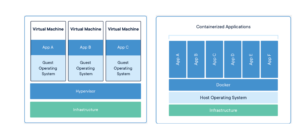
    Once microservices are introduced, they can be run more efficiently in what are termed ‘containers’. Containers provide an alternative approach to virtualization using a long-standing method for partitioning in Linux known as namespaces. The biggest difference between containers and virtual machines is that containers use the host software and host operating system and have no requirement for a hypervisor whereas virtual machines do need to have their own operating system installed.

    At Azenby we are beginning to see most applications from PGW, PCRF, HSS, IMS and all the newly defined 5G nodes, move towards a cloud native and container approach, this is a prerequisite to a 5G SA core.

    Maintenance and orchestration (MANO) has now become a crucial part of the NFV and containerization strategy. There is more need than ever to have a MANO layer for the daily operation of virtual machines and containers. Some virtualization vendors such as VMWare and OpenStack have a degree of MANO already built into them.


    blog graphic

    Figure 1 Containerized Applications and virtual machine side by side.

    We believe that the orchestration layer is essential, and the introduction of VNFs and containers suggests that MNOs will need to have a best-in-class MANO layer though in our opinion orchestration is still immature, highly complex and seems to be in constant evolution.

    Containers are much simpler to orchestrate than VMs. Containers have far fewer management and configuration requirements. As a result, container orchestration is a much simpler problem to solve and a number of solutions exist today, some examples are given below.

    • Kubernetes is an opensource container orchestration solution from Google and generally considered to be one of the best-in-class solutions and almost the de-facto standard. It has been adopted by many Telco’s. Many vendors are providing Kubernetes branded distribution.
    • Docker provides an infrastructure to create, manage and deliver containers. It is independent of Kubernetes but when combined with it, provides an extremely powerful option for container delivery and orchestration.
    • Puppet provides a container infrastructure and orchestration layer.
    • Red Hat OpenShift container platform is a leading enterprise distribution of Kubernetes optimized for continuous application development and multi-tenant platforms.

    Network Function Virtualization has been at the heart of recent network transformation. The view from Azenby is that this is a fast evolving arena and as such due consideration must be given to ensure that the correct virtualization plan is in place, a plan that will last well into the future and accommodate the fast-changing technical landscape, including micro services and containers.

    Formulating your strategy for virtualisation is a crucial element for determining your overall approach to 5G deployments. These decisions are probably the most crucial calls your business has to make in getting the 5G architecture right. At Azenby, we would be happy to help you make sure that you get it right. Contact Azenby and let’s start a discussion.

  • Goldilocks, Vodafone and the three bears

    In it’s Q1 2020 trading update Vodafone’s CEO announced the intention of divesting it’s European tower business. With some 61,700 towers across 10 European countries this represents a sizeable asset portfolio and of itself would be amongst Europe’s biggest tower companies.

    The underlying rational for this decision was cited as the financial reality that the ‘City’ value this asset at an attractive multiple of more than 20 times EV to EBITDA. With interest rates low across Europe our pension funds seek assets, such as bridges, buildings, tunnels and radio masts that generate regular income streams and are as the adage goes as ‘safe as houses’. In this regard Vodafone’s planned divesture of it’s tower business is very logical and will generate a useful lump sum diminishing debt on the balance sheet.

    Driven in part by the eye wateringly high valuations the City are currently placing on annuity assets, Vodafone Group will go through the process of carving out a European tower company in preparation for a sale. As well as a significant legal and corporate process, this also has technical ramifications since Vodafone must leave each tower site with a clean, tidy technical interface to the rest of the network. By February 2020 Vodafone aim to have a separate Tower Co with the purpose of achieving a rapid divestiture.

    It is good practice for any company to continually review it’s assets and make what we might call Goldilocks decision’s. Does this aspect of the business generate sufficient value? Can I buy this service or capability on the market cheaper or better than I can make for myself? Businesses change as does their environment and a continuous strategic dialogue, especially in such a dynamic industry like telecoms, is essential.

    In parallel with this change Vodafone announced it’s successful 5G launch across 5 countries using speed tiered unlimited plans. The point of capital and capitalism is to bring benefit to society. The roll out of 5G is an unalloyed good and a very positive contribution to Europe’s public infrastructure for the betterment of it’s citizen’s. The value of Vodafone depends in great part on it’s roll out of 5G. Indeed across many European countries Vodafone sit’s as the firm leader in the enterprise market and it’s these customer’s with their need for IOT and a desire to drive the 4th industrial revolution that will be at the forefront of 5G. A key  requirement to a rapid and successful 5G launch will be sites for antenna’s which will in urban environments be deployed more densely.

    We are not accountants at Azenby, so for us is seems counter intuitive for the financial market’s value of the EV to EBITDA for the whole of Vodafone (despite the potential of 5G) to be lower than that of one of its constituent parts: the Tower Co. Without the mobile service business, the towers have no value as they would have no purpose. Or from a Goldilock’s perspective: can the porridge be the right temperature for both Vodafone and the City? A 5G network will make greater demands on a service providers tower portfolio than previous generations of mobile telephony. Vodafone in common with all service providers will be reviewing its infrastructure portfolio with an eye to preparedness for 5G and at first glance easy access to prime tower sites seems very valuable from an operational perspective.

    In the original fairy tale of Goldilocks, an old woman, entered the bachelor residence of three bears tried the porridge, the chairs, the bed, before being spied, then jumps out of the window never to be seen again. Our more familiar version involves the testing of porridge, chairs and beds to find the optimal solution – porridge at just the right temperature. With the evolution of mobile networks to 5G working through these choices is essential for all service providers. We hope Vodafone finds a solution for it’s physical infrastructure that maximises both it’s value to the city and to it’s 5G customers. Both deserve porridge at just the right temperature.

    Azenby is a seasoned group of telecom insiders with significant senior expertise and experience in strategic, technical and commercial decisions with service operators. The team have worked through and implemented make or buy decisions, been engaged in IOT discussions and infrastructure selection. We would welcome conversations covering all aspects of this article so why not get in touch.


  • 2019 and all that

    It’s time for the customary Azenby annual review of all things good and the not so good in our mobile world. So where to start? February and MWC19 seems like a good place. I know, that misses out January, but who cares? Depressingly horrible month, January. Get rid of it from the Calendar.

    MWC 19 was, inevitably, all about 5G and for sure 5G hype is 5x all previous release hype! More on that later. We also talked a lot about AI, VR, IoT and of course Intelligent Connectivity in between the buffering and the call drops. Amongst all the chatter and the vendor presentations we are still searching for business cases but perhaps the mobile industry, that so often ploughs its own furrow, is a trend setter in this regard too. Yah Boo sucks to business cases, just get it out there. Those with better memories than I will recall the much-heralded launch of the foldable device from Samsung. A bit later than we were led to believe at MWC, it was finally launched in the late summer and Huawei followed on quickly, as they do, with their own version a couple of months later. You never know, you might find one in your Christmas stocking this year, but don’t bet on it and don’t, whatever you do, fold it.

    We mentioned in our review of MWC 2019 that Huawei came out all guns blazing defending security concerns about their equipment. Since then, one would have to say it’s not panned out to be a good year for the omnipresent Chinese manufacturer. Depending on your point of view, Huawei are either a chess piece in larger trade-deal talks, or there are real and genuine concerns about ‘back-doors’ and ’kill switches’ in their deployments. What is not in doubt is that the USA did put Huawei telecoms equipment on a blacklist and the impact was immediate and severe. The USA then exerted pressure on its allies to do the same and the “No Entry” signs were going up all over the world for Huawei. Meng Wanzhou, Huawei’s Chief Financial Officer and founder Ren Zhengfei’s daughter, has been under house arrest in Canada at the behest of the USA for over one year awaiting extradition to the USA to face charges related to conspiracy to commit bank and wire fraud in relation to skirting USA sanctions on Iran. . One wonders what the reaction in the West would be to the CFO of say, Cisco or Google being held under house arrest for one year in Shenzhen with an ankle monitor attached. These are the times we live in.

    At Azenby we have been thinking about the longer-term consequences of Huawei being on the trade blacklist and we can see a scenario playing out that may not be in the best interests of the USA. Deprived of US chip-sets and components and being given very restricted access to the Android OS, Huawei have no option but to now develop and build their own home made technology and OS and become more self-sufficient . Potentially a big export market for US component manufacturers dries up, followed by equipment and device sales for OEMS. Worse still Huawei devices will come with their own OS and their own App eco-system. This might not have a big impact in the West, but it could be massive in Asia and Africa and overtake Google Play Store and the Apple App Store in those markets. It could also herald the arrival of much lower cost smartphones flooding the Western markets. It could be a case of the USA needing to beware of the unintended consequences of trade embargos.

    On a bright note, mobile operators backed the GSMA initiative to lower the carbon footprint of their networks and their businesses. Climate Change can’t be ignored. Then almost immediately the industry was in trouble for cheap labour and dangerous working practices used to mine those vital and rare precious metals needed to make our smartphones. We know there’s gold in them there phones but there are also 16 of the most rare and precious metals as well. Maybe we have further to go on sustainability then we thought.

    We all like a good wedding and the long engagement between Sprint and T-Mobile US seemed to be finally heading down the altar only for numerous States to raise their own objections and put the merger back on the long and winding legal road. Still, Vodafone and CityFibre who were almost in bed before gooseberry Corbyn decided to give everyone in the UK free fibre and their courtship went on hold. The good news is that we will all have to pay for our broadband! (as Labour lost at the polls) and Vodafone and CityFibre are back in the sack. Well, almost. This does herald another significant sea change that 2019 has brought about. Wireless, be it macro cellular or fixed wireless access, and fibre in the ground, are becoming integral not only to the delivery of true broadband to the business premises and to the home (if you live in a city) but also in the backhaul for mobile networks. So, are we really on the verge of fixed mobile convergence? It’s been a long time coming!

    In Germany, the 5G mobile spectrum auctions ended in the eye watering license cost of €6.5bn from four operators. Despite legal challenges beforehand and cries of disaster afterwards, we see that spectrum, albeit mindbogglingly expensive, is still the lifeblood for MNOs and a barrier to entry for new players, both of which seem to us to be not so good for the mobile market, operators, competition and the prices we pay as consumers for mobile services. None of this is new of course, ever since four operators paid £22.5 billion (€ 36.9 billion) for 3G spectrum in 2000 in the UK, MNOs and the wider mobile eco-system have had to bear the costs for spectrum dictated by regulators and Treasuries all over the world. Now, what was I saying about business cases? The German blueprint is proving to be very familiar in many other countries as well with Operators crying foul but still writing the cheques. 5G does not come cheap, even before investing in the networks.

    A contributing factor is of course that radio spectrum that is fit for purpose for mobile communications is even scarcer than some of those precious metals in our devices. In fact, a lot of it is not exactly prime spectrum for cellular purposes but it is still commanding top prices. As we have more frequency bands in use, the need for MNOs to step up their surveillance of their spectrum is becoming ever more challenging. Add to that the advent of cheap SDR radios as new and potentially very annoying interference sources and the deregulation of local enhancers, it seems operators will have their work cut out in the next decade to ensure the integrity of their very expensive asset and to prevent illicit use of it. At Azenby, we think the management of spectrum will become a major focus of attention in the next decade.

    Going back to the to the 5G hype. It has been sort of launched and if you can afford a $1,000 device you too can experience super-fast download speeds in some parts of the world. Countries that worked together like South Korea and China, where collaborative joint launches were held, seemed to be first to make the 5G claim. It’s hard to get a real count of the number of live 5G networks worldwide but it looks to be in the order of 80 operators claiming a 3GPP compliant release. We don’t want to be party poopers at Azenby, especially at this is the time of goodwill to all, but we can’t help feeling that real 5G comes only when R16 is with us and that looks like something for us to talk about in our 2020 year-end report.

    We wanted to finish on a few things we didn’t see in 2019. Improved network and access security for one. It seems we need endless patience here! Blockchain remains in the shadows in more than one way. Making the internet care more about our privacy still seems to be an aspiration rather than a reality. The end of fake news. There are some things we would certainly like to see our industry tackle head-on in 2020.

    Whatever your business goal and drivers for 2020, we wish you all the best and success after success in your ventures and if we can help you navigate your way to increased revenues in 2020, then we would love to hear from you. Why not get in touch.

  • The Internet of Things – is there any hope for Security?

    (This is a personal view of the author and does not reflect the view of any of the Standardisation Groups or Organisations he participates in!)

    You all know the issues and read about it regularly in the press reports – Baby monitors and Cameras accessed remotely, Cars hijacked (like the famous Jeep take over), Televisions with viruses, talking Home Speakers and many other incidents.

    Many of these can be prevented by some simple security procedures, which are now freely available to help people who design connected things. Here is some background to the various activities that are happening now, and what we can expect in the future.

    The initial work was done by the IoT Security Foundation [i], who produced some great documents describing the sort of security methods that you should be taking, like eliminating default passwords by forcing change, boot protection, update security and a few simple ideas. It also encourages Companies to have a vulnerability disclosure scheme, to pick up errors and correct them – apparently less than 10% of Companies even have these! They have some great (free) documents, including DIY Certification.

    This initiative was taken up by Governments, so for example in the UK the Department for

    Digital, Culture, Media & Sport (DCMS) published in February 2019 their own document [ii] – A Code of Practice for Consumer Internet of Things (IoT) Security for manufacturers, with guidance for consumers on smart devices at home.  This is linked to their “Security by Design” ideas. It brings together, in thirteen outcome focused (I like that phrase) guidelines, what is widely considered as good practice in IoT security.

    At the same time ETSI (European Telecommunications Standards Institute) published a Telecommunications Standard on IoT Security, which can be used as a basis for Manufacturers and Suppliers across Europe. You can read the press release on how The ETSI Technical Committee on Cybersecurity (TC CYBER) released ETSI TS 103 645, a standard for cybersecurity in the Internet of Things via the link below. The idea of the standard is to establish a security baseline for internet-connected consumer products and provide a basis for future IoT certification schemes. You can also use the link to download a copy [iii].

    Notice in the above the mention of a Certification scheme – ETSI is working on an EN which has a legal status within Europe, and this can be used so that manufacturers can meet a Certification scheme under the Cybersecurity Act [iv] – let’s hope we will see this soon.

    So now we have a pathway for the future, where we can have Certified IoT devices with security, something that has been long needed. There are other such ideas, for example the Radio Equipment Directive [v] proposes that Privacy and Security should be part of the requirements: That’s the one that goes towards the CE [vi] mark that you see on equipment. Now that’s something I have doubts about, as I think that Technical Requirements should be defined by Technical people and not Lawyers, and there is no need for there to be more than one IoT security requirement, as it will just cause confusion.

    So, what can we expect? A perfect world secured IoT devices? Of course not, we all know that won’t happen, but at least it will force a thinking process, and make things better for the average consumer device and user. It will, of course, not protect Critical Infrastructure, for that much better security design is required.

    For us involved in Telecommunications it will ensure that our terminals are more secure, and at least reduce the amount of Customer Confusion, help maintain their Privacy and maybe even reduce Fraud. I also have in mind a simple set of security requirements like the IoT ideas, to secure a Telecommunications Operator, but that is another story ……

    Useful Links

    [i] https://www.iotsecurityfoundation.org/

    [ii] https://www.gov.uk/government/publications/code-of-practice-for-consumer-iot-security

    [iii] https://www.etsi.org/newsroom/press-releases/1549-2019-02-etsi-releases-first-globally-applicable-standard-for-consumer-iot-security

    [iv] https://ec.europa.eu/digital-single-market/en/eu-cybersecurity-act

    [v] https://ec.europa.eu/growth/sectors/electrical-engineering/red-directive_en

    [vi] https://ec.europa.eu/growth/single-market/ce-marking_en


  • What are you asking your vendors about 5G?

    Depending upon your preferred reading material, there are now over 300 operators worldwide in more than 120 countries trialling and demonstrating 5G, be it mobile or fixed wireless access. Looking specifically at the mobile sector, as we like to do, over 50 operators in 30 countries have heralded the arrival of 5G in their network although just how many conform to exactly what parts of the 5G 3GPP specification is still open to conjecture.

    What we do know for sure is that the focus has certainly been on adding elements of the 5G radio interface to the existing 4G core. I think we can also say that many MNOs around the world have done their first piece of work towards getting a feel for 5G and some have certainly claimed a 5G launch. Despite the number of trials and tests going on, the vast majority of MNOs are yet to select their vendor for the first serious 5G standalone rollout whilst the non-standalone deployments we are seeing today are really limited to working with the existing 4G vendor.

    Considering this state of play, at Azenby we don’t think it is too late for MNOs to start to draw up their tick list for evaluating vendors offerings for a fully-fledged standalone 5G network. In thinking about this, we considered very carefully the fact that for the first time, this is not a ‘bolt-on’ technology upgrade to the last generation of mobile architecture. Getting 5G right is not just a technical decision, difficult though that is, it’s about architecting a network that allows for vital collaboration between MNOs and partners to deliver new services, to new customers, and to be much more than just the connectivity player in the 5G world. It’s also about adapting technologies beyond the 3GPP specifications to achieve scale, faster service deployment and lower costs. This means a new approach to operating networks and moving away from traditional diagnostics to networks that think their own way out of trouble. The challenge facing mobile operators goes way beyond getting just the 5G vendor decision right but nonetheless, getting the 5G supplier aligned to your overall strategy is an imperative.

    Azenby has compiled a set of questions we believe every MNO should be asking themselves and then their prospective 5G vendor:

    Support for the commercial aspirations

    What is the business case for 5G?

    When you strip away the vendor hype, there are some underlying advantages to 5G though many would say they do not add up to the complete ecosystem change that the hype suggests is necessary. To test this thesis, ask the vendor what the business case is for 5G as opposed to 4G simple expansion.

    What is the business case for replacing existing infrastructure with 5G?

    This is a variation to the previous question, where inevitably it will be suggested that equipment that is not end of life will need to be written off and upgraded. This questions the business case for doing that, again once the hype has been cut through.

    What benefits can 5G bring during the roll-out period when it is not ubiquitous.

    This is a crucial consideration, the answer to which can have huge implications of the rate of spend required in network roll-out and consequently the timing of investment. It is vital to understand the impact on services if the roll out of 5G services is not ubiquitous, in particular if network slicing is being used. This is a good example to press for a view on, as slicing may only be effective when 5G has been deployed across the whole geography where the service is to be used, and this will impact the customer sales process, perhaps to such a degree that it is unusable.

    How can the network slicing capabilities and QOS management features in 5G be used to develop new propositions for new customer segments, particularly in IOT, and differentiated service delivery to different customers for a given proposition? Please provide uses cases for above propositions.

    The Slicing and QOS tool kit has to be used carefully for its benefit to be greater than the potential adverse impact to some customers. Is the tool kit sophisticated enough with adequate feedback loops, decision logic and automatic optimisation of the resource allocation? Naturally, the customer SLAs must reflect the degree of sophistication (or lack of) and the system must be capable of measuring and reporting service delivery against SLA.

    Has the vendor any business case models showing the benefits of network slicing?

    This question asks the vendor to quantify the propaganda around network slicing, giving for instance a couple of user cases that demonstrate how effective it is in theory. Similarly, it asks if the vendor has models that can be used to predict the effect in a live network, particularly supporting high mobility use cases.

    Have the results of network slicing testing been benchmarked in a real deployment?

    It is really important to see evidence that the modelling output has been benchmarked against a real deployment of their equipment. This can’t be relied upon if it is slideware alone.

    What 5G ‘unique’ features can be supported on your 4G infrastructure e.g. a proxy of network slicing, MIMO techniques?

    This question builds on the previous questions and is a theme about what the vendor is doing to help optimise previous network investments. Specifically, it asks if they have managed to make any of the new 5G features backward compatible to some degree with the existing 4G infrastructure.

    Network Architecture

    What is the hardware and software upgrade path from non-standalone to standalone 5G for RAN and Core, and are there any impacts on any terminals

    This question is self-explanatory, the expectation is that the NSA core will have a smooth upgrade path to the SA core whilst preserving all services. The second part asks for any incompatibilities that can occur between NSA and SA architectures that impinge on the mobiles themselves.

    Can I take your equipment in a mixed vendor radio environment, e.g. just deploying 5G economically?

    Here we assume the answer will be that each site has to be a single vendor site for the radio, but it would be interesting to see if they have considered any methods to install 5G as a standalone.

    What are the benefits of taking your equipment as an upgrade, compared to if I was a new customer to you?

    Often vendors offer deals to new customers that are as good or better than the deals they offer to existing customers. This question is designed to overtly explore that.

    What bandwidth efficiency will you guarantee for me for my deployment Mbits/s/km

    Again, there is a lot of hype about efficiencies and this is an impossible question to answer but posing the question will yield some interesting insights.

    Spectrum Aggregation: How will Spectrum Aggregation at 5G differ from 4G, in terms of the range of frequency bands included and the pairings permitted, including Supplementary Downlink and CBRS spectrum? Can the additional capabilities available in 5G be retrospectively applied to your 4G equipment in my network?

    Higher speeds in 5G are in part made possible through more versatile spectrum aggregation as well as the new air interface and massive MIMO. If similar powerful spectrum aggregation capabilities existed for 4G, this would extend its life and delay 5G spend for some MNOs. This is also a good time to find out how much of the frequency bands and pairing options available are set/constrained by standards and how much is vendor commercial choice.

    What 5G specification options are you making available and when, and what are the prerequisites for us to deploy them.

    Like 3G, and certainly 4G, the 5G specs come with a lot of options. So, understanding what the vendor includes in their 5G offering is very important. At the high level this could be is URLLC, eMBB and mMTC included. Diving deeper into the specs one could ask is de-coupling UL/DL included? But really, there are 100s of ‘options’ in the 5G specs so understanding what you really need and what is being offered is crucial.

    Explain your strategy and policies for the support of interoperability and the use of proprietary or open internal interfaces

    Again, this question is self-explanatory, there are a huge number of internal interfaces emerging in 5G and a generic policy statement on the use of interfaces and interoperability should be pre-requisite to any contract.

    How much of your 5G offering is dependent upon legacy infrastructure?

    This question probes how much of the 5G offer is complete in its own right, and how much additional equipment is assumed to be sourced by the customer, DNS, Routers, Firewalls, security/encryption functionality.

    What is the scaling capability of your 5G Core to support MMTC/IOT i.e. how many devices can each core node support and what are the upgrade paths to support further volumes?

    This is a question designed to tease out capacity of the core but also the underlying principles they have used in determining that capacity, it is actually a very difficult question to answer in a meaningful way unless a model can be provided.

    What is the scaling capability of your 5G Core to support mass small cell deployment i.e. how many small cell base stations can each core node support and what are the upgrade paths to support further volumes?

    This question is self-explanatory

    What is the scalability of your 5G OSS for supporting mass small cell deployment i.e. the volumes of small cell base stations that can be managed by the OSS instances?

    This question returns to the much promised but little delivered topic of orchestration but in this case in support of small cells where the node counts can be much higher.

    Operational Considerations

    Automation: How will network automation features in 5G compare with those in 4G, particularly in RAN where the operators continue to bear high costs of labour-intensive design, optimisation and operational processes?

    Automation has not been a great success story through the 2G-3G-4G journey. Some progress in automatic frequency planning, and SON in RAN and SDN in transmission are a far cry from self-configuring, self-optimising, self-diagnosing and self-healing networks which we envisaged more than 15 years ago. In fact, NFV has made a real difference indirectly in this area. There is much talk about AI in RAN automation. Time to sift fact from fiction and put pressure on the vendors to make a real difference. Will real RAN automation happen only when RAN virtualisation arrives? It’s also time to see how much of this RAN automation will come from functionality and features embedded in vendors’ equipment and how much from adjunct analytics platforms. It’s not just RAN either, of course, there is still quite labour-intensive design, implementation and operational processes in transmission and to a certain extent in core and backhaul too.

    Explain your supply chain including sustainability of the vendors and any involvement in trade sanctions even one step removed, including component sourcing, and 3rd party services

    This question is self-explanatory, but in today’s global supply environment, an issue with a single component involved in e.g. Chinese sanctions, can bring a line to a shuddering halt.

    Is the software supported in your home market?

    This question stems from the very public critical source code failure at a major MNO in Europe, where support was outsourced to such an extent that the in country local support team were completely unable to even restore service. Hence it is both a security and support issue. Don’t become dependent upon some small vendor who is more than one step removed from your prime vendor to fix bugs or even just renew your SSL Certs when the network is on its knees.

    What additional measures to secure AUSF in 5G will you support

    The focus of this question is to see if the vendor has a high entropy and physically secure solution for their AUSF, such as for instance a hardware based HSM.

    Does your 5G system offer protection and security from cloned or fake/rogue small base stations

    The question looks to understand if the vendor is aware and defends against rogue base sites which are easily implemented seeking to steal IMSIs or other confidential information through man in the middle attacks.


    We know that this list is just the tip of the iceberg but if it has convinced you to start pulling together your own list then we have done some good today. Compiling your long list of FAQs is a vital part of evaluating your strategy for commercialising 5G and these decisions are probably the most crucial calls your business has ever had to make. At Azenby, we would be happy to help you make sure that you have all the bases covered. Contact Azenby and let’s have a discussion.

  • The Brontosaurus Theory Of MVNOs

    There’s a very famous Monty Python sketch about brontosauruses. John Cleese plays ‘Anne Elk (Miss)’ who is being interviewed on a chat show about her new theory, which relates to Brontosauruses. Miss Elk’s eventually expounds her theory which is that Brontosauruses are:

    ‘thin at one end, much much thicker in the middle, and then thin at the other end’

    You can’t really knock the insight, if you’ve not seen the sketch its worth a quick look on you tube, there is a live version, but you might want to look from about 2 minutes in.

    All very interesting, but you might be wondering what it has to do with MVNOs, fair question, do let me explain.

    MVNOs come in many different shapes sizes and architectural styles. At one end of the spectrum are what are referred to as thin MVNOs, these are companies that sell their own mobile brand, but rely very heavily on their host MNO for the majority if not all of the telecoms services. In some cases, these companies really are just sales channels and a brand. Some of them are capitalising on their brand strength and others are serving specialist market segments.

    At the other end of the spectrum there are ‘thick’ MVNOs, these are companies that use a host MNO for the radio access network, but do much more of the remainder of the service themselves. For instance, they may have their own on-line charging system to bill mobile usage, or even their own PGW, the gateway device through which a customer’s data traffic passes, they may provide their own SIMs and have their own IMSI and network codes.

    There isn’t really a clear definition of the dividing line between thick and thin MVNO but you get the drift I hope. What we do know is that there a lot of them about these days. There are over 140 MVNOs in the UK alone.

    MVNOs developed quite a while ago, probably 25 or 30 years ago. At the time the first MVNOs I came across at least were all thin, for a couple of reasons, firstly the MVNOs themselves didn’t really have a lot of knowledge about mobile and so were struggling to get the terminal fulfilment and branding applied to a mobile offering let alone engage in any more complex and expensive mobile technology, and secondly because at the time the host MNOs were paranoid about giving any control away of the telecoms services to an MVNO that wasn’t a member of the exclusive club of companies that had bought some very expensive spectrum. The way they saw it, they weren’t about to give away any of that value.

    Time moved on and a side effect of the thin architecture rapidly became apparent to the MVNOs, which was that they were heavily locked into their host MNO. That might not have mattered during the initial contract and subsequent honeymoon period between them and their new host MNO partner, but after a few years, they tended to fall out of love with their host MNOs. There were two drivers for this discontent, one was that the reality of cost pressures sunk home on the MVNO, and the other was that the management of the host MNOs became disenchanted with their wholesale MVNO businesses, and tended to neglect it and milk it for cash.

    The problem that the MVNOs then had was that they were so dependent of their hosts that to risk a move to another host could cause such a service disruption that staying in an unhappy marriage with their original host was the only viable option. For instance in the UK, many MVNOs were at the lower end of the market selling prepay services, without properly registering customers, leading to a position where a change of host MNO would require a SIM swap…… tricky to do if you don’t know who your customers are or where they live!

    The natural effect of this was for many MVNOs to try to become less dependent on their host MNOs. There were two main drivers for this. One was so that they had much more leverage in commercial negotiations with their host MNO because they always had a viable threat of moving elsewhere. The second was to be able to differentiate services and have a greater control over tariff structures. For this independence to be real, and perceived as real by their host, they needed to wrest several pieces of functionality from the host, typically:

    • Their own IMSI range and MNC code
    • Their own HLR/HSS
    • Their own charging services
    • Their own GGSN/PGW gateways
    • Their own voice and SMS infrastructure

    An MVNO that provided all of the above themselves would definitely be in the ‘thick’ category and would have quite a realistic opportunity to move hosts if they needed to, to find a better commercial offer elsewhere. Pretty much that is where we are today, with a mix of MVNOs, but many of them electing to provide quite a lot of the technology of the mobile core, charging, and admin systems themselves.

    As time goes on the big thing that is changing from a market point of view is, as everyone knows, the consumption of data. Data usage is increasing at something like a 40% CAGR, leading to some pretty high payloads being sent via the MVNO cores.

    At the same time the MNOs seem to have a policy that the wholesale rate for a thick MVNO will be no lower than that for a thin MVNO, even though the thick MVNO is doing more of the ‘work’. I assume this is back to the old philosophy of wanting to keep the MVNOs as dependent and locked in as possible.

    Now you’ll recall the reason why MVNOs like the idea of being thick is that they get independence and can control their own propositions. A thin MVNO has to go to their host for each and every change which can be a painful experience as they compete for IT and network change slots which are being shared in providing changes for the host MNOs own services, and they will be very much the poor relation in this respect. Ideally the thick MVNO will control all of the components needed to control their proposition themselves, and so they can make more of these changes without being dependent on the MNO engineering teams and processes.

    As time has gone by, I have noticed that by far the majority of differentiation in services is commercial, there is very little differentiation in data functionality, other than what domains are zero rated, which does differ from MVNO to MVNO. Even speech services are very similar, as is SMS.

    So, if we cycle back to the requirement to maintain MNO independence it can be argued that time has shown us that independence comes from being able to control your own charging tariffs, be it real time or post pay, and to be able switch between MNO hosts by having the HSS/HLR and SIM, or in a couple of years time by using e-SIM technology to seamlessly switch the IMSI in use. The net result is that the drivers for being at the thicker end of ‘thick MVNO’ are rapidly disappearing.

    Looking forward, as 5G turns up with the expected very high volumes of data traffic the reasons why an MVNO would want to carry the payload traffic become even less obvious because:

    • The majority of differentiation comes from (and with 5G will continue to come from), the charging and tariffing systems such as the OCS which are not involved in handling the high data payload
    • The costs of handling data are related in some way to the volume of data, and since the MNOs show no sign of giving a discount when the MVNOs support the PGW, the data increases expected with 5G will simply increase thick MVNO costs

    An attractive scenario for a thick MVNO of today might be to reconsider their architecture for 5G data payload, asking their host MNO to support it for them, in particular because given that the MNO will be working at higher scale it will have a more economic solution than the MVNO could achieve.

    This leads to a migration towards a thinner network architecture for the MVNO than they may have considered optimum in the 2G, 3G, 4G era.

    That takes me back to Miss Anne Elk, I think her theory of brontosaurus’s can be reapplied to MVNOs, something like:

    ‘MVNOs were very thin at one time, much much thicker now, and will be thin again in the future’

    At Azenby we have worked with many MVNOs, to help them from business strategy, architectural analysis, through to vendor procurement and host MNO choice and negotiation. We believe passionately that periodic reviews of ‘cast in stone’ decisions such as architectural structure of networks should be undertaken. We have seen many companies sleepwalk into an inappropriate technical architecture because they have not tracked technology and industry changes closely enough, which is understandable once the operational pressures of the day take over their attention. If you would like to discuss how Azenby can help your MVNO business please get in touch.


  • Private LTE Networks: here already

    A serious train crash isn’t something I can properly imagine. It’s because they’re so out of the normal human context. Big, fast and very, very heavy. I suspect all readers can imagine the crunch of plastic and metal in a car parking accident and some may have had a sharper bump and the gut wrenching feel of the airbag going off. Think a 100 times more energy involved. Or 10,000, maybe 100,000 is closer to the mark. A friend who survived a collision with a small commuter train at a level crossing told me that when the rescue team found him dazedly walking in a field he was barefoot – the impact had ripped the shoes clean off his feet. Lucky man to be alive. The unlucky dead car was confetti for a kilometre along the line. The train was perfectly fine.  As reported by the BBC on 6th Nov 2018 a giant driverless train with 286 wagons filled with iron ore was safely derailed after 50km of increasing anxiousness. It was travelling at over 100km/hr thankfully through an unpopulated area of Australia. Had it arrived at the destination, a port,  the ore tsunami would have done untold damage, quite literally shunting all in front straight into the sea. More than a kilometre of speeding train is a special kind of wrecking ball.

    The good news is that such accidents will be rarer as LTE Private Networks are in the process of transforming industries. Ericsson, along with the other two major infrastructure vendors, Nokia and Huawei, are actively promoting LTE equipment optimised for industrial use cases, bringing about ‘critical communications for Industry 4.0’ as Ericsson announces. Significant benefits are obvious: dedicated coverage, be that the Australian outback or a tunnel in central London, high speed and a fast route to digital transformation. One specific industrial case mentioned in Qualcomm’s white paper is Rio Tinto’s implementation across 15 mines, transport hubs, trains, ports and offices. With mega trucks, drilling machines (and let’s not forget those trains!) there’s an absolute safety imperative in removing human’s from what is a very dangerous environment. In parallel, efficiency gains are self-evident. The network is managed from a single NOC (network operation centre) and in this case with dedicated 1800Mhz spectrum. On site engineers can use push to talk, video share and have precise GPS control over equipment.

    Not all gains from LTE private networks have to come from giant yellow dumper trucks. Lettuce picking can now be done on an individual basis, literally lettuce by lettuce, electronically with the farmer electively, growing, watering and harvesting a field selectively to match expected supermarket demand in an integrated supply chain. This has a many fold increase in yield, bringing us fresher produce with less waste, using a smaller quantity of targeted pesticide and providing the consumer full food provenance. In this example we can imagine how a farmer may work with a mobile operator and request a business solution with a guaranteed network slice whereas the distributor has a concentrated pick and pack warehouse with a dedicated network.

    Ocado, a food delivery retailer and another early adopter of this technology was cited as having the most densely packed mobile network in the world, with it’s warehouse having over 1000 picker robots and communications every 100ms. Cambridge Consultants redesigned a scheduler running on top of the LTE network. Between these private networks at the farm and distributor, the lettuce, no doubt cossetted in a smart IoT enabled crate, is tracked seamlessly by the operator across the public LTE networks, making certain critical temperatures are never exceeded.

    Every industrial vertical will be touched by this emerging technology. IoT and Private LTE networks will have a significant part to play in what will be a fundamental technological transition. Current mobile operators, industry leaders and mobile equipment manufacturers will be forced to find new ways of working together. This article is written at a time when we move from early adoption to mass market enablement. From leading edge to daily use. Mobile operators announce working 5G in the UK and across Europe. Equipment manufacturers now carry a fully suite of proven technology.

    Where there may be some latent slowness in adoption is with the markets ability to rebalance for this opportunity. Azenby sees mobile equipment manufacturers are currently scaled only to touch large operators. And Operators currently touching industry through SIM and handset bundles. Meanwhile industry has a vast quantity of private mission critical data and a desire to control its’ manufacturing process end to end.

    Azenby has actively engaged in these debates through spectrum requests, due diligence analysis, architectural review and partnership creation – we are at the beginning of the journey, but whether your business is in the fields of Lincolnshire amongst lettuce or in a mine with a mega machine – LTE private networks and their impact will be significant. It’s time to learn more. None of us can afford to be wandering around the field dazedly after the event. Whether there’s a need for advice on frequency and spectrum legislation, business support, partner discussion, RFQ creation, strategic review or technology analysis, Azenby can help and we have worked with customers and private LTE networks in UK, Europe and the Middle East.

    Back to the start – the train that was derailed to avoid a catastrophe was owned by mining giant BHP, not Rio Tinto. The driver had alighted from the train to check on a wagon and then couldn’t re-board. Us humans aren’t always smarter than the algorithms!  “The damage bill from BHP’s catastrophic iron ore train derailment could be exacerbated by millions of dollars in fines if the company is found to have breached safety protocols” investigators from the Office of the National Rail Safety Regulator reported in The Australian, adding to the woe’s that BHP face given closure of the line. Could perhaps the cost of a private LTE network be justified by just one days lost production and shipment of iron ore? And with our lettuce example we are reminded Ocado’s Andover warehouse was burnt to the ground in early 2019 after fire fighters failed to dampen the initial fire. Some reports suggest robot pickers accidentally spread the fire. Fortunately no one was injured. As a measure of the staggering robustness of Ocado integrated logistic network deliveries after the 1st week were largely unaffected. Bravo to good engineering!

    Now is truly the time to gain a better understanding of private LTE networks. We would be happy to help make sure no one is left behind on this critical journey. Contact Azenby to help you generate a clear LTE private network action plan.

    Follow up reading

    https://www.qualcomm.com/media/documents/files/private-lte-networks.pdf

    https://www.nokia.com/networks/solutions/private-lte/

    https://www.bbc.co.uk/news/uk-england-hampshire-47168430

    https://www.bbc.co.uk/news/world-australia-46105280

    https://www.ericsson.com/en/portfolio/networks/network-solutions/private-networks