
Category: Point of View

Our Azenby beacon is always on the lookout for all the latest news, views and happenings in the land of mobile. Here are some of our observations. Spotted anything else out there that we should talk, think and get excited about? Excellent! Drop us an email and let us know.

  • Could your 5G programme go the way of Crossrail?

    Crossed wires isn’t something we often talk about at Azenby, what with us being mobile people and predominantly wireless experts, but the recent news about crossed wires, delays and cost overruns on the Crossrail project got us thinking about why is it that strategic projects so often fail to deliver on time and to budget.

    Like many other UK businesses based in London and the south east, we have been looking forward to the opening of the new east-west rail route linking Essex and Kent to Berkshire through central London. Last week’s news that the opening date has been put back by one year, just three months before planned completion, was therefore a nasty shock. A project that started with a strategic study in 1974 and a construction start of 2009 just shouldn’t get to within three months of completion, before deciding another year is needed. Having over 100 consecutive RAG status reports at Green and then to go Red at this very late stage, must be major cause of concern for Crossrail and its customers. How could this happen though when Crossrail claim ’the key to managing a programme of this scale and complexity is the programme controls process. The Programme Controls sets out how Crossrail developed a world class controls function.’

    Crossrail’s own account is of delays to fitting out stations and software delays for the new signalling. We are not construction experts, but we can imagine that building huge station complexes 40m below ground in central London is difficult and prone to delays from unforeseen circumstances. As for software delays, this is a 10-year programme of work which does seem plenty of time to develop some software! Doubtless the programme has had a small army of Project Managers working hard and adopting all the latest start-of-the-art project processes and using all the best tools and systems available befitting a £15bn project. Yet still the project suffers problems at the 11th hour. So again, we ask; how can that be? Especially as we don’t doubt the dedication of the team on the ground, the excellence of the processes and the strategic commitment of the leadership.

    While we don’t have the inside track on all this, we are pretty sure that at Azenby, we can hazard a good guess! That’s a bold, brash statement to make but we do have many years’ experience of large complex projects in the mobile industry and have the battle scars to prove it. We can honestly say, ‘we’ve been there done that!’ Our own conclusion is that this “last minute nasty” surprise is the result of two factors.

    Firstly, programme failure. It isn’t for the want of project management that projects overrun, it’s the lack of real subject matter expertise that underpins the timing and budget assumptions that go into the making of a project plan. Project Managers may have PPM, Prince 2, Six Sigma, PMP or any other of the long list of qualifications behind their name, but without subject matter expertise to really understand the time and costs of delivering the desired outcome, they are really only making their best guess. Good project management alone is not enough. Real depth of experience counts.

    At Azenby, we have seen at close quarters many major mobile projects from 1st generation onwards and that is a lot of projects and a lot of learning. Something we are very proud of. Can we say the mobile industry is a role model for others to follow when it comes to delivering projects on time? Well hardly. 2nd generation (Global System for Mobile Communications, as it become known) was a good example. The introduction of GSM was indeed a large and complex project. Roll-out everywhere was plagued by delays. Circumstances outside of our control. Planning permission for the vital infrastructure needed, specification and network equipment delays, billing systems to be designed and built, sales channels to be established, nothing was off- the -shelf or ready-made. We were in unchartered territory. And just when we finally thought we had the networks ready, we looked around and discovered that there were no mobile devices for customers to use. In fact, Mario Sentinelli from TIM produced those now famous badges saying GSM stood for God Send Mobiles. Maybe every project needs divine intervention of one sort or another!

    What we at Azenby have learnt over many years of being practitioners in the mobile industry is that good and strong project management is vital, and no one stands above us in the support and appreciation of good project management, but a project plan is only ever as good as the intelligence it contains and that’s where subject matter expertise comes to bear. Thinking about that, we go through our check list starting with understanding what is really involved in each stage of the project; how long will it really take; what are all the third-party dependencies; have the all the costs really been captured; is the critical path missing vital parts; where will plan Bs be needed, are all the resources available when needed, are the subcontractors and their sub-contractors really prepared? Of course, Project Managers go through the same thinking process, but they don’t always know the answers to these vital questions. They are Project Managers, not subject matter experts. The value that Azenby adds is to ‘road test’ the project plan in conjunction with the project manager and project team. We bring an external, independent audit and review to the plan before it starts. We scrutinise and critique the plan and make sure it is robust, realistic, resourced and achievable.

    A second crucial ingredient in the failure of large projects comes from the contracts structure. Often little over runs are over looked, swept aside, ‘hidden’ perhaps until the nasty surprise at the end reveals systemic failures in the project. Creating a transparent and communication rich contract structure where 3rd parties and teams at all layers in the delivery can openly and honestly express concerns and challenges is an extraordinarily tough challenge, but time and again we have found excellent programme management can only be fostered when time has been taken to ensure absolutely that the leaders can hear, communicate and act on feedback from all the projects’ actors. We fully realise this is especially hard in large public contracts with political components, but nonetheless needed.

    Azenby often act’s as an expert support to the leadership team in large deliverable. A second channel freed of political, departmental, managerial constraints can help gather a more nuanced perspective on a projects progress.

    Over the years we have helped many Mobile Operators deliver complex projects such as RAN share and Network merge programmes all over the world. We bring our unique experience of these projects and provide the subject matter expertise to the type of projects that only ever get done once, helping make sure that they get done right first time. There is no second chance with these projects.

    At Azenby we have lived and prospered from 1st generation mobile to 4G LTE and now we wait with anticipation for 5G which is just around the corner. We write this article in the earnest belief that we can all learn useful lessons from Crossrail. At Azenby we will be delighted to share and support those successes.
  • MWC 2018

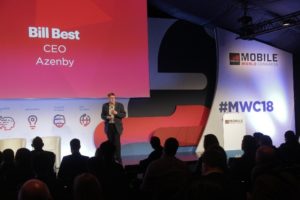
    Our CEO Bill Best was amongst four Azenby people at MWC 2018. Here are his observations of the event.

    Bill at MWC 2018This, we are very reliably informed by Mobile World Live, is the 32nd Mobile World Congress. There are, no doubt, a lot of people who attended the early GSMA plenaries, who still attend MWC
    today even though the nature and purpose of the event is totally different these days. I am
    not one of those first pioneers, but I have attended quite a few, probably over 20. This year I had the pleasure to moderate a panel session on mobile edge infrastructure. More on that later.

    I was one of the 108,000 people attending this year and if I wanted to visit to all the 2,300 companies exhibiting I could have spent 1 second with each (excluding travel time between stands) so I decided to be selective and plan ahead and work out who should have the pleasure of me visiting their stand.

    Traditionally, companies would use MWC to announce new products but we see a lot less of this happening these days. I think this is because there is so much noise surrounding MWC that it is hard to be heard unless you are a Samsung and indeed nearly all the talk and certainly the press talk was about their new Galaxy 9 range. This device is all about media, all about images, videos, and emojis. About post picture processing (do I smell the beginning of the end for Photoshop?). I think it supports communication as well. Not sure though, this aspect was never mentioned.

    Thanks again to Mobile World Live who reminded me that back in 1987 someone called Nokia turned up and announced their new handset, the Cityman 1320 which weighed one kilogram, had an 8-hour charge time and 30 minutes of talk time. This year Samsung unveiled the new Galaxy 9 with a slightly different specification, but these two devices retailed at about the same price in their relative eras. Amazing that. Just to put a dampener on Samsung’s show, The GSMA the device of the year in the Global Mobile Awards went to Apple X. I read that Samsung sell two Galaxy devices for every one Apple phone sold. You pay your money and make your choices!

    Talking of choices, full marks to HMD (those guys who own the Nokia handset brand) who had a good go at grabbing some of the device attention away from Samsung by unveiling five new phones including a remodelled 8110 and the premium Nokia 8 Sirocco. I saw a forecast saying that there will be a growth of one billion mobile connections from now until 2025, mostly in developing markets like Bangladesh, China, India, Indonesia, and Pakistan, as well as markets across Sub-Saharan Africa and Latin America. Looking at that new one billion mobile customers, I think few will be Apple X and Samsung 9 buyers, so maybe we might just see the re-emergence of Nokia, at least in those developing markets.

    Enough about devices. To more important matters; 5G. There were enough stats flying around MWC this year to keep the most ardent anorak happy for a year. One report said that it will be 2025 before 4G accounts for half of all global connections and that seems a long time to me. We will see commercial launches of 5G this year but whether these will be fully 3GPP compliant is a doubt. In the same time frame – 2025 – 5G will account for less than 15% of connections. I am underwhelmed by these projections. Perhaps this is because Operators were lining up to say ‘no 5G business case’ (intended for the ears of the vendors), and the vendors were saying ‘massive new revenues’ (intended for the ears of the Operators and Service Providers). The business case for an MNO does appear challenging unless they can monetise data and not just shift it.

    Maybe the focus is not so much on us humans now and the march of the machines and IOT is catching the attentions of the Service Providers. GSMA Intelligence is forecasting the number of IoT connections (cellular and non-cellular) will increase more than threefold by 2025, reaching 25 billion. So, it is not surprising that 23 mobile operators have commercially launched 38 mobile IoT networks worldwide across using the NB-IoT and LTE-M standards.

    With the remarkable claim from last year’s show that roaming charges would be abolished being conveniently forgotten and brushed under the carpet, GSMA Chairman, Sunil Mittal, this time round called on mobile network operators to seriously consider the NetCo model, a consortium-like approach to network building. Now at Azenby we will say ‘great idea but we were there 10 years ago!’ Azenby has been heavily involved in over ten major RAN and Net share projects around the world in the last five years alone.

    I think MNOs of all types and sizes are now all fully aware now that infrastructure sharing is a necessity of business life and more than that, their existence depends on it. The final catalyst for this conversion in thinking is 5G and no MNO sees a case for competing 5G network infrastructure. Further evidence of this came from the announcement that five of the world’s largest operators have formed an alliance with the goal of driving forward the development of a more open, smarter generation of radio access network. The ORAN Alliance comprises AT&T, China Mobile, Deutsche Telekom, NTT DoCoMo and Orange, and combines previous groups the C-RAN Alliance and xRAN Forum into a joint, operator-led effort to help shape the next generation of radio access networks.

    It’s rare that serious discord breaks out at MWC but this year we witnessed a bit of a dust up. In the red corner was Vittorio Colao and in the magenta corner Timotheus Hoettges. Heavyweight Tim started it by saying he was determined to block any potential deal between Vodafone Group and cable giant Liberty Global. Vittorio weaved and counter-punched saying (I paraphrase slightly) ‘you should never look to shut down one of your competitors – you have to win by fair means.’

    I think Vittorio won on points. He finished by saying “here you have a national player who says that a competitor should not buy a regional cable company because this creates some kind of threat to something. If you follow that logic, then DT should be split in two – perhaps an east and west Deutsche Telekom.” Ouch!

    What’s really eating DT here? Its my favourite topic that content is king. DT worry about a cable monopoly. Vodafone Germany already owns Kabel and if you add Unitymedia, (Liberty Global’s German cable company) you can see a dominant force in converged fixed-mobile services, exactly the area that DT says they want to own. The cynic in me thinks that if DT want to block it they will need to make only one call to the regulator!

    Vodafone expansionism was not confined to cable and TV though. They said they are going to build a base station on the moon. Cue the thousands of tweets saying ‘can’t they build one in [enter your post code here]. They should have seen that one coming! This was interesting though. It’s a mission by German engineering and science company PTScientists, which – together with Vodafone Germany and carmaker Audi – aim to complete the first privately funded moon landing in 2019.

    Vodafone said the 4G network will allow Audi vehicles on the moon’s surface to send data and live HD video streams of footage from the area around NASA’s Apollo 17 lunar roving vehicle, which was abandoned on the surface in 1972. The operator expects the network to be able to support 4G using the 1800MHz frequency band. It got me wondering about spectrum license charges on the moon!
    Yes, there were 2,300 companies at MWC this year but a few noticeable absentees. The GSMA say that the global value of the mobile industry is $9.1trillion (2013 figures – I haven’t seen them updated since). Let’s call it $10 trillion today. The combined market valuation of Apple, Google and Facebook is $2.89 trillion. These aren’t like for like figures I know but the point I wish to make is that these guys plus Twitter, Instagram and Snapchat, must make up a very sizeable proportion of the globalmobile economy – yet none of them were at the Mobile World Congress. Perhaps the World in MWC excludes the USA!

    I’m no longer chairing the judging panel for the GloMos as we now call the GSMA Global Mobile Awards but I did pop in to see some of the award ceremony and Huawei cleaned up at the GloMos. Another sign of the times.

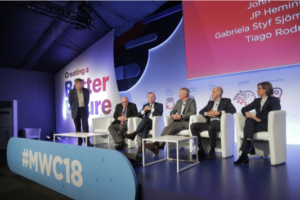
    mwc panelI had the great pleasure to facilitate a session called ‘Owning Edge Infrastructure: Burden or Opportunity’.


    I was joined by:

    • Ulf Ewaldsson, SVP & Head of Business Area Digital Services, Ericsson
    • JP Hemingway, EVP, Product, Strategy & Marketing, SES
    • Tiago Rodrigues, Senior Director, WBA
    • John Baker, SVP 5G Development, Mavenir
    • Gabriela Styf Sjoman, SVP & Global Head of Networks, Telia

    The session was very interesting, and it was hard to disagree with the underlying conclusion that with data likely to grow at exponential rates, we need to put more content and more control at the network edge. The very driver for Multi-access Edge Computing. I actually think this is one to watch and throws an additional challenge to be overcome in RAN sharing.

    Azenby had four people at MWC this year checking out what’s hot and deciding what’s not so hot. We have vast experience in the mobile world offering consulting and advisory services across the whole industry, so if you have a problem, just call on the Azenby team. Feel free to contact us.

  • Whatever happened to device innovation?

    At Azenby we are always interested in and tracking what innovation is happening in the world of mobile. One of our product design and development experts Phil Knight has been observing what is happening in the world of mobile device innovation:

    Last week I looked at all my old phones, I have a terrible habit of keeping all of them, each time I upgrade, yet another phone goes into the drawer. I have them going all the way back to the old feature phones, and even a couple that could barely do SMS and could double as dumbbells, the batteries were so heavy. I even found my very first phone, a Siemens brick that took so long to charge that even if I put it on to charge as soon as I got in from work, by the morning it was still only half charged by the time I had to leave again. It could store up to 30 numbers though!

    We have certainly moved on a long way from those days, and actually over the whole course of the history of our industry, I would have to say it is the terminal vendors who have really played the major role in getting the industry to where it is. Sure the networks have been built and some clever people have written and agreed some clever standards, but the terminals are what have given the mobile industry popular appeal. It’s all the customers see of the mobile industry after all and all they care about, well the price plan as well I guess.

    Anyway, back to my beauty parade of old phones, so there it was, a long line of mobiles that have changed immeasurably from the early days and added huge amounts of functionality and style, or so it seems. I say this because there is another very noticeable trend that seems to have happened over the last 5 years; all the phones look the same, maybe a little bigger, with screens that are so good now they are beyond the visual acuity of my eyes, but basically the same designs from all of the vendors for the last 5 years and more, when someone says smartphone these days, there is no question about what it looks like….. they all look identical!

    This can’t be the case surely, they may look the same, but they must do lots of new things? Well not really, some modest innovations like finger print sensors, and even (if it works) face recognition, but pretty much identical units with the addition of greater definition. This leads me to the question, whatever happened to all the innovations in terminals that took us from my Siemens brick of 25 years ago to the smartphone of today? The innovation appears to have stalled, we seem to have plateaued.

    Maybe this is unfair, maybe the identical terminal designs we see from every vendor is really totally optimal, and there is nowhere else to go and that is why all the innovation that has really captured the customers imagination in the last few years has been  the OTT apps they run. I am joking of course, you can see lots of options and it is odd they haven’t emerged For instance, in the laptop market we see 2 in1 device formats where the same device can be used in tablet or PC mode, both very effectively. The same could be applied to mobile terminals for instance, a smartphone form factor that is for every day mobile use which the user then opens up to provide a screen twice the size for browsing.

    Then there is the input mechanism, it is so primitive, still reliant on one way or another a thought being turned into the motion of  fingers on a keyboard or other iconic touch displays, though here I was really pleased to see an announcement from Facebook about attempting to make an interface that would allow text messages to be constructed from brain wave analysis Sounds tricky but well done for trying to do something really innovative.

    There have been other innovations of course, smart watches are an interesting idea, but pretty much a notification adjunct to the terminal with some new health  considerations. Also, a brief foray into glasses that try to present augmented reality in a seamless fashion, but largely attempts so far haven’t been engineered well enough to have mass appeal. Perhaps that will be a new thread, the practical implementation of visual input output devices which link back through the terminal, even to the extent where the need for a screen on the terminal becomes obsolete, it becomes relegated to just handling wide area communications.

    Perhaps I have unrealistic expectations, but it seems to me that we have reached a point where the technology is more able than the ideas behind it pushing new applications. Perhaps we are missing the true visionaries of the past who combined their ability to see a way forward with the ability to motivate and deliver. Maybe the duopoly of Operating systems and their limitations is hampering innovation. One thing I am sure of though, this continual optimisation of existing designs with gimmick products to justify new releases and higher price points, is really all rather dull.


    If you have any thoughts or comments on this post please feel free to get in touch.

  • Cyber Security Standards – why should you care?

    Cyber Security Standards – why should you care?

    At Azenby we take network and data security very seriously and we are proud to have Charles Brookson, a renowned authority on the  subject, as part of our team. We asked Charles to give us an update on what’s been happening in the world of Cyber Security recently:

    ETSI TC Cyber has been going for just over three years, and I’ve been there from the start, since I was involved in setting it up.

    For those of you who don’t know, ETSI produces standards for Europe on Telecoms and ICT. There are three standards organisations within Europe and they all cover different sectors of standardisation. It also manages areas like mobile from the GSM days to 5G (www.3gpp.org). It is true of course that ETSI standards are often adopted well beyond the shores of Europe and can be considered to have great influence globally.

    Lately we have produced some quite interesting documents and reports, which are well worth looking at for cyber security.

    One of them is ETSI guide to quantum safe computing. Although we can’t expect quantum computers for maybe another 10 or 15 years, it’s worth looking at the history of cryptography to see just how long old algorithms are used in devices. GSM A5/1 was produced in 1986, and is still being used today despite being able to be broken within a few minutes. You should be thinking  about Quantum if you’re designing something for the Internet of Things; with an estimated life of 15 to 25 years, you’d have to look at building algorithms to provide confidentiality, integrity and authentication that will hold up for this length of time.

    The same goes for Banks and Institutions securing customer information, for example.

    So, what does this ETSI guide tell us? Well even with conventional symmetrical algorithms such as AES, you’d have to look at doubling the effective key length in order to remain secure. What is more worrying is that some public key algorithms and elliptic curves will offer no security at all, this is because these type of public key algorithms can be broken by quantum computer: It can be a real concern, because I believe that many of the cloud based resource suppliers for computers are looking at people being able to access a shared quantum computer.

    So, if you are designing or looking at new systems, or using systems that may use public key or symmetric algorithms, you ought to have a read of the ETSI guide on quantum computers.

    Another report that we have just written is the one on the NIS directive, which is an EC Directive. This one looks at what you have to do to meet the rather opaque statements that are contained within the NIS directive. This should be of interest to anybody who is running a network and information system. Basically, there are some legal requirements that you have to meet, have technical and organizational information system risk management and you have to be capable of exchanging information of incidents securely when there are issues with your system or service.

    So, what are we going to be working on in the future? Well there are over 20 documents already produced by the cyber security group, but certainly I think one of the major ones that we will be working on will be how you actually try and meet the General Data Protection Regulation (GDPR) on Data Protection, which is due to be published in May next year. One of the most important features of this will be that if you are trying to meet it as a business, then you have an existing standard that will enable you to at least make sure that you meet all requirements!

    We’re also working on Middlebox security, and many other important security issues.

    I’d encourage anybody who is interested in these particular areas to come along to ETSI and participate, or at least read the documents.

    ETSI TC Cyber details: http://www.etsi.org/technologies-clusters/technologies/cyber-security

    • TR 103 456 CYBER; Implementation of the Network and Information Security (NIS) Directive http://www.etsi.org/deliver/etsi_tr/103400_103499/103456/01.01.01_60/tr_103456v010101p.pdf

    • EG 203 310 CYBER; Quantum Computing Impact on security of ICT Systems; Recommendations on Business Continuity and Algorithm Selection http://www.etsi.org/deliver/etsi_eg/203300_203399/203310/01.01.01_60/eg_203310v010101p.pdf

    And if you think you need some help in getting your network and systems up to standard for cyber security, then feel free to get in contact with us here at Azenby.

  • Azenby turns 5

    This month we celebrate our 5th Birthday. How time flies. It really doesn’t seem like five years have passed since we started Azenby. We’ve certainly been busy, we have worked on over 40 client projects in 26 countries around the world. We have been engaged in almost every sector of the mobile industry helping large and smaller companies alike with a wide range of opportunity and challenges.

    We wondered what we should use as our strap-line when we started out and settled on ‘Mobile is our thing.’ It just seemed right then and it still does today. It has worked well for us even though ‘mobile’ today encapsulates an ever widening industry as we move towards the connected world. It won’t all be wireless of course but for sure a lot of it will be and this coupled with IoT all adds up to a collective GDP contribution from the mobile industry of £3.3tn.

    The growth in diversity of the wireless industry and the rush into mobile from so many other industry sectors is probably the biggest change we have seen in the 5 years we have been helping clients. Connected living, the connected city, mobile commerce, the dominance of apps, the introduction of new business models – especially from disrupters, the surge from the PC as the tool of choice for accessing the internet to the mobile handset and tablet, have all contributed to completely change the mobile landscape. Few industry observers would disagree that the pace of change in the mobile world is faster now than it has ever been and it shows no evidence of slowing down soon.

    We are in an age where the long-standing rules of how Telco business models work are being torn to shreds. Consumers perception of value has shifted subtly from the cost of the connection (the line rental or monthly recurring charge) which were once the bedrock for Telco’s finances, to the content they can access. Content is the driver and customers just want the cheapest connection and factors such as network quality become less relevant. The access scene is increasingly WiFi dominated where the user sees this as being free at the point of use – even when they pay for the broadband behind it. Mobile Operators are well aware of the new challenges and are adopting different tactics to stay relevant to their customers.

    At Azenby we have had a bit of a focus on helping MNOs to make radical changes to their network cost base by sharing and merging networks. Indeed, we do regard ourselves as somewhat of RAN share and Network share specialists. We have worked on many projects where MNOs have concluded that sharing expensive infrastructure in part or in whole makes a lot of sense.

    We have enjoyed our first five years together and are looking forward to the next five. We wrote a blog recently on the next 25 years of the internet and we certainly do spend a lot our time looking forward and helping our clients find their own path in the highly competitive world of mobile services. But just for once, as a birthday treat, we thought we would take a look back at what was happening in our world 5 years ago when we launched.

    April 2012 headlines

    What was making the news When Azenby launched?

    4G becomes a reality in the UK

    Commercial 4G networks were being launched. In the UK EE claimed first mover advantage after it was allowed to re-farm its 1800MHz spectrum. Its local competitors cried foul – naturally!

    EE Admits 4G Teething Problems

    EE, Britain’s first 4G mobile network, admitted a “teething problem” after it was branded a “rush job” by customers who complained of difficulties obtaining SIM cards, connecting to the network, and dealing with “confusing” customer service systems.

    Ah well, it’s not easy being at the bleeding edge! Nonetheless 4G was coming.

    Meantime elsewhere in the world 4G was already a reality

    In the USA Sprint announced it was launching in 15 US cities but was seen to be playing catch up with Verizon who had expanded to 304 markets and AT&T whom were reportedly the worlds single largest LTE operator with 10m sub’s in Q2. However, T-Mobile were still to launch when Sprint announced.

    In Japan NTT DoCoMo announced that LTE sub’s had hit 4 million and that they had added 2 million subs since March 2012.

    Whilst other network rollout approaches seem doomed to fail

    Wholesale LTE network provider Light Squared struggled to make their business model work in the USA after spectrum interference concerns and a lack of approval for commercial use pushed them to file for Chapter 11 bankruptcy protection.

    Network Sharing and consolidation continued to make ground

    O2 and Vodafone in the UK announced they would bolster their existing deal from 2009 with a 50/50 JV via Cornerstone Telecoms to build out one consolidated national network grid sharing cell site equipment and backhaul infrastructure at 18,500 locations.

    In July Vodafone Ireland and Three Ireland announced a strategic partnership to share physical network and site infrastructure at 2000 locations across the country.

    In Denmark the existing joint venture between Telia and Telenor; TT-Netvaerket, won 800MHz spectrum which it said was a ‘major step’ in the build-out of its 4G mobile broadband network.

    Tower deals were still continuing to be signed and in October 2012, IHS Africa completed a 284 million USD acquisition of 1,758 mobile network towers in Cote d’Ivoire and Cameroon, from MTN Group. Under the terms of the acquisition, MTN sold its passive infrastructure to IHS, and then became the main tenant of those towers in a managed network structure. Similarly, Wireless tower operator SBA Communications Corp bought more than 2,300 tower sites and some antenna assets from Mobilitie LLC for circa $1.09 billion

    Devices dominated the news as they always have done. Its where the marketing bucks are after all!

    Google Nexus 4 Leaked by Carphone Warehouse

    The Carphone Warehouse blew the gaff on Google’s planned unveiling of the LG Nexus. The device was expected to be the centrepiece of a Google event in New York in October, when the web giant is also expected to update its Nexus 7 Android tablet.

    The Nexus? Hmm, rings a bell!

    Retailers line up for Samsung Galaxy S III

    Yes, we really were only up to series 3 in the great Samsung Galaxy voyage.

    I’ve still got mine.

    Nokia Lumia 900 hit by launch bug

    Oh dear, a memory management issue evidently. Perhaps a wider management issue inside Nokia?

    No one admits to still having one of these

    Boeing makes super secure Android phone

    A Smartphone built for military officials and it’s the ultimate secure smartphone for all the top-secret goings on of military officials.

    Anyone who admits to still having one of these must kill you afterwards, so don’t ask.

    Xperia smartphones launched in style

    More Xperia magic from Sony who launched the Xperia smartphones in style last week, with an exclusive Labyrinth concert in London. Some funky robot dancing was the highlight of the show

    Great phones, so why don’t Sony do better in the marketplace?

    BlackBerry Curve 9320 appears online

    The company promised to go back to basics, with the BlackBerry Curve 9320 (following another set of disappointing results). It had a QWERTY keyboard. Remember them?

    There are still some crackberrys around today who just didn’t want to give up on them. Just not enough of them alas. I have to say I do miss the BB OS though.

    LG denies it is ditching Windows Phone

    If that headline has said LG confirms it is ditching Windows Phone just think of how much agony LG would have avoided in the subsequent years.

    New iPhone 5 touted for June launch

    Another embarrassing leak, this time from China, told us that the iPhone 5 was coming soon. Some folks were sceptical saying that the iPhone 4S hasn’t really had a full year to pick up sales. But it could happen. When it does, it could also happen with a radical new design.

    Everyone still has their iPhone 5

    I think it appropriate to finish the device news with Apple. If anything, their dominance increases. For some, Apple is the mobile industry.

    Another bumper quarter for Apple

    25 April 2012

    35.1 million iPhones sold in the first quarter of 2012. You can probably guess that Apple is doing well with its mobile devices right now, but just how well might stagger you a little. Figures for the first quarter of 2012 have just been published, with Apple confirming sales of 35.1 million iPhones and 11.8 million iPads in that 90-day period. That brings total sales of iOS devices up to an amazing 365 million. According to Apple, that’s 88% growth for iPhone sales and a 151% increase for the iPad compared to the same period last year. Yes, those sales figures just keep on growing. That could well be down to international growth, with 64% of Apple’s sales now outside the US.

    The numbers would be bigger but the same article could be written today.

    iPad mini rumoured to launch late 2012

    Chinese sources claim six million units being readied. There were rumours that Apple was testing a smaller and cheaper iPad. Did we really need a mini? Doesn’t matter – we bought it anyway.

    Outside of the device world a few other things caught our eye.

    Instagram launches for Android

    Instagram is now available to download for Android devices, meaning it’s no longer an iPhone exclusive.

    I think it fair to say that Instagram have also had a pretty good last 5 years.

    Google Drive gets an official launch

    5GB of free cloud storage for your Android device. The front runner.

    O2 Wallet launches in the UK

    Barclays Pingit got some competition, in the shape of the O2 Wallet. O2-branded, but available to all mobile users who use iOS, Android, and BlackBerry OS 6 (and above), this is another way of using your mobile phone to pay for goods and transfer cash.

    And saving the Best for last

    Azenby offers professional services to the mobile World

    London – April 2012. A new mobile specialist consulting firm was unveiled in London today when Azenby opened its doors to offer consulting and advisory services to the mobile world. A team of expert practitioners have come together to offer the mobile industry the benefit of their collective 300 years’ experience working at the mobile coalface – albeit at C and VP level.

    From small acorns………………

  • Mobile World Congress 2017

    Mobile World Congress 2017

    It was, we are told, the biggest yet and the number of attendees exceeded 100,000 for the first time this year. The show just seems to get bigger and bigger each year and there is talk of another day being added to the programme for next year.  The show coincided with Formula 1 testing also taking place in Barcelona and one could be forgiven for thinking we had stumbled into the wrong venue such were the number of racing cars on display here at MWC. Come to that, the number of top range cars sitting in the exhibition could even have convinced me I was at the Geneva Car Show.

    MWC2017 1MWC 2017 4

    There were plenty of cars on show this year!


    This is the big clue of course as to why this event is getting bigger and is now so much more than just a mobile technology trade show. The connected car, city, world, and the evolution-come-revolution of IoT and Virtual or Augmented Reality (and a bit of Artificial Intelligence, but not much) means that just about the whole world now sees this extravaganza as being about the digitally connected future. It’s now Digital McKinsey and Digital Accenture and companies like Bosch showing us where the chips go in the freezer and of course how to use our Bots and PANs. This connectivity is being called the 4th Industrial Revolution.

    Whether it is your private area network or just your chance to network with real people it seems the events main attraction is still about personal and business networking. Presentations are made, bottom lines are haggled over and deals are done. I’m told by those in the know that really big deals get sealed here at MWC and we are in the age where it really is mobile money that makes the world go around.

    Thankfully, 6G was rarely mentioned. There appeared to be a realism about the challenges in deploying 5G, both technically and, rather worryingly, from a business case perspective. Claudia Nemat, Deutsche Telekom’s new Chief Technology and Innovation Officer said the problem is in identifying user cases for 5G. We have been here before of course and it does make me wonder just how many operators have been able to tick the box on payback on 4G investment before they start all over again with 5G. The absence of a sound business case hasn’t stopped investment in the next generation before of course and will 5G be any different? Perhaps a much tougher stance will be taken on the approach to 5G investment. Sunil Bharti (more from him later) said “Revenue is tapering off, and down to single low-digit figures, which is unsustainable in a capital intensive business,” going on to point out that although something like $200 billion per year of capex was being expended, the return on capital employed was in the single low-digit figures. “You may as well put the money in the bank and go and play golf.”


    MWC 2017 8

    I do sense a distinct difference in approach and optimism about 5G between Europe and that in Asia and North America. The latter seem to be far more aggressive and confident about 5G. Europe still seems to be unsure. It seems in Europe there is lot of work to be done in convincing operators that 5G will be a commercial success and mobile operators in Europe seem to be taking a less adventurous stance than many of their governments and regulators, who all want to see their country as the world leader in 5G, even if most of them, and especially in Europe, have a very strange way of going about it.


    There was an IoT show going on within the MWC show. Big numbers of connected devices are bandied about and the essential ecosystems are emerging but are far from complete. In taking a look into the prerequisites for IoT, one didn’t come away thinking that 1Gbps data speeds were the crucial element. Far from it, there were very few IoT applications being demonstrated here needing anything like that kind of data speed. There was more emphasis on latency, in-building connectivity, billing mechanisms and of course security. An IoT world will need a new approach to security if it is to be successful. There is pretty much wide agreement on this but in truth, very little evidence of a radical new approach being demonstrated and too much stretching of conventional thinking. The real breakthrough in IoT security remains the big goal for someone.

    If IoT is the promise of the future than what we used to call OTT is the reality of today. Increasingly it is the major applications that grab the headlines and dominate the key note speaker slots. Filling the auditoriums this year was John Hanke talking about Pokémon GO (it has accounted for 4,500 TB of data since its creation – wow!), Reed Hastings from Netflix and John Martin from Turner to name just some.

    The audience is still mainly made up of operators in these keynotes and the Q&A that follows them always has a recurring theme, ‘how do operators make money?’ and ‘are you the operator’s friend or enemy?’ The underlying grievance behind these questions hasn’t changed. It’s us (MNOs) who make the huge investment in infrastructure, pay huge spectrum licences, employ lots of people and pay taxes; but it’s you guys making all the money. I am always intrigued and fascinated by the response from the OTT industry. Most of them have to stop and think about the answer because it’s not something they have ever felt the need to concern themselves with – and why should they! Your problem, not mine.

    This brings me round to thinking about business models for MNOs and the need for them to evolve. I can see some evidence of that happening already. Exploiting verticals with the right partners is an obvious choice and this means finding both the right sector expertise and a system integrator. Creating ecosystems in new verticals is one way for MNOs to counter the ‘dumb pipe’ challenge. Orange are making an impressive success of their banking services for their customers. Could this extend beyond their own base one day? That would be interesting to see. Many operators are looking at content and how to provide premium and live content to their customers. Content as the next gold rush was a sub-theme at the show. The argument here is that customers perceive value in the content they watch, not in the access they use.

    Not surprisingly, many operators are talking about their transformation programmes and the CTO of today is now the Chief Transformation Officer. Getting fit for purpose for the digital economy and the connected world is encouraging operators to think about these new business models. VimpelCom announced at the event that they have rebranded themselves and are now called Veon and their business is not about infrastructure any more but about being a digital technology company. It seems that whether by choice or by necessity, mobile operators are determined to break out of their Telco mould. MWC 2017 may have been the tipping point towards a new era in which we will have to start classifying mobile operators differently and the days of them all looking the same with the same business models are changing fast. We wish them well as they boldly go where no MNO has gone before!

    We could not finish this review of MWC 2017 without going back to day one and the opening keynote speech from new GSMA Chairman, Sunil Bharti Mittal, who of course is also the Founder and Chairman Bharti Enterprises who own and run Airtel. To say he caused a stir on opening day would be an understatement. “I can promise you, during my term at the GSMA, roaming charges will be a thing of the past,” he told us all. The driver seems to be not so much about offering a better service and better value for money for international roamers but more to do with the stigma of the reputation indices showing mobile operators as “trending just above the tobacco industry”.

    Azenby-HT-Passport-400px1-wpcf_220x220We have commented on our pages many times before about the irony of industry insiders visiting the world’s premier mobile trade show and getting onto WiFi as soon as they can and putting their mobile phone on standby. The reason has of course been the roaming pricing strategies adopted by MNOs which have successfully persuaded us all not use the roaming service. Maybe the fightback starts here. We at Azenby will be following this very closely to see how this develops in the coming months.

    That’s the end of our quick tour of MWC 2107. I hope you enjoyed it. Please let us know and let us have your comments and feedback in the box below and if Azenby can help your business in seizing the new opportunities that lay ahead, please do give us a call.

  • AppsWorld2016

    AppsWorld 2016 was held this week in London so I went along to see what’s buzzing in the world of apps. Its billed by Informa as being ‘Europe’s largest gathering of passionate Developers, Mobile and Marketing professionals.’ The pre-event publicity also said that this was being held in conjunction with Bot World where we could discuss the opportunities in AI technology and Chatbots. At the event one half of the hall was marked as AppsWorld and the other half as VR & AR World. Apps, Bots, ChatBots, Artificial Intelligence, Virtual Reality……………..a chap could easily get confused. My conclusion is that the world of apps is moving on quickly and AppsWorld was simply signalling the changing times. Someone soon will come up with the new idiom for this expanded new genre. Maybe TelAPPathy.
    The blogsphere has been talking down apps of late. Despite Apple telling us that there are 100 apps downloaded for every iPhone sold, other studies show that we use fewer than a quarter of our downloaded apps in any given month and that the average app loses nearly 80% of its users within three days of being downloaded. In the U.S., 30% of the time when an app is downloaded, a person never opens it more than twice. None of this is very encouraging for App for developers which may be the real reason Apps have peaked. See below the data from Statista.

    Have Apps Peaked?
    Have Apps Peaked?

    So perhaps its hard economics driving the app world forward rather than old fashion user demand. Technology advances, as ever, demand changes in user behaviour and the quest for artificial intelligence and is half cousin, virtual reality, is gathering pace. Are Bots a stepping stone along the way or a passing fad? It wasn’t easy to get answers at AppsWorld. There were lots of Bots evangelists on hand to make the case but I for one was struggling on the user cases.

    Apps have dominated the mobile telecoms space for ten years and more now. The dash for Apps forged mobile device operating system consolidation. We went from over 30 to 2 in no time. Big name casualties like Nokia, Motorola and now BlackBerry have found that people want apps and app developers didn’t want to develop on lots of different platforms. Canute like behaviour lead to their downfall and cleared the way for iOS and Android dominance. It wasn’t only device manufacturers feeling the icy blasts of change. Apps were the vital spark that created the OTT challengers that have turned traditional Telco business models on their head. As customers have gradually perceived the value in the applications and the devices, their desire to pay a premium for a connection has waned, fuelled by the abundance of ‘free’ Wi-Fi. And yet, the App revolution, if we are to believe the soothsayers, has peaked and the world awaits a new king. I think in reality we have just seen the inevitable shake out of apps. There were always far too many for all of them to be making money. Rather than the end of apps we are just seeing the emergence of the small percentage of apps that people want to use and that have a viable business model. The natural selection process is ensuring the survival of the fittest and although the total number of apps may well now rapidly fall, there is little doubt that those in the top 20 of downloads will dominate the landscape for some time to come yet.

    All of these thoughts were uppermost in my mind when strolling down the isles at AppsWorld but I’m sure the many others there were having their own thoughts about exactly what will be occupying the other half of the hall at AppsWorld 2017!

  • Thinking about the next 25 years of the internet

    An amazing thing the internet, I am old enough to remember when there was no internet, for a person of the internet era the prospect of not having access to Google eBay and Facebook is probably quite scary but it was once the case! When I started work there was no internet, there was dial up modem access, and if you wanted to buy something specialised it was a long drawn out process of either physically visiting a shop (if there was one accessible), or sending away for a catalogue, waiting a couple of weeks for it to arrive if it indeed did, and then trying to persuade the vendor to sell you whatever you wanted by sending them a cheque in the post. The equivalent today would be an eBay or Amazon search, or at worst a Google search and then ordering on line, maybe paying via PayPal, all done in 10 minutes!

    So access to information content, and the ability to do commercial transactions pretty much instantaneously, has to be appreciated as one of the most incredible achievements of the internet era, and this has needed everyone in the industry to play their part, from access, through search, retail presentation, and of course secure payments.

    There are other aspects to it that are perhaps less positive. For instance the development of the dark web providing untraceable access to anyone for anything, privacy is all very well but it can be used for evil purposes, maybe it’s not appropriate to blame the tools people use, rather the people themselves. In some parts of the world though this is probably one of the main reasons for brakes to be applied to internet development and adoption.

    The impact of the internet has also changed several other industries massively, for instance it provides an easy method for small specialised retailers to access their market globally, but it has destroyed some aspects (social aspects) of the traditional physical shopping and the necessary physical retail outlets.

    It provides new ways for people to communicate but then has created peculiar physically insular behaviours, for instance people spend hours physically on their own, logged on, or walk down the street totally divorced from their physical situation, fixated on their phones, and probably largely unaware of their fixation.

    So it follows my theme of generally a good thing but open to miss-use, as is any powerful new(ish) tool in practice.

    Looking more to the telecoms industry itself, the internet is again a double edged sword for many players. I can recall the mobile network operators launching data services at a time when everyone in the industry was looking for the ‘killer app’ that was going to take the world by storm, and justify the billions of investment needed in the access network. So, it is more than a little ironic that while they were looking so hard, they missed the fact that ‘looking’ is itself the killer app, i.e. ‘search’ is probably the most popular and enduring service that there will ever be, everything else seems to have its moment and fade, but not ‘search’, that remains a pretty generic high utility requirement.

    That irony aside, the internet has stimulated a massive commoditisation in the telecoms sector, where the access be it fixed or mobile is far less valued and certainly far less valuable than it used to be. Similarly, the traditional killer services of voice and messaging (in the form of SMS) have also been devalued, in the case of voice because not only are there alternative OTT voice services, but also there are alternative methods to communicate, principally messaging (The extroverts reading this will not agree, but the introverts will understand what I am on about).

    Looking to the real value in the sector, you frequently hear that ‘content is king’ personally I think that is rubbish despite what the money markets might tell you, (money markets: guys who managed to create a completely unnecessary internet triggered crash if you recall, believing their own self-induced hype and having misunderstood the nature of the internet in its early years) the reality is, access is useless without some form of content be it self-generated or commercially generated, and vice versa, content with no access method to deliver it is equally useless. My belief is that things will over the long term normalise to reflect their genuine value, and that will eventually reflect the cost in some way.

    But when you put it all together the kings of old of telecoms, the BTs and Vodafones have done OK despite their whining, they may have lost a lot of their traditional voice and messaging revenues, but they have gained a customer base with an insatiable and long term desire for their prime service, data access, and today that is driving pretty much all of their revenue. That desire for data access also looks to be there for the very long term, so as they build their business plans going forward they may well be being commoditised, but they have a future that is assured, not such a bad position in such an uncertain world. The painful pill will be to make the books balance with the investment needed to keep access infrastructure sufficiently scaled, and here, I believe governments will need to take a hand with regulation, to prevent for instance the nonsense we have heard recently from BT about copper being sufficient until 2030 becoming a reality.

    The outlook for the internet giants is perhaps a little less secure, whilst it appears that there will always be internet giants, they do seem to come and go all be it on a long cycle, they become untrendy and whilst the core services they provide may well continue they often do so under a different guise.

    So, looking into a crystal ball what for the next 25 years, well I would predict:

    • The appetite for data consumption continues, driving ever more need for both ubiquitous mobile and fixed high speed internet access and all at massive volumes,
    • Access will become more commoditised, allowing customers to move between providers very dynamically almost on a session basis, this will trigger the emergence of a tier of access aggregators and an access spot market,
    • The reliance of society and commerce worldwide on the internet continues to increase, such that it becomes a totally fundamental piece of infrastructure, and any society or sect that does not embrace the internet becomes unable to compete in any real sense,
    • Language barriers disappear as the use of simultaneous translation services becomes totally normal, totally expected and totally accepted, a babel fish albeit technologically based,
    • Security continues to be a concern and there continue to be high profile hacks as the war of attrition plays out, no magic solution will be found,
    • New and innovative services continue to develop, and the tendency of company’s having their 15 minutes of fame and then fading into the background continues meaning many of the big names of today will be dim and distant memories,
    • The next truly major breakthrough in internet technology (as opposed to incremental improvement in access and services) will be in the human interface,
    • The internet will be acknowledged as a addictive drug and treatment for it formally developed,
    • AI’s will continue to develop and their main influence will be in making the internet a far more personal and efficient experience,
    • Anyone not using the internet to its full extent will be unable to succeed in nearly all professions but particularly commerce.

    Is that a recipe for a good world, well I could think of a lot worse outcomes.

  • A new era for MVNOs

    If, as many would have us believe, virtualisation is the next big thing,  then maybe one of the first examples of virtualisation in the mobile industry, the Mobile Virtual Network Operator (MVNO) is due a comeback. True, they never really  went away but then again they have never really made the commercial breakthrough that many thought they should have done.

    The MVNO is a service provider without a radio access network. For radio access they rely on buying airtime minutes in bulk from a host Mobile Network Operator (MNO). By buying in bulk through a kind of wholesale deal, they achieve discounts on the airtime minutes, sms, and data they buy, thus allowing them to retail to their own customers at competitive rates. Often, the MVNO will discount the retail rate of the host MNO, which may well be one of the reasons why they have struggled to get real market traction.

    An MVNO may decide to deploy their own network core, making them less virtual, whilst others use the MNO core and therefore focus more on providing their own billing and CRM and leave all the network technology to the MNO. We tend to call these two ends of the MVNO spectrum, full (or thick) and thin. There are also many variations in between the two. There is not such thing as a ‘standard’ MVNO. MVNOs can trade on their brand, their existing channels and distribution,  better customer care or even their ability to serve niche market segments such as ethnic communities, as well as novel retail pricing and bundling. MVNOs have, however, always suffered from three drawbacks; being tied to an MNO and an MNO dominated wholesale pricing structure, the inability to differentiate their service offering, and the inability to offer price competitive roaming services. Add to this that it has been the 3rd and 4th operators in markets most interested in doing MVNO deals and that these tend also to be the MNOs with the lowest quality of network in the market. No matter how strong and well known the MVNO brand may be, breaking free of this stranglehold has effectively put a glass ceiling on their ambition.

    At Azenby, we think the market for MVNOs is changing, and changing rapidly. There are many factors all coming together to create the perfect storm for MVNOs.

    1. MNOs in developed markets have reached saturation point and retail pricing competition between MNOs has intensified. On the face of it this may not seem like good news for the MVNO but the upside is that increasingly more and more MNOs see selling air time (their factory output) through wholesale as being a good way to sell their full production capacity. This is especially important given the price they pay for spectrum and the costs of upgrading technology. Using all of that spectrum profitably is a major objective of all MNOs so some are becoming a bit more MVNO friendly.
    2. Wi-Fi has changed the mobile market dramatically as we all know. For data, and soon for voice as well, it is becoming the default access bearer for businesses and many consumers. Some estimate that already 70% of data consumed on smartphones goes over Wi-Fi. The majority of tablets no longer even have a SIM slot today. So an MVNO can start to make use of Wi-Fi to lessen their dependency on the MNO and also to reduce the access charges they have to pay the MNO. Wi-Fi first MVNOs such as Google Fi and FreedomPoP are already changing the face of the MVNO market in the US and certainly have international expansion in their plans. These new entrants have also broken the mould of exclusive ‘locked’ deals between the MVNO and the MNO by being the first to achieve multiple deals with two or more MNOs in one market. It does seem the time is right for MNVOs to be renewing their MNO commercial and technical deals.
    3. That brings us to the third factor. MVNOs have been local suppliers, requiring wholesale deals with an MNO in each market they want to serve. The enhancements in multi IMSI technologies – the ability to change IMSI on a device – coupled with the ability to ‘flip’ between Wi-Fi and Cellular when Wi-Fi is not available, is allowing MVNOs to now think about being international service providers.
    4. Virtualisation is also a big factor in emerging technologies now. Using Network Function Virtualisation (NFV) the cost of a core and the speed of deployment now makes it a viable proposition for an MVNO to use their own core including IMS and HSS functions. Not only does this change the costs of doing business for the MVNO, it also means they can start to differentiate themselves and introduce new services independently of the host MNO. A full MVNO will now be thinking about moving to a core of their own for these reasons. A thin MVNO may now consider this to be a viable option for them where hitherto is was too costly to consider. There is one other very attractive reason for an MVNO having their own core: changing MNOs or even having multiple deals with different MNOs is a whole lot easier with your own core.
    5. With the advent of their own NFV core and HSS, and the ability to use multi IMSI technology, an MVNO can now think about a new approach to roaming deals. This is particularly important for those thinking beyond their home market.
    6. We can see the nature of the MVNO changing. There are less Telco ‘look-a-likes’ today, traditionally strong ethnic based MVNOs have suffered from pricing competition in the market in general, roaming regulation has had an impact in Europe for the roaming ‘concessioners’ and the domestic retail discounters have felt the breath of the MNOs down their neck as they have reduced their own retail pricing. What is emerging are the Wi-Fi first service providers as mentioned above, the quad players (fibre/broadband ISP, TV and phone, now adding mobile) and the content owners looking to control the distribution of their content.

    Today, Europe is still the centre of MVNO activity. Despite the commercial barriers and difficulties discussed above, their number remains healthy in Europe. Some 65% of the world’s 1300 MVNOs are in Europe according to the Global Mobile Radar report from GSMAi in June 2016. Across Europe some 10-20% of mobile connections are with an MVNO. The market is healthy in terms of the number and players and the customer base, but the economics still remain challenging, certainly for those following the more traditional MVNO business model of price discounting. It is likely that we will see a spate of consolidation of MVNOs in the coming years and the only thing that has delayed this to date has been the ‘lock-in’ with the host MNO. Don’t be surprised if we also see MNOs buying MVNOs.

    The emerging MVNO market now has attraction for many that previously had not considered mobile. Whether it be to add mobile to a bundle of Telco services such as Sky are doing in the UK or to increase accessibility for users as Google are doing with Google FI, soon to be followed by Apple some speculate, the MVNO market is now beginning to look like a very different species to the we have been used to do. Evolution is happening and it’s happening fast.

  • First a friend and then an enemy

    SIMs and SIM credentials have always been bastions of operator ownership.  Together they are an operator’s last line of defence in the battle to protect its customer base.  Operators’ absolute and uncompromising control of the SIM and the associated identification credentials (the SIM credentials) has made sure that only a customer who was prepared to swap out the physical SIM card could ever escape from Alcatraz Mobile.  All that however is about to change.  Recently there have been various industry developments that erode those ownership bulwarks and could lead directly to the commoditisation of operator access.

    First is the development of the enabling technology to allow SIM credentials to be downloaded to SIMs remotely.  From one perspective this is obviously a good thing.  Consider the Internet of Things (IoT) where the terminals may be inaccessible meaning that the cost of physically changing the SIM or even of having a SIM card slot at all can be disproportionately expensive.   In this case the ability to download SIM credentials for a particular network that has good coverage in the relevant area is a cost saving method which benefits all players. To achieve this, the mobile industry has been working on a set of standards to let this happen in an industry wide compatible fashion.  Clearly this will be welcomed as a way of keeping costs under control, and avoiding IoT devices being un-connectable due to being locked into a single vendors proprietary solution.

    This solution however does open up some other interesting opportunities that will be much less welcomed by the mobile operators.  For instance consider the above case where an IoT device, say a water or gas meter, is actually within coverage of two mobile operators. In this case, since the service from either mobile operator is acceptable, the choice of which one to use could suddenly become purely commercial. No longer would there be a need to swap out a physical SIM in the IoT device (if that were even possible) in order to move from one mobile operator to another.

    Currently mobile airtime contracts are renegotiated on a periodic but infrequent basis, often in some form of deal that has volume-price curve, some minimum commitment, and some period of guaranteed business.  That could all change if mobile operators become hungrier for business once the constraints and defences relating to SIMs and SIM credentials have been eroded.  The limit condition what we expect to emerge is that operators will offer downloadable credentials with no minimum commitment and purely a bulk price volume deal. As this happens the service providers will have the opportunity to operate arbitrage far more frequently between the operators offering these deals. Effectively this would commoditise the access provided by the operators.  As with any other commodity market in operation today, spot prices would emerge and would be used in a much more dynamic fashion than is possible today.

    That is all very well for the IOT world, but in actual fact there is little to stop a similar techniques from being used with standard terminals.  It is true that there are some other complexities in making the service seamless, such as the way incoming calls are handled, but most problems are solvable when the economics are compelling. If and when that happens, then it will not just be IoT service providers that are choosing what network to use on a dynamic basis.

    The second development to consider is an approach that is being used by some terminal suppliers and service providers. It is, in some ways, a poor man’s version of what I have described above, but it is in operation today, and works like this. Conceptually instead of downloading new SIM credentials to terminals, the interface between the SIM and the terminal is removed/abstracted to anywhere in the world. The actual physical SIM is then housed in a SIM bank and selected dynamically when the terminal requests a service.  This can be done in a very dynamic fashion on the basis of terminal location and cumulative terminal usage. The net effect is that an end user (or a service provider) will have access to many different tariff plans from many different operators, and can then choose which plan to download to a particular terminal.

    This second aspect works particularly well for data services where the ability to intelligently use allowances and to change tariffs based on location can result in significant savings.  It also affords the opportunity, contract allowing, to share the allowance bundles on the pool of SIMs between multiple customers.  There are however some issues with this technique. For instance, if there is not a good co-operation between the service provider and the operator supplying the SIMs, then if a SIM is apparently used in England and then an hour later in Australia, it will almost certainly trigger a velocity check fraud alert that could result in the operator deciding to deny that SIM access to any services.  Conversely, if there is co-operation between the mobile operator and SIM bank operator this could be handled.

    So where does that take us to?

    Looking ahead, all of the technical enablers are being put in place to allow the dynamic loading of SIM credentials into terminals. As this matures there is a likelihood that a set of service providers will emerge, possibly operating across multiple territories, which will use this technology to provide the best available tariff to the end customer in a highly dynamic fashion.  Some incremental value-added functionality might be needed to ensure that the service is seamless to the end user.  Ultimately, the effect of this would be to further commoditise the role of the mobile operator and to create a segment of service providers that have a genuine cost advantage over a single MNO for the first time.