Category: Point of View

Our Azenby beacon is always on the lookout for all the latest news, views and happenings in the land of mobile. Here are some of our observations. Spotted anything else out there that we should talk, think and get excited about? Excellent! Drop us an email and let us know.

  • Is critical communications in a critical state?

    I have been wondering about the future for critical communications so in May I attended Critical Communications World in Amsterdam, and this included the TETRA World Congress. TETRA is a standard that we developed in ETSI in the mid-1990s for the blue light services. It was based on GSM with enhancements required for public service, such as push to talk, group communications, mobile to mobile direct working etc., It is still widely used, mostly within Europe but also a few other countries outside, such as Brazil and Hong Kong.

    I was there to chair two days on the sessions on cyber security issues, as well as giving a presentation and moderating a panel discussion. The venue was interesting, and looked like a bouncy castle. There was a large exhibition and a formal conference stream.

    Very little enhancement has been made since the first design, with TETRA 2 fixing some of the issues from the first release. The data rates supported by TETRA are still very, very low indeed. It was released with a rate of just over 22 Kbps (almost the same as good GPRS in GSM) and TETRA 2 supports just over 100 Kbps (similar to EDGE). The point was made well that many of the experts who had developed the system are now grey-haired or retired. Indeed, we saw a few retirements during the week! There were not many new people getting involved in the Standards, with the previous experience and knowledge to enhance it, rather similar to GSM for railways (GSM-R) which also got a mention a few times.

    TETRA is certainly not dead, and an interesting development this year was it being adopted within the USA, Admittedly only for a few customers, but the with the potential to grow.

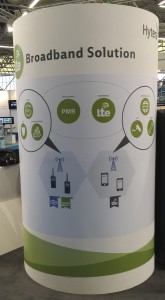
    The biggest challenge seems to be to support the data rates required by the emergency services: It was interesting to see how some of the apps developed could still run on the old system, but there were also many hybrids on the show, such as handsets that supported both TETRA and Android and used TETRA and 3G/LTE for the backhaul.

    There was interesting example of a radio data unit in use in Finland, which had number of 3G/LTE receivers, and chose the best service provider to overcome this problem of high speed connectivity, but of course this needed multiple SIMs as well. There is also the question of the radio frequencies, with the present TETRA systems providing broader coverage at the lower frequencies compared to the 3G/LTE ones in the GHz spectrum.

    TETRA and 3G_LTE hybrid from Hytera
    TETRA and 3G_LTE hybrid from Hytera

    There is also the challenge of the change from a dedicated system, to one provided by a public operator. In some countries such as Finland TETRA is run as a national service by the government, and they allow multiple selected users: The move to a public network raises issues such as resilience, coverage to everywhere including out to sea, availability, Quality of Service (a challenge with present 3G/LTE for example).

    There are also security issues such as denial of service, and separation or sensitive information from the public information also being carried. Think of the issues where criminal photographs exist on the handset, and somebody could accidentally post them on their personal social media account. It is possible to effectively split the single network into two virtualized networks, one for public, and the other for emergency services. This still has security risks, as the core network is still the same, and there are security issues with a virtual network. You could also offload critical communications onto a different technology in an emergency, for example 3G and LTE: Even this has security issues such as jamming or denial of service issues.

    There are standards being developed within 3GPP SA6 (3GPP are responsible for GSM, 3G, LTE and 5G), which will provide possible solutions, and allow TETRA type systems to migrate to a public 3G/LTE network. At the moment there are hybrid solutions available, and these seem to be in use in countries such as Finland and the Netherlands. The Finnish stand had a particularly impressive display of an integrated system of all their services, with live data such as positions and incidents of all their emergency services, with border guards as well as police ambulance and fire and private ambulances. This used the hybrid solution of TETRA and 3G/LTE, and the live moving display of all their services and incidents was very impressive, which was available in every vehicle.

    Within the UK the decision has been made to move to a system that doesn’t use TETRA, but uses a public operator, on 3G/LTE, it will be interesting to see how this develops, as it is the first network to do this. From my point of view, I can see many security issues where a sensitive system runs on a public service, which will need to be addressed. As they used to say in the TV program “Yes Minister”, a courageous decision.

    The use of public networks has a particular challenge, and security in a hybrid system with good separation of the handset and networks makes sense: I have seen many of the security issues from my years of involvement that arise in a public network, which is open to scrutiny by potential attackers, and who have the means to access it. No security system is perfect, so there will need to be constant monitoring, tinkering and improvement. These security issues, my particular field of interest, will no doubt keep us all gainfully employed for many more years!

    So to answer my question, Is critical communications in a critical state? I’d say not critical yet, but being called up for the operating theatre, as new solutions to give to give the users what they want have to be developed: People are used to on their own Mobile phones with a rich suite of services and using WhatsApp is not enough to replace TETRA!! I’ll watch the experiments and development with interest.

  • Three into two won’t go: A comment on EU Regulation of UK Telco Mergers

    Certainly Three’s attempts to acquire Telefonica UK (02) have been thwarted – save for a possible legal challenge. Back in March of last year, when Hutchison Whampoa announced it had agreed a £10.3bn deal to buy 02 from Spain’s Telefónica, creating Britain’s largest mobile network, most industry insiders thought that this deal would happen. The new network was quickly dubbed ‘03’. Mobile is all about scale these days and in this, its largest ever overseas deal, Hutchison would combine 02 with its Three mobile business to bring together 31m customers, or about 41 per cent of the UK wireless market. After all, the precedent had been set already in Europe with the approval of similar deals in Austria, Ireland and Germany, all allowing a reduction in the number of operators.

    This news broke only one month after BT, the former monopoly provider of conventional ‘fixed’ line services had announced its intentions to buy EE for £12.5bn and add 25 million mobile customers to its base and emerge as a very bulky fixed mobile converged player. Indeed, with its existing internet business and its more recent foray into content spending heavily on some of the Premier League football rights, BT was arriving as a real quad player, and crucially, one with huge scale. This was again subject to regulatory approval and again industry insiders were predicting a nod through and already speculating on what both of these deals would mean to the UK market. As is often the case when analysts analyse, they were coming up with different answers but very few, if any, were saying these deals would be blocked. In general, sentiment was positive that the deals would be good for the telecoms industry in the UK. It’s true the deals were different in nature as the ‘BEET’ deal was not reducing the level of completion in the mobile market but it was certainly tilting the playing field in mobile services. ‘03’ seemed like a necessary counter balance.

    One year on and us industry insiders are one for two. The BT deal has glided through the regulatory process like a swan on water whilst the 02 deal has been holed below the water line. This week the EU Commission for Competition has decided that from their view in Brussels, the Hutchison acquisition of 02 is not a good deal for the UK consumer. I have read some accounts saying how dare these unelected and unaccountable bureaucrats block the deal which should be a matter for the UK to decide. However, those making that point probably have ulterior motives whilst another debate altogether about Brexit rumbles on and also ignores the fact that our very Ofcom and the UK’s own Competition and Markets Authority (CMA) were also putting the boot in in no uncertain terms. In fact, it was the UK’s very own CMA that referred this deal to the EU. In truth all the regulatory forces had seemingly combined to make sure that this deal didn’t happen. Quite what brought about this change of direction in regulatory bodies is still unclear but the industry is now left scratching its collective head on exactly what the policy is now in Brussels, or if there is even a policy at all, as the current Commissioner for Competition is taking a very different line compared with her predecessor. Industries prefer consistency from governments and regulators and dislike uncertainty.

    Now I will be the first to admit that the 03 deal was, as Sherlock Holmes may have put it, a two pipe problem. Indeed, it was a weighty problem for sure and we can even put a figure on that; 2.6kg was proudly boasted by Competition Commissioner Margaret Vestager as the weight of the documentary proof and evidence behind her decision. There is a certain degree of ‘never mind the quality, feel the width’ going on here. We think the same decision would have been arrived at with ten pages of evidence as minds were made up from the very beginning of the review process, but there is a civil servants delight in producing a tome instead. The evidence is in there somewhere; but good luck in trying to find it. I think that few of us will force our way through the full document. We all have a will to live after all! Maybe the lawyers will be picking their way through it all, especially if Hutchison carry out their threat of a legal challenge.

    I confess therefore to only having read a few grams of the report but we can see one of the main reason for rejecting the deal; it will reduce competition in the market place from four MNOs to three and that all the evidence shows that when a market goes from four to three players, prices go up. Much of the 2.6kg of evidence deals with this in great detail (I’m told) but I know I am not alone in thinking that all of this data is short term based and we are still to see the real impact over time in any market of three instead four operators. The EU Competition Commission also claims that the more competitors there are, the more innovation one sees in a market. We at Azenby are free marketeers, so we go along with this latter argument to a certain extent but where we begin to differ with the EU Competition Commission, Ofcom and the CMA, is that a lot of the innovation being sought by regulators requires an awful lot of investment and a lot of investment requires very strong balance sheets to support it.

    At Azenby we have concluded that three bigger, stronger, more profitable operators, with healthy balance sheets is a better recipe for longer term forward investment in crucial elements such as 5G, rural expansion, high quality in-door coverage and much faster mobile broadband. The status quo of one giant quad player, another major MNO apparently disengaging from the wholesale market and two others without the wherewithal for substantial investment is not going to help consumers. We also accept that better services like 5G will cost us all a bit more money on our monthly bills but we are convinced three larger competitors is the optimal mix on between price competition and obtaining forward investment in new services and innovation.

    In short the EU has got it wrong and more sadly Ofcom too. Industry insiders just wonder if economists really understand the businesses they are asked to regulate? The advancements they wish to see, are very expensive to deliver.

    One of the other convincing factors for us at Azenby in thinking that the 03 deal would have been good for the market was that it was going to considerably increase the market power and presence of some of our virtual mobile operators like Talk Talk, Virgin, Dixons Carphone, Tesco and the soon to launch Sky mobile offering. Without this deal the landscape for MVNOs looks bleak. Baroness Harding, CEO of Talk Talk, has been quoted as saying that she believes Vodafone are in the process of withdrawing from the MVNO market and others in the industry take a view that 02 and Three alone, don’t have the necessary spectrum or network capacity to allow MVNOs to scale up. This leaves the MVNO wholesale market in the UK looking short of competition, a bizarre outcome from the competition regulator indeed!

    This is a really important point. Were we really looking at a market going from four operators to three, or a market reducing to three MNOs but with the tempting prospect of as many as ten service providers, the majority of whom would be MVNOs, all competing with each other with retail deals on the high street? We believe that if Hutchison had followed through with their ‘open to all’ network strategy, it would have kick-started a new age for MNVOs and this would have forced both Vodafone and BT to respond, creating a new competitive market for wholesale. This would have increased competition for consumers.

    Here is the case in a nutshell for us. Much of the investment needed is in the radio networks, that’s where the big sums of long term investment are required and do we really need four operators investing in the same infrastructure where the benefit to the customer is barely noticed? Surely we want investment in new products and services, all of which can happily share the same radio infrastructure. Radio network sharing is a reality today after all. We are much more likely to see faster, better, more extensive mobile coverage when radio networks are shared and co-invested in. If your view-point is the former, as would seem to be the case with the EU Competition Commission, then we think you are going to be disappointed because even though the EU has preserved the status quo, it is by no means certain that all four operators are going to be investing in infrastructure that has marginal value in differentiating themselves in the market place. When did you last see a coverage map in a phone store?

    Perversely, the EU Competition Commission seemed to recognise this when they said that the deal would endanger the current RAN sharing initiatives in the UK. The very initiatives brought about because no one MNO can afford to make all investment needed in the radio network on their own! The economics just do not work. Now EE, sorry BT, with the Emergency Services Contract safely tucked away its back pocket, may change that but this is all the more reason we why we need effective competition to the new monumental kid on the block. We believe that 03 would have provided that necessary competition and without its promised new investment, we will all be worse of in the long run.

    So what does happen next after this ruling? Hutchison may appeal the decision and ask for judicial review but that is a long drawn out process and not cheap to do either. Hutchison had said that following approval of the deal they would invest £10bn in the new combined network. Exactly what we do need to see happening. Does the EU Competition Commission believe that Hutchison will stick to this now? And what of Telefonica? The parent back in Spain seems determined to sell its UK business to reduce their own enormous debt burden. That’s doesn’t sound like they will be making big investments in their UK business. Perhaps others will now circle 02 and make a bid. That is possible and as long as the bidder is not an existing UK MNO, it should sail through the regulatory waters just as BT did with EE. Or perhaps others will look at the UK market now and realise that any further consolidation is out of the question for many years to come and think that this doesn’t look like a good place to piling in millions of pounds of new investment.

    In our view this decision boiled down to whether three strong MNOs was better than four, inevitably, smaller ones. The EU has opted for the status quo hoping that will provide their desired outcome of more investment and deeper price competition. That old saying, be careful what you wish for, springs to mind and Ofcom, the CMA and the EU have all got their wish. Now they need to start praying!

  • A Rose by Another Name: but what about M2M?

    If you haven’t looked into the topic of M2M for some years, then you’re going to find it complicated when you do. A lot has been going on. And a lot is still happening.

    First, there is the new name. It’s not even called M2M anymore – that is so last century. It’s now IoT, or “internet of things”. But to quote the Bard (only fitting as it’s 400 years since his death) “… a rose by any other name would smell as sweet… ” The question though is whether M2M or IoT is any closer to smelling sweet now than it was a decade or so ago when it was over promised as the future of mobile? That was the question on my mind when I went along to the grandly titled “M2M World Congress” in London in early May. Interesting that it was not the “IoT World Congress”, but presumably someone else had an event with that name so perhaps the organisers had to make do with this throwback name? Or perhaps they were proudly refusing to be forced by fashion and public opinion to move away from M2M? Whatever the reason, the organisers had done a good job at assembling speakers covering the full variety of radio network technologies.

    This brings me to my second point. A few years ago, the only radio networks that were available for M2M/IoT use were the networks owned by the traditional mobile operators. In that era the MNOs enjoyed a monopoly position and they knew it. Like moths to the flame, they were both attracted by the light that was the billions of potential devices; but were simultaneously frightened of being burnt by the low ARPUs from same devices. In what has become a typical pattern in the mobile industry, the greed and fear of the MNOs both delayed the growth of connected devices whilst spawning a range of new-entrant competitors. The 2016 landscape of “connected devices” therefore looks more like a primordial soup that David Attenborough would recognise with many different wireless solutions fighting for life and vying for supremacy. Indeed it is far from certain whether the MNOs will regain their dominance or whether, as with messaging and VoIP (think Whatsapp, Vyber, Skype etc), the MNOs can do little more than lament what might have been and blame previous generations of mobile executives for “obvious” failures. Time will tell, but metaphors of stable doors and horses bolting came to mind at many points over the 2 days.

    My third point concerns the language of obfuscation. Mobile telephony has always loved three-letter-abbreviations, or TLAs. Used well, TLAs offer a shorthand to facilitate the communication of complex ideas between experts. Others, of whom I confess I am one, suspect that the semi-technical abbreviations are little more than a trick to disguise chasms of emptiness by members of secret societies who are dedicated to little more than job preservation by making sure no-one knows what on earth it is they are talking about. I needed to find out what all these new abbreviations were so that I could get to the heart of the technology options. Having learnt to speak the version of rhyming slang currently used by the M2M/IoT industry, what I learnt was interesting.

    Whilst the MNOs had slept, secure in the belief (or hope) that their dominance was absolute, at least 3 new groups of challengers emerged. First an aggregator layer climbed out of the soup, led by names such as Jasper. These aggregators took whatever tariffs they could get from MNOs around the globe and did their best to re-package them into offerings that fledgling device businesses could think of using. The laconic MNOs opened one eye and set up bodies like the M2M Alliance in the forlorn hope that they could see off the aggregators, but as Cisco’s recent $1.4bn acquisition of Jasper shows, that was not to be.

    Meanwhile, more serious threats were entering the fray. To the MNOs it remained unthinkable that totally new radio networks could be deployed to eat their lunch – but that is what happened. Well, let me re-phrase that: that is what is happening. 2 main challengers exist in this group. In one corner there is Sigfox, and in the other the LoRa Alliances. Each is different to the other, but they share the same raison d’être: which is that the MNOs failure to serve the device connectivity market properly has created an opportunity for a new entrant. They differ in the degree of overt challenge to the MNOs. Sigfox is unquestionably a direct rival of the MNOs; whereas the LoRa Alliance is keeping its options open – perhaps it is a rival or perhaps it is only a temporary solution whilst the MNOs catch-up? In both cases, time is the only thing that will tell. Will Sigfox get its worldwide network sufficiently deployed before the MNOs have lumbered ponderously to their feet? Will LoRa networks really be quietly decommissioned and deprioritised when the MNO solution is available? Tune in next time (about 2 years from now) to find out.

    The MNO response to Sigfox and LoRa is of course several different competing solutions instead of a single solution. Again, this is not really a surprise because when has the mobile industry ever agreed on anything early enough to stop the horse from bolting? At the M2M World Congress we learnt about NB-IoT of course. But we also touched on EC-GPRS, LTE-M that used to be known as “Cat M”, and also about Cat 1. We heard where 3GPP is placing its efforts in standardisation in order to counter the threat that is the non-3GPP world. It is all splendidly interesting so can you see now why this strange soup provides such a good hiding place for so many people?

    Joking aside, it is great to see so much activity concentrated on the topic of device connectivity. It is long overdue, and all involved are to be congratulated. But I left the M2M World Congress with some major reservations.

    Picture1Pricing remains a conundrum at the heart of device connectivity for the MNOs. This could not have been better illustrated than by comparing points made by Sigfox on one hand and one of the big MNO groups on the other. Sigfox are preparing for a world in which the volume of devices connected to their network will be so large that a radio module will cost no more than $1 and a year’s worth of connectivity will cost the same. Versus the MNO view which was that a new charging model intriguingly called “value based charging” is needed so that MNOs can charge higher prices for connectivity! “Oh no! When will they ever learn?” I thought. But to my horror, most MNOs that I spoke to later over coffee seemed to think it was a jolly good idea to use “value based charging” in order to increase prices. Sigfox must have been euphoric.

    Picture2The market for device connectivity urgently needs more robust thinking about marketing, segmentation and targeting. One size never fits all. For example, Sigfox will be perfect for some use cases and awful for others. But is anyone properly thinking this through or are they all just rushing forward in some tragic display of strength like rutting stags, doing nothing more than damaging each other in the forlorn hope that one of them can survive without sustaining too much damage? With better thinking on segmentation, both the Sigfox approach and the MNO “value based pricing” approach can work. A lot of IoT will be low value, low bandwidth, and Sigfox is built for that. Some (a small % perhaps) will be high bandwidth, low latency, high value) which is what the MNOs may choose to go after. But if they invest in and build their networks hoping for the volume of the former with the ARPU of the latter, then it will all come to an awful end.

    Picture3Where were the device manufacturers? With a very small number of exceptions, everyone at the M2M World Congress seemed to be a network provider who had turned up to meet his (yes, usually it was a male, but not always) mates from the last Congress a year ago (or the other World Congress, a few months ago). These people, speaking with knowledge and using TLAs like antlers to advertise their superiority, were by and large just talking to other connectivity providers. The customers, or connectivity users were hardly represented at all. As it happens, I know a few “connectivity users” and not many of them even thought of coming to this World Congress. Apart from anything else, their nascent businesses cannot spare the time or the cash for their people to go to events like these. They are too busy out there trying to sell; trying to cut device costs; trying to find an edge in the market. Most of all what they want to talk about is not what was being talked about at this Congress. “How soon?” and “what price?” are far more important to them than philosophies and roadmaps articulated with hyperbole on pretty slides.

  • Bill goes to Apps World 2015

    Bill goes to Apps World 2015

    I went along to ExCel for the 7th edition of Apps World to find out what’s hot and what’s not. Apps World claim 10,000 visitors over the two days and 350 exhibitors from across the planet of the Apps.

    A long standing friend of mine and a fellow frequent attendee to Mobile World Congress and its previous incarnations used to call that event the annual bump. He didn’t mean everyone is continually walking into each other – but with 80,000 attendees there is more than a bit of that going on. No, he meant it’s where you continually and regularly bump into so many people you know from the industry. So for me the big difference here is no bumps – what does that tells us about where the MWC crowd are and what’s important to them these days?

    MWC has striven over the last few years to fully represent all seven layers in the classic OSI model as well as the ever burgeoning mobile eco-system. So layer 7, Applications, is well represented at MWC. Here at AppsWorld this is all about layer 7 and only layer 7. As the name implies, this is the Apps show! It does what it says on the tin. Are Apps important to Telco’s and Tier 1 vendors? It would seem not judging by their lack of interest and participation at this show. And isn’t that very strange because Apps is not just where it’s at today – it’s where the money is and where contact with the billions of mobile device users occurs. Without doubt, mobile device user’s moments of truth are though the apps they use.

    So why stacks 1-6 are away doing whatever they need to do today, stack 7 comes out to play and takes centre stage. Much of what goes on at AppsWorld is about sustaining the App eco-system and it’s largely a B2B show but small B to small B in the main. Of the 300 or so exhibitors here this week, how many will be big and even very big B’s in the coming years? Who are the ones likely to get to escape velocity and become a moon-shot? I wish I knew. I am sure there are some who will make it big which does increases my amazement on why so much App activity carries on under the Telco radar. Have they given up getting in on App monetisation?

    Perhaps that’s the case but I note a distinct change of tone coming from MNOs recently and an acceptance of the argument put forward by OTT and App players that they help carriers sell more data and that is good for the carrier. Certainly Vodafone’s recent half-year results seemed to support this. They told us that Data traffic in H1 grew 75% and the desire for Apps drives smartphone adoption meaning that Vodafone now have 29.9 million 4G customers across 19 countries with 9.7 million of them coming in H1 alone! Although these numbers are impressive that still only equates to 20% of their European customer base taking a 4G service. And here is the nub of it all: customers who move to 4G typically buy bigger data packages and see their data consumption double, and average usage per smartphone customer in Europe is up 39% year-on-year. I can hear Silicon Valley saying ‘told you so.’ The real growth is still ahead of us and is it customers’ desire to use apps that will encourage them to take up 4G price plans.

    Let’s get back to what the data generators are up to. Well, Apps for everything is the phrase of the day as you would expect. There really does seem to be an App for everything you want to do and a whole lot more for things we never thought we needed! Innovation and invention is what will make the difference to the winners and the losers and we know that the vast majority of Apps on the market never make any money. So taking some time to get your App proposition right seems a very good thing to do. Our very own Julia Shalet was on hand to give start-ups some vital tips in the Launchpad zone. Julia told us “Don’t build it until you have looked users in the eye and see what their response is. Go validate all the assumptions you have made about how people feel and behave before you go too far”. Sound advice indeed. You can see Julia’s full presentation here:

    Having the great idea is one thing. Getting the App built these days seems pretty straightforward judging by the sheer number of App builders there were promoting their services at the show. The tough part has always been the turning the App into a commercial service. The quality assurance, the de-bugging, the payment method (it’s really nice to get paid!), the customer experience, the analytics, the asset inventory, and anything else that’s needed to make the App a commercial success. It is here I saw a big difference between the show this year and that of a couple of years back when I last attended. The support eco-system is now very strong. An App developer doesn’t have to go it alone and reinvent things that are necessary but don’t add value to the proposition. The plug-ins are now abundant.

    I hope next year I may bump into some of my colleagues from the MNO and Tier 1 vendor world. There really is a lot that they can learn from a day out at Apps World 2016!

    Apps World Next Year

  • Will Small Cells become Big?

    Small Cells have been a talking point for many years now. There was a time some years back when they seemed to be the next hot topic, the Small Cells forum was born and everyone was talking about small cell solutions. I often wonder what makes small, small and whether small will become big!

    What do I mean by this? Well when small cells became the hot topic, MNOs were actually already doing small stuff – small footprint cells from a radio coverage perspective using small footprint equipment, small structures (such as mock lighting columns) and smaller capex budgets than what are required for a big macrocell – in fact they were rolling out microcells. Was this the birth of the small cell? Microcells were (from a classical radio coverage perspective) supposed to be a lower level of coverage, below the surrounding building clutter and hence providing street level coverage over a more limited area that a macrocell. Some MNOs in the UK found a loophole in the requirement for paying rent on highways land and hence a proliferation of mock lighting columns happened. I recall being part of the design team who created the whole “Lamp post site” concept with a major UK MNO and was somewhat surprised as to how over time many MNOs morphed these designs into ever larger structures and equipment cabinets and the term “Mini Macro” started being bandied about. It felt like the microcell had an identity crisis; it had been on steroids and grown bigger than intended! Some of this was driven by the economics of the solution, no ground rent, smaller capex than a full blown macro and the ability to push the design to achieve larger coverage footprints meant the MNOS wanted to squeeze maximum bang for buck from the designs and the associated capex budget.

    Then came the Small Cells fervour and a lot of pundits thought that MNOs would be deploying Small Cells en-masse. It was easy to see why – many areas had been saturated with macrocells, some microcells had also been deployed and with increasing demands for higher bandwidth services and the associated capacity required to serve them it seemed logical that another layer of cells would appear below the macro and micro ones. “Ah a picocell” I hear all you die hard radio planners say – well yes, this classic layered vision of the radio network had been around for a while and it was expected that picos would follow micros in the layered rollout vision. In fact I recall going to Finalnd to see a new product from Nokia (before the NSN and the new Nokia days) that was specifically built to serve the pico market it was called “Insite” and I thought it was rather a good concept unfortunately despite the impressive investment in a mass production facility in Finland the product had limited functionality and as anyone who has worked in a radio engineering function will know, us engineers like our functionality. Anything below the required GSM/GPRS/EDGE/UMTS/HSPA/HSPA+/LTE/LTE-A functionality is seen as a little undesirable by the engineering fraternity. The Insite was a GSM only non-EDGE capable base station at a time when data was started to become a reality on mobile networks. Due to lack of demand the rather cute A4 sized Insite was put to bed, never to be woken again.

    Now I’m not having a good at Nokia here, the other vendors were also considering or doing similar things but there is a theme emerging regarding what MNOs demand from a product and how that impacts the cost of providing a picocell or small cell that meets their requirements.

    Why does this matter? Well picocells have competition, there’s a another guy on the block whose been around for a while, somewhat seen as a sideshow by the MNOs for some time but becoming an increasingly serious contender for the small cell crown – Mr Wi-Fi Access Point, already rolled out en-masse and offering data services to cellular customers all over the world.

    “It’s not a small cell” I hear the dissenters shout – “it’s not cellular, not part of the cellular network layers, an outsider incapable of mobility, data only, out of step with radio network equipment functionality, can’t be monitored as part of our network management systems…….” Well I would agree based on those arguments but based on the need to provide a small footprint of coverage to a dedicated location allowing customers to access data services from their cellular devices I would disagree – Wi-Fi access points are already out there providing “Small cell” type coverage.

    I went to a base station themed conference in Bristol UK in 2012 and there was still a lot of talk about small cells, in addition there was a lot of discussion about “HetNets” – Heterogeneous Networks with lots of different spectrum bands, technologies and cellular layers needing to be glued together seamlessly to offer customers coverage, capacity and functionality where they needed it. Nothing wrong with that I say, but the small cell layer had still not emerged in the real world as seen by the visions of the presenters. I didn’t see a lot of people presenting on cellular small cell rollout success stories. What I did see was O2 presenting the success of their Wi-Fi network rollout in London particularly around Oxford St, Exhibition Rd and Trafalgar Sq. plus Virgin Media talking about their London Underground Wi-Fi deployment. Don’t get me wrong full blown cellular technology small cells were also being discussed and presented but very much in the trial phases.

    OK this is a few years out of date but in the same year some commentators were stating that Small cells would account for 88% of all mobile base stations by 2016. I’m not convinced, even now – I’m still not seeing mass rollout headlines for small cells of the cellular kind. My ex colleagues in the MNO world do not appear to be planning large pro-active small cell layers across all their most populated areas of coverage. “What about AT&T?” I hear you shout “they were expected to deploy 40,000 small cells by 2015” – I haven’t seen mass publicity about progress on this initiative, it’s not easy to find.
    Meanwhile that lean and mean Mr Wi-Fi Access Point continues to stride on emerging everywhere and anywhere – even my local Sainsburys is offering free Wi-Fi which makes it convenient for the budget conscious shopper when checking the price of a toaster at Argos compared to their special promotion………..but I digress.

    So what does this mean anything, nothing or something? Well I haven’t got a downer on full blown cellular small cells there is indeed a place for them but it feels like the small cell is suffering a bit like our Microcell on steroids – it has an identity crisis. Is it cellular or Wi-Fi or both and which identity should it adapt to become big?
    This is a complex issue (as all techies like to say) there may still be a wave of pro-active small cell deployments by the MNOs especially now the likes of 2600MHz spectrum is in their hands – an ideal spectrum band for small cell / hot spot coverage deployment. However practical challenges remain.

    First and foremost location – as any homebuyer knows, location is key; the same applies to a small cell deployment. The fact is if you are using your small cell to soak up demand driven by your consumers then in today’s world of high bandwidth consumption they are generally located in a specific area sat streaming the latest episode of Game of Thrones or catching up on The Great British Bake Off in HD. OK so just put the small cell where they are then: simple to say but less so to do. A lot of this consumption is in cities in areas where there also happens to be a lot of retail and service industry presence – big brand names in desirable looking spaces or trendy boutiques in fashionable streets. So what? Well if you want shop front space in Bond Street expect to pay in excess of £900 per square foot – very nice for the landlord. Cue Mr MNO knocking on landlords door asking if they can come and drill the walls and mount base station, antennas and cables, disrupt the retail space, put something ugly on the face of the building (with a H&S warning about radiation on it) and pay a pitiful amount for rent. Oh you also need the local authority to approve you destroying the look of that nice regency façade with a bit of telecom’s kit. Guess what – you can’t get the Small Cell where you need it, you might be able to find another property a bit further away but then you are not quite covering the hot spot you need to.

    In addition to being able to get the small cell exactly where you want it, you then need to connect it to your mobile network. You’re in a high demand area so you need a good sized backhaul solution, no line of site for a microwave transmission solution due to the environment so it’s a fixed line solution with similar pricing to a full blown macrocell leased line. OK I could try and use a non-line of site microwave solution but again – I get the feeling these solutions are limited in number in the real world.

    Then there is the cost of the equipment. The engineering functions in the MNOs want a fully standards compliant small cell – a big stamp of 3GPP compliance and all the mobility and radio functionality expected. Fair enough that is their job but compare that to the required functionality for a Wi-Fi Access point and the associated cost and you have another headache to contend with – how do you justify the cost of the equipment.
    So as an MNO you are struggling to locate your (cellular) small cell so you may not cover the area you need to, the transmission cost is relatively high and your equipment price point is way off compared to a WiFi Access Point – Is this good bang for buck for your capex?

    Meanwhile the tenant in the retail space has brought some Wi-Fi access points, plugged them into the internet and started offering service to their clients.
    Maybe I’m sounding like a fully paid up member of the Wi-Fi Alliance but frankly I have no bias either way. I accept that there are other variants of small cells that are a bit easier to deploy such as Femtoc ells that can be plugged into the internet for connectivity and look very much like a Wi-Fi Access Point but I guess I am trying to make a point about mass small cell deployment. The reality is that there are many challenges to small cell deployment of the traditional cellular kind as articulated above and whilst the MNOs have been struggling to justify a proactive small cell rollout, leaner and meaner Mr Wi-Fi has sneaked round the back and got all the customers, hell some landlords are even making sure they get Wi-Fi to ensure users of their premises get what they want – coverage wherever they are.

    Whilst the MNO engineers continue to demand functionality from their small cell providers that is absent from Wi-Fi pushing the price point and complexity up, their network end users are happily using a much lower spec, lower price point, less functional solution because it gives them the hot spot data coverage they need. Allied to that the next generation of Wi-Fi access points are coming supporting radio functionalities such as Multi-User MiMO giving multiple users much higher data rates thus meaning Wi-Fi will continue to be the sole source of data coverage in many areas as consumer demand for bandwidth increases. Add to that Wi-Fi calling capability and suddenly you have a Wi-Fi solution that directly competes with your cellular small cell. Oh and you don’t get stung with data roaming charges when you use Wi-Fi solutions abroad with the many Free Wi-Fi services on offer.

    One other issue that also contributes to the consideration of whether mass small cell rollout will become a reality is the very prudent practice of MNOs sweating their assets to the maximum. Having spent a fortune rolling out a macrocell network you want to make sure you get every available improvement possible from this network before you start rolling out another one. With the advent of lower band spectrum for LTE and techniques such as Carrier Aggregation (CA) offering more data throughput and capacity capability one could argue that MNOs will continue to try and cover those urban areas both indoors and outdoors with their existing macrocell base. The superior in-building penetration of low band spectrum and the improved data capabilities of CA could stave off the need for small cells just a while longer. Remember that MNOs are already companies with a high operational gearing and the addition of many hundreds of small cells just makes their operational challenges and cost base look even more scary than today – a time when MNOs are seeking to reduce site Opex costs through network sharing, not add to them with another major rollout!

    So what’s the answer to my question – will small cells become big? I personally believe that from a Wi-Fi perspective they already are and will continue to get bigger but from a full blown cellular solution perspective there is still some way to go. If we believe the forecasts for data use and the need for very high bandwidth and ultra-low latency services there is no doubt many areas will need improved quality of coverage and capacity and it may be that the only way to achieve this and fully optimise it is with more, smaller cells (of the cellular variety!) connected to fibre backhaul and located closer to the end user.
    There will always be practical challenges to deployment of any technology but I think the MNO and vendor community needs to consider what they think the end user needs and what end users are actually using as a solution today. Maybe a marriage of Wi-Fi and cellular is required with a fully open and functional relationship to really make MNOs end users and the Wi-Fi community benefit from the future of small cells. I don’t mean Cellular and Wi-Fi technologies sat together in one box either I mean a fully interoperable Wi-Fi/Cellular networking solution.

    There are hints that 5G will deliver this kind of Multi Radio Access Technology, multi-layered interworking across licensed and un-licensed spectrum and vendors continue to talk about the need for ultra-dense networks with many small cells to enable users to get the throughput and latency required for next generation services.

    However all this is just theory if you can’t get over the deployment practicalities and constraints and your cellular small cell solution price point. Much as the techies would love to roll-out masses of small cells, the truth is MNOs have limited capex and will continue to only do what is essential to keep up with the market; any mass small cell rollout programme will need the CFOs sign off, in no way an easy task in the current financial environment….

  • Small Earthquake in London

    Business life carried on as normal in London last week and especially for Mobile Operators who are feeling better about life after a few years in the financial doldrums (just blame the crisis) and 4G LTE will get us back on track. Certainly, the global stats seem to suggest its full-steam ahead for LTE:

    • 395 commercial LTE networks today – growing to 460 by end of 2015
    • 500 million LTE subs
    • 2,919 LTE devices on the market from 297 different OEMs
    • 50% of devices are smartphones and 37% support LTE TDD
    • 89% of devices are backward compatible with 3G (98.5% for phones)
    • 200 VoLTE smartphones have been announced

    So with everything looking rosy for MNOs they can focus on the next big thing, the IoT, and what’s there for them to worry about? Well maybe the Wi-Fi Global Congress held in London last week didn’t register on the MNO Richter scale but those paying closer attention may have noticed a small tremor with its epicentre at the Tower Hotel. Not enough of a shock to reach Paddington maybe but perhaps enough to make me think that MNOs need to be paying closer attention to the emerging Wi-Fi progression from free public hot spot utility to serious player in the IoT eco-system.  (I intentionally leave Enterprise use out of this piece for brevity).

    If IoT is the next big driver of revenues in the Telco industry and carriers, integrators and service providers all want to find their position and their slice of the cake in the value chain, then how crucial will wireless be? Are the battle lines being drawn between LTE and 5G, and Wi-Fi? (not to disregard other wireless options in unlicensed spectrum as well).

    The Wi-Fi Global Congress made the case for Wi-Fi last week and much of it was compelling. A few factors which caught my attention were:

    • 85%-90% of IoT and M2M user cases will be short range
    • Customer Premises Equipment (CPE) needs to be ultra-cheap
    • Device support needs to plentiful, generic and non-certified
    • Wi-Fi in lower frequency bands (900MHz) is on the road map
    • Cellular could be a good back haul
    • Let’s assume IPv6 is seamless

    The route to the technology starting grid has some critical lap times that need to be achieved. The wireless industry in particular is establishing some widely emerging fundamentals needed to support the IoT world:

    • Capacity: 1000 fold increase from 7 billion to 7 trillion connections
    • Speed: 50MBps (up to 1Gbps for some applications)
    • Coverage: truly ubiquitous
    • Latency: Zero

    Latency? Yes, Latency. I for one do not want to be in a driverless car whilst the control system is buffering incoming data!

    As the work hungry SDOs begin to put down on paper the requirements for 5G – doubtless cognisant of all of the above – The Wireless Broadband Alliance are plotting the path forward to make sure Wi-Fi supports all the needs of IoT.

    So will battle-lines be drawn, or will peace break out and cellular and Wi-Fi protagonists work together? Some say spectrum may hold the key. Can unlicensed spectrum support the needs and demand of the future? Is this why cellular carriers in the US have just broken all the records in the spectrum auctions earlier in the year? Can Wi-Fi overcome its security doubts? Battery life is another concern. Do these aspects point to an advantage for cellular and macro coverage plays? Perhaps but it’s not all plain sailing either. Is 5G coming to the party too late? Will it be over specified? How important will mobility be? Are device costs too high? Is 5G too complex a technology for what will be largely simple user cases and transactions?

    What are the wider implications? If there are indeed going to be 7 trillion connections, then (data) storage is also going to be a big factor and if the preferred method is cloud storage then transport mechanisms will be crucial to shift large volumes of data around the eco system. System Integrators will also be big players, especially where IoT is being used to increase enterprise efficiency. It is obviously a very different model than today’s voice and data bundles for Service Providers to start to understand.

    I think we can summarise by saying that we have more questions than answers at the moment but I also wonder if we learnt last week that the Wi-Fi lobby is ahead of the cellular family at the moment, albeit in the early stages of what will be a marathon race. And if the WBA congress last week didn’t quite make the earth move, it did send a shudder and should have sent a wake-up call to MNOs. IoT may well provide the next major shift in revenues but this time round the competition is energetic, strong and able.

  • Bill’s Bests from MWC 2015

    This year’s theme sounded a bit like the innovation is going on somewhere ‘over there’ and we are on the edge of it looking in. Anyhow, the show gets bigger and bigger and this year saw 93,000 attendees. And it felt like it.

    2,100 companies were exhibiting. How many of them can any one person get round in four days? This was the 10th year in Barcelona and it’s beginning to feel the strain of so many people descending on the city. It was also the 20th edition of the Global Mobile Awards

    The cycle of life (in the Telco Universe)

    The general mood amongst analysts, journalists and scribblers was that Europe’s big telecom operators are back to rude health, and few CEOs here were disagreeing with that. Of course every good news story has to have its downside so they were also concluded that this was in fact bad news for their upstart rivals.

    Looking at the reasoning behind the upturn gives different outcomes: 4G is delivering (on lower costs and improved customer experience); the regulatory mood is moving on to encourage forward investment in 5G and Fibre and away from MTR caps and Roaming charges; consolidation is being viewed positively by investors, and – for incumbents – the ability to charge more for access to their infrastructure. It’s the latter that has the new breed crying foul.

    I think the unrelenting message that the Tier 1 Telcos have been directing at Bruxelles finally got home. “We aren’t the bad guys, we pay Corporation taxes, we pay employment taxes, we gather VAT, we contribute to national GDP, we are a vital part of national infrastructure, stop picking on us and go figure out how to make the internet providers play by your rules.’

    Timotheus Hoettges, Deutsche Telekom Group CEO, said Facebook was a communication service, yet not regulated as one. He then argued there was a “clash of business models” between network operators and internet firms, and that network players were left holding the short straw.

    “We are an asset-heavy industry, where everything is interoperable and open,” pointing out that interoperability even extended to “closed networks”, such as Google and Facebook. He wanted to remind regulators that internet giants were asset light and could offer services for free. “How can you compete with a voice, SMS or video service which costs nothing?”

    More M&A and Convergence on the way

    Reuters also gave a briefing saying that bankers and industry executives predict more mergers and acquisitions in Europe, perhaps eventually across borders. Incumbents won’t have a clear playing field either it seems. The likes of Altice, Hutchison and Iliad, were better placed to buy assets because they had billionaire founders behind them with big ambitions and were unafraid to load up on debt. The evidence being recent deals in Portugal, Britain and Switzerland respectively.

    As if to emphasise this point Cisco boss John Chambers said half of today’s service providers will be “irrelevant” within a decade. He expected sweeping changes in the operator landscape, with 50 per cent of today’s service providers becoming irrelevant in ten years’ time as they fail to adapt in a fast-moving digital world.
    The traditional incumbents won’t have it all their own way of course. Vodafone boss Vittorio Colao led the ‘worried majority’. “Some operators can use their networks as a fortress, we cannot afford to have re-monopolisation in Europe.”

    One thing is for sure, the landscape is going to be forever changing and sometimes very rapidly in our industry.

    Quad Play

    There are two schools of thought on this. Two extremes in fact. One says quad players will rule and content is king, the other says access quality and pricing is what the customer wants. One thing is for sure, the battle grounds are being drawn and the Tier 1 Telcos must certainly see quad as the way to protect themselves from upstarts and to lock in customers. I think considerations around Quad play are already shaping the M&A and consolidation environment and that will continue.

    Deutsche Telekom Chief Executive Tim Hoettges said; “It is the convergence that makes the incumbents fly.”

    The major vendors are leaning this way; they are good at seeing what way the wind is blowing from those that sign the biggest cheques. Much of their talk this year was on how to support the Quad play for Telcos.

    5G

    Inevitably, before 4G is anything like a universal reality, in developed markets let alone elsewhere, 5G is being hyped up. One could hear stories about it being here by 2018. This before the ITU, or anyone else for that matter, have even defined what it is! Of course faster, bigger and better access for sure but 5G has to be a lot more than that. I am left asking ‘exactly what is 5G?’ Helpfully, the Next Generation Mobile Network Alliance published a paper saying a lot more work is required and its years away from standardisation. Don’t confuse ‘pre 5G’ with the real thing. OK, that’s clear then.

    TDD and 3500MHz gets serious traction

    After many years of pondering, TDD is starting to make real headway and not just in China. In Japan and Korea, ambitious plans to use the unpaired spectrum were now well underway and 3500MHz spectrum seems to have been the catalyst. Will this spread from Asia?

    China on the march

    There was a very notable increased presence (again) from China at MWC. I wonder if this show won’t be in Shanghai in 5 years’ time.

    This year’s Buzz

    There were three candidates for the hype prize this year. NFV is everywhere, in every hall, in every PR, in the Cloud, in the core, and in your face. This is looking like a crowded space now. Coupled with SON most of the time, it was hard to get away from it. Similarly, IoT was with you wherever you went. Maybe this is what is meant by IoT! We shouldn’t forget Wearables as well I suppose. I wish we could, but we can’t!

    Devices

    Of course Apple kept away, arrogant as ever. Still, everyone else was here and the trend for launching devices at the show continued: Samsung unveiled its latest flagship devices, with its Galaxy S6 joined by the Galaxy S6 edge – a smartphone with a curved display on both sides. HTC debuted its latest flagship device, One M9. Alcatel launched the new OneTouch and says it aims to become a top 3 handset player. For clarity the Alcatel phone is not made by Alcatel but by Chinese manufacturer TCL, so maybe it does stand a chance of that number 3 spot. Microsoft announced a couple of new Lumias, the Lumia 640) and the (much) larger 640 XL – armed with Snapdragon 400 processors, 1GB of RAM and 8GB of on board storage. Both with the new Windows 10 OS. Will that make us rush out and buy one? BlackBerry launched their new smartphone called Leap. Ominously, nothing new from Sony accept a pledge to stay in mobile. Tough times ahead for them I fear.

    Device OS

    Nothing is shaping the mobile market quite like the device OS so it’s worth a good look at what is going on here. Is there life beyond iOS and Android? Would that be good or bad for the industry? A lot of mixed views on this. I rather hope that one or both of Ubuntu or Firefox can get some market penetration and start to give some competition to the duopoly we have today. I might be a bit unfair on Windows when I call it a duopoly but I am not (sadly) being unfair on BB OS 10.

    Of course no new OS can enter the market without the cooperation of the device OEMs and what manufacturer is going to put a brand new OS on their device with no proven eco-system? Samsung see Tizen as their alternative so are they going to embrace another OS? Unlikely, and this then only leaves the next tier of device manufacturers and for them to go ‘left field’’ on an OS would be brave.

    So it’s left to the wannabes to find a new manufacturer with no market share and nothing to lose to play with or to build their own device. So Ubuntu have now launched the BQ Aquaris E4.5 device. It is a rather nifty sub £130 smartphone that actually is very clever and very cool. Made in Spain it runs on the Ubuntu, open source, Linux based OS. It has no App store of course but what it has done is really neat. Instead of Apps it uses ‘Scopes’ which are user defined home screens dedicated to one topic — for instance music, video or news — that pull together content from various sources. For example, instead of having a YouTube app for watching online videos and a separate app for watching the videos saved on your phone, the video scope pulls them all together in one place. Each service on that aggregated home page — like YouTube or Vimeo — can then build its own branded scope, which is more like a traditional app. The phone and OS deserve serious consideration. The phone will only be on sale in Europe. Ubuntu has done deals with GiffGaff in the UK, Three in Sweden, Amena in Spain and Portugal Telecom to offer SIM bundles when customers buy the phone. It’s unlocked, so you can use it on any network supported by the phone. The other thing going in its favour is that the OS is totally compatible with your PC as well as well as your mobile.

    And then there is Jolla and they have set themselves the rather ambitious target of forming the third mobile ecosystem after Android and Apple iOS, ousting Windows Phone from the top three. “We expect to be the third,” said Marc Dillon, co-founder and COO of the company, which is in the process of rolling out the second generation of the Sailfish OS and the first Jolla Tablet. Jolla believes it will be able to achieve its targets with Sailfish 2.0 because the OS offers something different from what Dillon described as the monopolistic tendencies of the two dominant players.

    Dillon was particularly critical of what he described as the anti-competitive practices of Google, also noting that Android was designed to capture data from users and profit from it.

    Not to forget Mozilla, they have lined up with leading operators KDDI, LG U+, Telefonica and Verizon Wireless on what it’s billing as a new category of Firefox OS phones, with a planned launch date of 2016.

    Maybe we are seeing the first signs of a shift away from the iOS Android duopoly but a quick reality check is in order. The wannabes have their work cut out: Android and iOS accounted for 96.3 per cent of all smartphone shipments in 2014, with Android’s share at over 80 per cent. Windows Phone accounted for a relatively small share of 2.7 per cent. It’s a very big mountain to climb for the new entrants.

     I did my last Global Mobile awards

    Yes, this time really is the last. I have been involved in these awards since 2002 and chairing the judge’s panel since 2005. It’s come a long way in that time. This year we had 40 categories, 800 entrants and nearly 250 judges. I created the CTO panel and this year we had 23 CTOs on board to pick the ‘best-in-show’ technology.

    This year it was the turn of John Cleese to be seen with me and have the pleasure if sharing a stage with the good and mighty from the mobile world.

    There were two new big awards this year. Connected Women – Leaders in Industry. The award went to an operator, Ooredoo, for growing the female digital economy in Myanmar. The other was the Young Mobile Innovator of the Year. The winner in the end was Ted Nash (Tapdaq) from the UK.

    One last thought which struck home given my long marriage with this industry was that BBC Click’s entire MWC report for 2105 was filmed on mobile phones. How far the industry has come!

  • NFV – Network Function Virtualization or New Financial Value?

    Looking back over the past year, the most overused acronyms seem to be NFV (Network Function Virtualization) and SDN (Software Defined Networks). With so much hype surrounding these abbreviations, it can be difficult to identify what they actually mean. They are touted as disruptive technologies, which, to me, mean they will have a positive impact on the value chain for Communications Service Providers (CSPs).

    I have been studying the positive impact of NFV, and the effect it will have on a mobile network operator. One of the most important things that NFV has the potential to achieve is positive cost reduction, and this is why I have come up with an alternative, and, from a financial perspective, a more accurate meaning of NFV — New Financial Value.

    CSPs are faced with a myriad of complexities in network infrastructure procurement, for example: the licensing costs per subscriber, the cost for node license, capacity licensing, software licensing — the list goes on. Due to these complex costs, I maintain that it is an almost impossible task to come up with a highly accurate cost per subscriber, per month. Imagine if you could simplify the whole software buying cycle. No more license costs for capacity, subscribers, number of nodes etc. with a single charge.

    The challenges involved in the exponential growth in data and the number of subscriber additions, together with machine to machine (M2M) traffic, such as wearables and automotive contributing to decreasing revenue per user factor, have never been greater. The opportunity to begin your NFV strategy has never been bigger.

    Let’s take a look at what the telecom equipment manufacturer’s approach has been to NFV. So far we have seen proprietary hard and software ported over to virtualization of the various different network nodes, HSS, P-GW, S-GW etc. and their placement onto virtual machines running on Common Off The Shelf (COTS) hardware. So exactly what has changed with their approach? Nothing. The same nodes still exist, the same complexities of managing expansion, the same license cost.

    NFV is just one technology that fundamentally changes the CSPs business into the data centre and cloud services model, allowing associated savings by running networks on COTS and more cost effective infrastructure. It allows for rapid expansion, earlier creation of services and the ability to create products in short timelines.

    But NFV goes further than a change in technology; it fundamentally changes the value chain positively along with the procurement cycle. CSPs have to focus on the business and operational transformation to maximize the NFV opportunities and benefits. This goes all the way through the entire CSPs business, from planning to procurement, and design to implementation.

    Here at Azenby, we are all change agents. Looking back over thirty years since most of us were involved in the launch of the first UK mobile networks, we have seen the transformation of the wireless industry and networks progress from 1G to 4G — and now we see the introduction of NFV. With our extensive knowledge of NFV, knowing the implications, the benefits and the positive value chain impact, we are well positioned to guide you through the profound change NFV will bring.

    The time is right for extracting New Financial Value – NFV and unlock the hidden revenue in your network enabled with NFV.

  • Azenby advises Sky on entry in to UK mobile market

    Azenby has been working with Sky to help launch its new mobile offer in 2016. Azenby has contributed strategic, commercial, technical and engineering expertise which will help Sky deliver a range of exciting new services to its customers.

  • The new breed of MVNOs and why they are good news for MNOs

    A look at the rise of Content and Universal Service Suppliers (CUSS) and what this means to the mobile world as we know it today.

    A CUSTOMER DRIVEN CHANGE CONFRONTS US
    An analysis of the telecom market today tells us that what most people want to do on their mobile is view content, that they will pay for some it, that they want it conveniently delivered wherever they are (at home, at the office and while they are out and about) and that they want to view it on all their terminals and devices. They expect to be able to make a voice call and send a message as well but these are now taken for granted and the expectation is that they should be just thrown in as part of the allowances.

    Quote 1
    Every so often an industry undergoes dramatic and fundamental change which uproots established norms and rules, creating the conditions for new growth to occur. The opportunity is often exploited by a new entrant or an established player from an adjacent sector. Sometimes the catalyst for change is driven by regulators, sometimes by market disrupters using new technology and sometimes because the way of doing business has been reinvented by a new entrant with new products. The last 20 years has seen significant disruption to Financial, Transport, Retail and Manufacturing.

    Telecommunications has been going through its own disruption but perhaps we have only seen the tremors so far and the real shocks are yet to come. What people want to do on their device is the catalyst for disruptive change about to sweep through the telecom industry.

    MOBILE AS A DISRUPTER
    The mobile industry itself was a beneficiary of industry change partly driven by regulatory intervention, new technology and new products and services. The advent of the “new mobile industry” saw a rapid decline in the fortunes of established wireline operators who were saved from almost terminal decline by the advent of ADSL technology which they branded as ‘broadband’. This in itself was driven by the biggest market disrupter of all – the internet. It was people’s desire to access the internet which drove ADSL demand rather than anything particularly clever that the wireline service providers were doing. Although largely unnoticed at the time, we were witnessing the beginning of customer needs and requirements being influenced by the content they wanted to access rather than the method of accessing that content. For the first time, the access medium was becoming just a matter of convenience where only the cost of access mattered to the end user. This wasn’t just consumer led. In the enterprise world, the desire to access email (content) gave birth to Blackberry and business users even carrying around a second device.

    Mobile was protected from this phenomenon to a certain extent because it was able to levy a premium in its pricing for the convenience of mobility. It also had managed the device distribution very well in most markets so that the customer saw their mobile service provider as the place to get the latest device – often heavily subsidised in exchange for longer term contracts. The handset device itself, being far superior to anything being offered by the wireline operators, meant it became the phone of choice for making calls for many people, even when the desk phone was at hand. Even something as simple as the mobile phone book was responsible for calls being originated on the mobile device rather than on the desk top phone or the home phone. Mobile also offered the advantage of the ‘one number’ meaning users could be reached anywhere, anytime on their mobile phone. The big switch-over from fixed to mobile was well underway. A new generation were emerging who saw no need at all for having a phone tied to the home. The mobile device met all of their needs.

    Mobile phone service providers also faced local competition from other licensed mobile operators – something that the traditional wireline carriers had been immune to for many years and consequently struggled with when new players arrived on their block. The competition kept the market fresh, leading to innovation unheard of in the old fixed world such as per minute billing, voice mail, international roaming, pre-payment, simple text messaging, free local calls and so on. Mobile was on the charge and the wireline carriers struggled to compete. The industry change was well and truly underway.

    MOBILE DATA ARRIVES BUT WHERE ARE THE SERVICES?
    The mobile phone industry saw the need to include the internet into the user offering. Although some early examples of doing this using GPRS (2.5G) and WAP (Wireless Application Protocol) were over hyped and underwhelmed the customer, the need to have internet access on the mobile device was now paramount in almost everything the mobile industry was doing. In a way WAP typified the Telco mentality and approach to services – this was a protocol which was marketed as a service! The need to get ever faster data access on mobile was the prime driver in all the standards work being undertaken in the newly formed 3GPP and was instrumental in the advent of W-CDMA as the chosen bearer for the new third generation for services. But here the first struggle began. What exactly were 3G services?

    Quote 2

    Where was the new revenue opportunity coming from? Where was the ROI for the necessary but huge investments being made in the new technology and the spectrum licenses?

    The drive for faster and better (and cheaper) access for mobile customers also made adoption of IP essential and was duly introduced into the standards work for the next generation of technology – no matter that MNOs had not yet figured out the new revenue models for 3G!

    IT WAS IP THAT CHANGED THINGS
    Mobile was to learn the same lesson that the wireline operators learnt. IP opens the door and lets in all sorts of new players and they bring with them fresh ideas and concepts that have universal appeal. They focus on the service and the product, not the technology and Telcos have always struggled with this. With the advent of IP mobile networks and smart sophisticated devices, the internet players were quick to see mobile as a very new and important access medium for their own services. The established internet players were already providing services that users wanted, so accessing them on the mobile device seemed a natural next step. The beauty for the internet service providers was that – just in the case of wireline internet – the customer paid for the access. Mobile network operators were now being caught in the same trap that had ensnared the wireline operators. Access was important for the customer – but not valued.

    The intrusion into the MNOs cosy world by the so called OTT players came as a shock. IP messaging services such as WhatsApp were killing SMS revenues and now voice apps such as Skype, Vonage and Viber threaten voice revenues. Increasingly the MNO is selling data only – in reality, access to other people’s services. Not a great position to be in. If we add to that the advent of ‘free’ WiFi hot spots and wireless routers in the home, users were becoming savvy in finding the cheapest access or even free access.

    TRULY, MNOs ARE AT A CROSSROADS
    Mobile Operators can see the changing dynamics in the market place. We believe that they have five viable options open to them:

    1. Engage in active network sharing deals to improve market position and business performance through substantial reductions in operating costs
    2. Consolidation of MNOs in each market
    3. Changing the business model to become a very efficient mobile carrier and ditch all the thrills
    4. Diversify and buy wireline business to lessen dependency on mobile revenues and expand the services portfolio – in particular, include more relevant enterprise services
    5. Find a way to become part of the new value chain and not be the ‘dumb pipe’. This means buying the sort of content that customers will pay for or forming allegiances with content owners

    In our view, content is king and content is the ‘killer App’. So nothing new here then but we wonder if the MNOs have seen this reality? In the UK market, we have seen all five of the above strategies playing out. T-Mobile and Hutchinson 3 completed a 3G RAN share and created a new JV to own and operate the infrastructure, MBNL Ltd. Telefonica 02 UK and Vodafone responded by forming Cornerstone to create greater network efficiencies. T-Mobile and Orange then consolidated to form EE reducing the number of MNO competitors from five to four. Vodafone have bought the Cable & Wireless fixed line business (and continue to buy other wireline companies around Europe).

    Quote 3Vodafone have also struck deals to include Sky Sports, Spotify and Netflix in their 4G red deals, demonstrating that 4G alone doesn’t appeal to customers – it’s what you do with it that matters.

    CONSIDER OTHER DEVELOPMENTS IN THE UK MARKET
    BT, who got out of mobile when they sold their mobile arm 11 years ago, entered the recent 4G spectrum auctions in the UK with serious intent and paid £186.5m for new mobile spectrum. Before and after this, BT has spent £2bn on buying up sporting TV rights including £738m on a small part of the Premier League Football rights, £152m for rights to Aviva Premiership Rugby, and more significantly, out-bid the long standing holder of UEFA Champions League rights, BSkyB, forking out a whopping £897m. On top of this BT has also bought rights for tennis and BT also announced a distribution deal with the Eurosport channels, which will bring tennis, cycling and snooker coverage to its customers. Compare this to the spend on spectrum and one can see that BT is putting a much higher value on content than on access. They see that content matters.

    Quote4Liberty Global, the US Company that owns Time Warner and Viacom and is already a significant cable, broadband and MVNO player in Europe, bought Virgin Media for £15bn. BSkyB agreed a £211m takeover deal for broadband firm Easynet and followed that up by buying BE from 02 for £200m and then The Cloud to create 23,000 WiFi hot spots.

    This means the leading Broadband providers in the UK are:

    1. BT (PlusNet) 7,385,000
    2. Sky Broadband (BSkyB, O2, BE Broadband) 5,247,000
    3. Virgin Media 4,524,200
    4. TalkTalk (AOL, Tiscali, Pipex) 4,206,000
    5. EE (Orange and T-Mobile) 775,000
    Source ISP Review http://www.ispreview.co.uk/review/top10.php

    CONTENT IS SHAPING THE MARKET DYNAMICS
    Significantly, the four major Broadband providers are all ‘wireline’, all with content and three of the four are existing mobile service providers through MVNO relationships. All of this tells us that the telecoms market, both wireless and wireline, is reforming quickly and that content, along with the means of distribution, are the two fundamental planks of the emerging strategies.

    People will pay for the content they want to watch but the content owner needs to have the full range of delivery capabilities to get the content to as many customers, in as many places, at all times and on all devices. This is where the battle is now being fought and how this plays out in the next few years will shape the future telecoms market for the next decade.

    THIS CHANGES EVERYTHING FROM MVNOs
    We are now seeing the ‘third wave’ of MVNO players. The first wave saw MVNOs positioning themselves as price leaders – they have mostly fallen by the wayside. The second wave were better at targeting segments, using their brand and/or channel distribution. Some of these have been successful, particularly those with excellent execution. The second wave of MVNOs have been able to get enough traction in the market place to force MNOs to start to view them differently. They realise that if an MVNO can sign up five million customers then the MNO better make sure that those customers are on their network! The second wave of MVNO still focus on voice and messaging as prime services. They do include data in their bundles buts its access only. The success of the larger second wave of MVNOs has also triggered a different approach from MNOs. They now see having a smaller number of large MVNOs as being strategically much better than the previous situation of a large number of small MVNOs. Consequently a ‘clear-out’ of small MVNOs began.

    THE THIRD WAVE OF MVNOs
    The next wave of MVNOs are content carriers. They bring a new dimension to the market place. They bring valuable content. Looking at this new wave of MVNOs gives us valuable insight into how the market will change in the coming years.

    Liberty, in buying Virgin Media, gains access to wireline and mobile methods of distribution (Virgin Mobile being a long standing MVNO in the UK). BT, already with substantial wireline and fibre distribution, has obtained 4G spectrum and changed its MVNO host from Vodafone to EE. BT is gearing up for re-entry into mobile but it will look totally different to the BT that exited the market 11 years ago. It will look to consolidate the enterprise space with a complete package of communication solutions for corporates through to SMEs but also attack the domestic and consumer market by leading with rich content. Sport to begin with, but it’s unlikely to end there. The early significant increase in BT Broadband customers off the back of the free BT sport promotion is testimony to the strength of this strategy.

    Sky have been active in pushing Sky Go out to their customers beyond the DTH (Direct to Home) channel and more and more, Sky customers access Sky content from their tablets and smartphones. So far, Sky have left it to their customers to figure out their own access but obviously The Cloud was part of the process of making it easier to access Sky content and – significantly – a lot cheaper than using up the data allowance on the mobile tariff plan. And therein lies the dilemma for the MNO; rich content gobbles up data resources. An HD feature film can easily consume 5GB of data. That’s most people’s monthly allowance gone in one viewing! The stresses on the MNO’s network resources – even with LTE, new spectrum and small cells, is going to be severe. The jury is still out on whether LTE can deliver the rich content and other data services at the right economics in a data hungry market. This in itself is another driver for mobile network operators to seek the economies of scale that network sharing brings.

    ALL ROADS LEAD TO CONTENT
    An analysis of the all of this tells us that people want content: Entertainment falls into content needs; people will pay for some it; they want it conveniently delivered wherever they are (at home, at the office and while they are out and about) and they want to view it on all their terminals and devices.

    Mobility is clearly part of this requirement but it is inconceivable that the MNOs of today can continue to charge for data at the rates we see in the market currently. 4G/LTE as a premium is a part dream. Customers expect that new technology means lower prices, not higher. There is little room for manoeuvre on price reductions given the high cost base of delivering data, even with network sharing and other radical solutions. Clearly the MNO needs to be part of the end-to-end content value delivery chain and that means finding a new commercial strategy which makes them relevant to the content owners. They have to be offering their mobile networks to the content owners but the conventional wholesale and MVO models just won’t wash any more. What worked (kind of) for voice and text just doesn’t do it in the new world of content driven business models.

    Quote5

    THE NEW EMERGING MODEL
    There is no longer sufficient perceived value in voice and text services to sustain MVNOs and beyond voice and messaging, their locker is empty. MNOs need to embrace a totally new philosophy and create new commercial frameworks for the new breed of MVNOs (and let’s stop calling them MVNOs now) or face a long slow decline. It’s unlikely that we will see mobile services delivered by service providers which look and feel anything like todays MNOs. The MNOs that adapt and adopt one of the strategies outlined above can succeed and prosper but with different looking business models (and probably lower margins) than have been used to in their commercial lives so far.

    So what will the landscape look like in the new world? Some of it we can see today: Messaging will continue to be dominated by the host of new providers, WhatsApp, Kakao, Snapchat, Facebook, iMessage, and more than likely a host of new messaging service providers as well. Most messaging Apps will be add-ons contained within bigger new media services where convenience and simplicity will be fundamental. Others will be differentiated in some way with some form of highly original user case or user segment. All will be free.

    Voice will follow this same route and even when VoLTE arrives and gains traction it will look much the same as the other VoIP Apps that beat them to market, such as Skype, Viber and Vonage. There will be a plethora of others as well, many embedded in Apps. And of course many of the IP Messaging Apps will have evolved to include voice as well. The pricing model will be very similar to the way OTT players have operated so far; free at point of use for the customer – for the vast majority of voice calls that they make. One can only help but feel that MNOs own voice offering, be it VoLTE or 3G/2G, will need to be free or included in all-you-can-eat tariff plans. We don’t hold up much hope for RCS making any difference to this changing-of-the guard. It’s too little, too late.

    CONTENT CALLS THE TUNE
    It is undoubtedly those who own and control content that will shape the new paradigm. As I said earlier, mobile networks are an important part of getting the content to the end user. However, as we learnt in the original structuring of the internet world, the carrier is a convenience to the content owner and as far as the content owner is concerned, the access provider needs to scratch a living in providing the access alone. One can discuss just how long this model is sustainable. Building and operating access networks, be they fibre or wireless, is an expensive occupation and the revenues need to come from somewhere to justify the continued investment in the carrier infrastructure. But this argument is not new and so far has had little impact on how the cake is divided up between content owner and content deliverer. From time to time we hear stories – or are these threats? – from Google and other internet kings that they will build their own super highway or launch balloons to provide direct access. One suspects that a deep look into the costs of these scare them away from taking the next steps. We can’t get away from the fact that providing access is capital intensive and expensive to operate.

    WHERE DO ACCESS PROVIDERS FIT INTO THE NEW WORLD?
    Access providers need to find the way of adding value in the delivery chain beyond being a dumb pipe. For example, if a customer wants to watch premium content on their mobile device and will pay £5 for this, could the carrier be paid a small percentage of this to deliver the film using Quality of Service guarantees to maximise the user experience? It’s obvious to us that universal access must not be allowed to get in the way of inevitable market drivers. Could content owners pay carriers to deliver ‘mobisodes’ to devices or perhaps to download films and other content overnight when networks are underutilised?

    Some of these options and perhaps others may come to bear and the carrier will see its place in the new value chain. The crucial point is that this will be determined by what the content owners want to do and not what the MNO wants to offer. This is the realty behind an inevitable restructuring of wholesale and MVNO commercial deals.

    Quote6

    THE SERVICE PROVIDERS OF THE FUTURE
    This then brings us to the crux of the matter. The need to redefine the relationship and commercial model between those who want to offer services and products to mobile users and the access providers who will deliver them. The days of the MVNO as we understand them today are numbered. They rely on re-selling (albeit through re-branding) voice and messaging to conventional mobile customers but as voice and messaging trends towards being free, so the revenue stream dries up. The new ‘MVNO’ emerges and they are the content holders with the rights to the distribution for the only product the customer will pay for directly – content. We highlighted three of the potential new Service Providers in the UK market previously. Call them quad players or as we like to call them Content and Universal Service Suppliers (CUSS). They will be calling the shots and bundling (today’s) mobile services into their portfolio. This is an inevitable and unavoidable outcome. This will not be done through today’s conventional MVNO commercial models. New commercial constructs are required which reflect the fact the mobile carrier is no longer irreplaceable. The content kings have marginalised them and they will need to play by the new rules set by them.

    CONTENT AND UNIVERSAL SERVICE SUPPLIERS (CUSS) 
    The new CUSS provides conventional communication needs for the vast majority of users. With Sky I buy content and get broadband for free. With BT, I buy BT sport and get broadband for free. The end result is the same in both cases. The customer hook is the content. Voice and messaging become commodities bundled into the core offerings of the package but the big difference being that the content players have the ability to still make charges for voice calls and messaging services even they may still appear to be a bolt-on or an add-in in pricing terms. Will MNOs be able to compete for what has traditionally been their core services? Not using the conventional way they do business today. They either need to follow BT into buying content, do the sort of deals we see Vodafone striking, or adjust to life as an efficient carrier and rescale their businesses to be profitable on the sort of margins that are the lot of Utilities.

    MNOs WILL NEED TO ADAPT
    CUSS players are set to reshape the market going forward. Not all today’s MNOs see this yet but the ones that react and adapt first will be best positioned to still be left standing when it all shakes out. There are many advantages awaiting MNOs in this new model. The revenues from direct retail alone will not give the sort of returns necessary to allow ongoing investment in LTE, LTE+, 5G, 6G and it goes on and on because advances in access technologies will always be happening.

    Allowing the new CUSS access to their networks is a good way to sell many more units of use, to expand greatly the number of addressable customers as well as the range of content and other services that customers are prepared to pay for. Re-establishing an upward cycle in revenues has to be the goal for today’s MNOs and CUSSs are a way to make that happen, not a competitive force to be discouraged.