Author: Bill Best

  • 5G is enough thanks

    5G is enough thanks

    At Azenby we are always busy helping our clients in the mobile world with their projects or with their business development but every so often we like to spend some time on our observation deck and cast our eyes further afield and look into the future. Looming on the distant horizon is 6G and last year we took a look at how the Framework for IMT2030 was progressing and you can catch up with this here.

    Today we are giving some thought to how the IMT2030 framework may playout with regard to the business prospects for Mobile Network Operators and Service Providers. We acknowledge that there are differences in the way that markets work around the world, but the fundamentals of MNO business plans have many similarities.

    We do see opportunities for MNOs in 6G, but we also see some dangers that need to be thought about now, well ahead of deployment in 2030. In part one we look at the potential hazards and dangers to MNO that 6G will bring.

    Where’s the data going?

    Competition for providing and selling data services to mobile customers with technologies other than cellular is intensifying at an ever-quickening rate and there a range of analyst reports available which suggest 90% of mobile device data is carried over WiFi in western markets but this also is something that is trending worldwide. To some degree this suits MNOs especially for heavy data users and HD video downloaders but there is a downside and that is the need to stay relevant for each new generation of mobile user. We also see that for the first time in some 15 years the compound rate of increase of mobile data has declined.

    Who gets the spectrum – who wants the spectrum?

    WRC-27 seems a long way off but the lobbying and positioning for spectrum is already well under way. Battle lines are being drawn between those pushing for spectrum to be unlicenced and those that prefer spectrum to be licensed to give exclusive use and to create a barrier to entry for new market entrants. 

    It is inevitable that supporters of  unlicensed spectrum will see the amount of wireless data carried over WiFi as the trump card to play when new spectrum is allocated. New spectrum for 6G is challenging in its own right for traditional cellular coverage. Current consensus is that it will have to be in the 7-15GH frequency range as this offers the best possible balance (from what is available) between coverage needs and capacity requirements. Nonetheless its far from ideal for MNOs. After this it is about looking at sub-THz spectrum and that seems light years away from the original deployments of MNO networks at 900Mhz!

    The deployment costs for 6G in new spectrum, in the current way that the MNO business model work, look to be challenging when it comes to achieving a rate of return. There might be more than one MNO Chief Strategy Officer that’s thinking it might not be such a  bad idea to miss out on licensed spectrum for 6G!

    The MNO business model 

    Another point that unlicensed spectrum protagonists will make is that the current MNO business model of invest in deployment with up to ten-year payback timescales will prove to be unsustainable for 6G. The case for WiFi is that the user pays for the base station (access point) and the backhaul. This, they argue, speeds up deployment of new technologies. This assumes that the infrastructure provider provides the connectivity only. We may be reaching an inflexion point between using spectrum more for local coverage than in the macro layer. A key point to note when considering just how much data is being consumed over WiFi is that the predominant use case is indoors. If 6G is about competing against WiFi then the challenge is to somehow obtain more indoor coverage from the macro layer. This is not a new problem for MNOs to solve but the need to do so is becoming more and more critical for them if they continue to see a high degree of indoor coverage as being a competitive priority.

    Inability to monetise core features

    In each step function change in core technology from 2G onwards, there has been the promise of new revenues beyond bundled tariffs for voice, data, and text (e.g. offering premium services over an assured level of QoS). The reality however has told us that this has never happened in any significant way. That’s not to say the enabling functionality in each standard has not provided new opportunities but by and large the new revenues have been creamed off by OTT players. This has left MNOs making the business case for new generations of technology on better economics for cost per Mbps, lower latency and increased coverage.

    We believe that the business case for 6G will be challenging for MNOs based on past deployment practices and 6G rollout will need to be approached very differently.

    Is mobility still the killer app for MNOs?

    Until now, MNOs have had a valuable USP, mobility. The biggest difference between a Wi-Fi connection and a cellular connection has been mobility, the ability to keep a call or data session whilst on the move. There is a but though. If 90% of mobile data is already going over Wi-Fi, this would suggest that mobility is becoming increasingly less important to users. It is not good news for mobile service provides  if usage is increasingly static. There will always be a need for mobility, for people in cars, trains, and buses and even for those walking the street with their eyes firmly on their social media or map app. These are, however, in the main low data applications and can be adequately delivered over 4G – and if rollout permits, 5G. 6G certainly isn’t needed for mobility and if that is the case then the business case for 6G has just got a whole lot harder to make.

    Regulators aren’t helping

    This is not new news. The heavy hand of regulation can feel to the MNOs as if they are being beaten with 3 big sticks at the same time.  The first big stick is Treasury’s unwavering determination to “monetise spectrum” at the time licenses are granted to the MNOs.  Although the ludicrous spectrum licensing we saw for 3G is now history, regulators still see spectrum in terms of premium value licensing. Their thinking on spectrum licensing has become outdated and is not serving the industry – or consumers – well. Extracting huge sums of money from one single point in the economic chain  (i.e. the infrastructure providers using the spectrum) is an inhibiter and disincentive to investors in critical infrastructure and furthermore is blind to the application layer where, let’s be honest, all the money is being made.

    The second big stick being used on the MNOs is the unhelpful and enduring insistence upon coverage of a very high percentage of land mass and or population under license terms – even though a very large percentage of the land mass is uneconomical and loss making for MNOS. We have pleaded before for regulators to start thinking outside of their comfort zone and furthermore suggest that if they don’t, 6G could be a non-starter.  

    The third big stick being used on MNOs is implicit retail price control, primarily being imposed by means of merger control.  It is all very well telling MNOs they have to pay a lot for new spectrum and must pay a lot to roll-out that spectrum quickly to fields full of sheep and cows, but it doesn’t take a modern-day Einstein to point out that something has to give.  Companies can just keep absorbing costs if they cannot recover those investments in their prices.  The market leaders may be able to sustain the pain for longer than the weaker ones, but if those small players find it impossible either to hike prices or exit the market, then the spiral of woe will be continual to an inevitable conclusion.  And that won’t serve anyone’s interests.  Not the consumers’; not the MNOs’; not the Regulators’; and certainly not the Treasury’s.  Something has to give.  If governments want money for spectrum and ubiquity of all spectrum, then prices will have to rise to pay for it.

    Competition for coverage

    Another of the MNO USP is ubiquitous outdoor coverage but yet another thing that 90% of data going over Wi-Fi tells us is that outdoor coverage, like mobility, is something a lot of users find less important but nonetheless is still  something that has a strong pull for most users. A lot of the outdoor usage, as we mentioned, is low data applications and only some of it is likely to be the high data / low latency of the type that needs or would justify a wide area deployment of 6G”

    Satellite mobile (direct to device) coverage is on the up. It’s extremely expensive today but prices may fall before 6G arrives and could be a better option for rural coverage. We shouldn’t ignore the pace at which FTTH is gaining traction and is increasingly proving a reliable and fast back-haul for WiFi Aps that previously may not have been possible. Couple this with the research and standardisation  work on extended Wi-Fi coverage and we see increasing competition and options for mobile users.

    Devices galore

    A traditional strength of the MNO has been providing devices bundled into tariffs. This has made mobile phones, especially high-end devices, accessible to more MNO  customers. Whereas many people still like to renew their airtime subscription in conjunction with a device upgrade, there are a growing number of customers now sourcing their phones directly from retailers offering discounts and payment terms. These users then tend to look for SIM only deals and are prepared to shop around and change service provider. This is reducing traditional customer loyalty that MNOs had got used to.

    The passing of the physical SIM

    Following on from a weakening in attracting customers with device deals the disappearance of the physical SIM is the last of things to induce sleepless nights for MNOs. This will certainly make changing service provider much easier and also allow device manufacturers to have a much greater say in how mobile users pick and chose what they do with their devices and what access technology will be chose for them by the device.

    Wrap up

    The justification for investing in 6G in current MNO business models isn’t apparent (in fact some MNOS are even struggling to justify 5G SA investment). We have little doubt that the way 6G will be deployed by MNOs will follow very different practices than we’ve seen previously. It is not clear to us that 6G will bring anything like the increased revenues that will be needed to provide a return on investment. Neither do we see 6G adding anything significant for the MNO to offer their customers over and above 5G.

    This leads us to propose the prospect that the WiFi networks continue to become de facto bearer for the vast majority of high data and static applications, leaving the mobile networks, very much focussed on mobile use cases which by their very nature are lower bandwidth. We believe that mobility is a fundamental requirement, walk around any city and you will see zombie like people of all ages, completely absorbed in their phones as they collide with unsuspecting passers-by and the occasional lamppost. This in turn makes us think, well if that is the case, then surely 5G is enough, isn’t it? 

  • Thinking about 6G.

    In a blog we posted in April of this year; we bemoaned just how long it is taking to roll out 5GSA to all the population of the UK. Well, to those people lucky enough to be in an MNO coverage area anyway. So, you may wonder, why are we even considering matters relating to what follows 5G, which for now, we’ll call 6G. 

    The answer is that there is a lot of thinking to be done and so the sooner we start the better. The ITU-R has already fired its starting gun, in fact it did that in March 2021 and it’s called the Framework (for IMT2030) phase and, as the name implies, the objective is to come up with an outline of what the next generation may look like. It’s inevitable this is being called 6G. That phase finished last month, and we’ll soon learn the details and that’s why we think it is timely to give some time to our thoughts about 6G now. The next phase is, after all, about requirements and evaluation criteria. This is the crucial pre-standardisation work which will set both the business and technical challenges for 6G. The estimated 6G launch is 2030 and you may be wondering if it isn’t too early to be thinking about requirements for a 6G network today, but when we start to consider the challenges in front of this programme, perhaps it isn’t!

    We have decided to devote a bit our own thinking time inside Azenby to what comes next and to start thinking about the opportunities and the challenges that lay ahead. In a series of blogs over the coming months we will shine a light on many of the issues that will be testing the brightest telecom brains on the planet, and a plethora of other brains outside the telecom world as well. Whenever there is a catalyst for change, as 5G to 6G undoubtedly is, the first question to be answered is always ‘do we evolve, or do we disrupt?’ Are we looking on this as an evolution from 5G or as a chance for a revolution for 6G?

    Like Antonio in The Tempest, we wonder if we are fated to act by all that has gone before us, “Whereof what’s past is prologue;” suggesting we are slaves to previous generations and evolution is the only option. But then again he follows this with “what to come, in yours and my discharge”  and we can interpret this as that everything up until now has merely set the stage for us to make own destinies. OK, we don’t think Shakespeare was thinking about 6G when he wrote this, but it does seem an apt analogy of where we are today. Can we decide that 6G should have a destiny of its own and not be incumbered by backwards compatibility to previous technology generations? Can we decide on revolution? This is important because the paths ahead between evolution and revolution are vastly different roads indeed.

    Convention and past practice have a foothold already. IMT2030 and the framework study initiated by ITU-R is thinking about 6G from the radio ‘in’ as we see it and we have a strong view that, really, 6G should be from the core ‘out’. In fact, we think 6G is more about the seamless management of many access technologies, not just about a new 6G radio interface. This begs the question ‘are we even starting from the right place’? We do understand that a new radio interface to support the aspirational targets for 6G on data speeds, ultra-low latency, and mass device support, will be needed and that it will require many years of research and development. This being so, we have no problem with the work happening now. What we would like to see is a parallel approach to produce a complete rounded new 6G technology that thinks much wider than a new radio interface.

    We wonder if we might end up in a different place altogether if network security, resilience, and the adaptability to serve the next decade’s needs was the starting point and then work out whatever  access methods will be required, (6G) radio being but just one of them. Alas the starting gun has sounded and it’s a radiocommunication centric programme – at least for now.

    In one way it is exciting to start thinking about what 6G needs to be and to whom. Should it be people focussed or industry focussed? Should it seek to connect the unconnected? How do we make it trusted for all users and make sure it is resilient and reliable for a range of new services and use cases that we haven’t seen thus far in 5G? There are many component parts that will make up a successful network of the future and 6G does need some new and different thinking compared to  what has gone on before. Is 6G the ideal opportunity to create opportunities for new entrants in infrastructure, equipment, devices, and service provision? Or should it be driven by the needs of today’s incumbent players? For many of the previous mobile generations, the emphasis has been on the technology, not the business cases or even user requirements. The next generation presents a challenge, as we need to predict the future: What will the effect be of climate change, of Artificial Intelligence, the state of the World economy, and security and the risks from those with malevolent capability?

    Over the coming weeks and months, we will be publishing a series of blogs to cover the topics and subjects that we think need to be considered and resolved if we are to end up with a new generation of telecommunications for the next decade and beyond.

    We are going to take a look and form a view on the following topics and maybe more.

    The Benchmark

    What are the aims and goals for 6G? They are many and varied and some are aspirational. What we see currently is a focus on the conventional three performance indications we have become familiar with in 4G and 5G. Speed, latency, and density. It is worth just taking a look on where we are today on these three PIs.

    4G5G6G
    Data Throughput1Gpbs*20Gpbs*xTpbs
    Latency0.01*0.001*0.000xseconds
    MMTC (density)100k*1 million*xxx milliondevices/km2
    *Not achieved yet

    There are of course many other targets for 6G to aim at but the three KPIs will always figure large in most people’s thinking inside the industry.

    Intelligent core / network of networks. As mentioned before , we think that this is the better starting point for determining the telecommunications strategy and standard for the next decade.

    Geopolitics Probably the single biggest barrier to a successful new global standard. Does it even matter that we may not end up with a single globally adopted standard? Is the need for global roaming now being met outside of the 4G/5G domain? Can a trusted environment be created allowing OEMs from all markets to serve all markets?

    Services and Use cases. We have been thinking a lot about this. When 3GPP was formed, the decision was taken to leave services out and focus entirely on bearer technologies. Develop the technology and then worry about the services and use cases. Various possible use cases have always been touted for each new generation by equipment manufacturers and to be honest, very few have ever come to fruition. Is this because we do things the wrong way round? We believe that 6G definition should start with the ‘Purpose’ rather than being a bigger and faster version of 5G. That is a long-standing trait of the telecom’s world, but it does make us wonder if the development of 6G needs to be more user focussed than has happened previously. We also see that needs and requirements will vary greatly and ask, ‘can a single global standard be optimal for the vastly differing needs of markets worldwide?’

    The spectrum challenges. Wow, this is a biggy. Where is the spectrum we need for optimal and economic services? We can’t find it; we can only see the best of a lot of worst options. Do some low usage systems taking up valuable spectrum (largely for historical reasons) need to be shifted, moved, or closed? That would be radical, but it needs to be on the table. The needs of the many outweigh the needs of the few. Let’s throw in today’s archaic spectrum licenses culture and hope for some new out-of-the-box thinking from regulators for 6G where growth is the driver and not filling Government treasury coffers around the world.

    Devices. There are two takes on end user devices. One is the handheld smartphone as we know it today and the other is embedded devices inside of all sorts of machines and equipment. Chips with everything will now be radio in everything. 6G needs to deal with a world of sophisticated automation driven on by AI and everything connected to everything. That’s complimentary with our view on truly intelligent network cores. Certainly, it’s the end of the road for physical SIMs. 

    Private Networks in the 6G environment. If we are looking for clues on the take up of the non-consumer-based capabilities of 5G and assume that this will be repeated in 6G, then the abundance of private networks does seem to be a crucial part of what 6G needs to support. Where we see MMTC and low latency capabilities being deployed in industrial applications, (mainly in China and the US) three things stand out, private networks, the need for the fully functioning core (SA) and spectrum to support them.

    Componentry. What developments and enhancements will we need to see in processors and memory to fulfil the aspirations of 6G? Maybe the semiconductor industry moves so fast anyway that components will be far ahead of the 6G needs come 2030.

    Resilience . Amongst the touted industrial use cases, and even on video game console use, we hear that low latency is crucial. Ultra-low latency throws up its own challenges in any radio environment but in some use cases like health and real time robotic machine needs, ultra-low latency is as a must have. Thinking on a bit from this, if we can achieve ultra-low latency we also need highly resilient networks and availability way above today’s base line. Ultra-low latency is no good if network connections are lost! Similarly, when future Emergency Services Networks include 6G, the importance of resilience increases.

    Economic Viability. It goes without saying but we’ll say it anyway. Economic viability for all stakeholders in the next generation of network. This does not just mean the existing players in the market, but we must find a way to encourage a generation of new entrants. We will need fresh players in the market, and this can only happen if revolution is in the air. Evolution will be a barrier to entry. We also need to think about whether we really do need to keep building numerous separate networks to service the same markets. We have to consider that those operating a physical network may not even make a ROI from it, but they may be paying all the costs for equipment and licences. 

    Perhaps regulators around the world need to review whether they are too focussed on protecting consumer prices and should also be charged with ensuring that the mobile industry, a critical piece of national infrastructure these days, is also protected.

    What we don’t want to see is a return of the PTT. We need to make infrastructure sharing a reality but still have competition at the service level. This will also be particularly important to support Net Zero targets and make 6G environmentally sustainable. 

    SDOs and Open Source – who wins? Here’s a thought. We think a 6GPP is needed to deliver 6G. That is no criticism of 3GPP who have done an excellent job and finally achieved a truly global standard with 5G. If 5G is ‘just’ a steppingstone towards 6G then probably 3GPP in its current form will do the job. But what if 6G is a dynamic new ‘standard of standards’ bringing computing, satellite and glass access, WLAN, IPvX, together? Then we need a broader confederation of standards bodies all-round the same table working on 6G. Then there is the thought that more open source is crucial if the economics of 6G are to stack up and to avoid the usual IP and patent wars that always surround a new release of technology.

    Security. We published a thought provoking  article last month on security and highlighted that we still use security algorithms devolved 40 years ago for GSM. In a world where cyber protection always seems to be one-step behind hostile actors looking to destabilise infrastructure systems and steal personal data for malevolent ends, 6G has to be the standard that is hack proof. Is AI friend or foe? Is it an enabler for better security or a threat?

    Coverage. So far, improvement to geographical and indoor coverage seem to be the two elephants in the room. When there are two elephants in the room, we really do need to take notice. If we continue to count coverage on outdoor population coverage alone then we will have missed a wonderful opportunity to serve the unconnected with 6G. We know macro PLMN networks just cannot provide ubiquitous geographical coverage economically and 6G isn’t going to change this without embracing other access technologies and making them core to 6G. The indoor issues are more solvable and certainly need to be solved. I was recently talking to a distinguished veteran of our mobile industry in the IET building in Savoy Place, London, and he was lamenting that after 40 years he still couldn’t get a signal in the centre of one of the biggest cites in the world. If 6G does anything, it must address better coverage. It isn’t good enough for it to be under consideration. It needs to be a priority.

    MVNOs and the smaller MNO. 6G seems at the moment to be the reserve of the big players, whether they be OEMs or current mobile network operators. We wonder what 6G will mean for smaller networks. Some small networks are sophisticated, clever, innovative, and economically successful. Many of them are small because their addressable market is small, not because they are unsuccessful. What does 6G need to be for these important service providers around the world? Will the industrial application focus be damaging for them? We also think about MVNOs. In the UK, nearly one-quarter of the market is now supplied by an MNVO. Is the virtual approach the right way to go. Should 6G be a network of networks open to all forms of service providers to provide tailor made services for different market segments?

    Well, this is just a few of things we will be considering and bring answers – or at least our views on in the current weeks. We’d like to hear your comments as well. Please use the comments box below and have your say. If you want to be kept up to date and receive or series of blogs on 6G why not let us know also using comments section.

  • Waiting for 5G

    Waiting for 5G

    It seems that 5G is all around us already and Mobile Network Operators (MNOs) and service Providers (SPs) are doing a lot to drum up excitement. Dig a little deeper however, and different picture emerges.

    In late 2021, the EE brand and demand generation communications director, Kelly Engstrom, told the world that “5G is about building excitement for future use cases.” So, are we all getting excited? She also confirmed full (but actually only outdoor) UK national 5G coverage will take until 2028 to complete. Perhaps we shouldn’t be getting excited too soon then! It seems EE’s rollout plans are more or less in line with the other MNOs in the UK. Ubiquitous 5G is still a long way off.

    Although there was, and still is, a race to make early 5G coverage claims, the actual pace of roll out is a bit more sedate. There are good reasons for this, the technology is not cheap to roll-out, new and re-farmed spectrum needs to be prepared – involving the retirement of 3G technology – technical standards are still only at 60% finalisation, the ‘China core’ problem, availability of handsets, and perhaps most significant of all, the worry over payback. The cost of capital is heading in the wrong direction for expensive infrastructure problems. 

    Should we be concerned as customers about the state of 5G? Probably not is our view and here is why.

    The three pillars of 5G are enhanced mobile broadband (eMBB), ultra reliable, low-latency communications (URLLC), and massive machine-type communications (mMTC). In simple terms faster, instant and IoT ready. The idea was to be able to develop many more use cases and broaden the horizons for mobile communication business plans. Some observers have noted that many of the new use cases identified for 5G are able to be delivered on 4G, but really 5G is all about doing these things on scale and at lower delivery costs.

    Perhaps nearly all current mobile phone usage is in the consumer sector, individuals making calls, sending messages, attending to their social media, web searching and doing a bit of streaming. Yes, businesses and business men use mobile devices too but mainly to do the same things consumers do. 5G is meant to change that. The ability for mobile to integrate deep into business processes and improve productivity makes up two of those three 5G pillars. These are supposedly where the new business cases are to be mined and where new revenues and 5G pay back will come from. All well and good but URLLC and mMTC do little for the consumer and today’s customer base is consumer orientated in its behaviour. What the consumer wants, or so we are told, is faster data speeds to get things done quicker. Even without these new use cases data traffic growth in the UK is something like 40% year-on-year. This puts a drain on available capacity and a choke on data throughput speeds and as we all know, it’s all about speed today. And so, eMBB is what’s needed first from 5G and therefore, step forward 5G Non Standalone.

    5G NSA is the method widely adopted to get 5G ‘out there’. The advantage is that it only needs the 5G radio in place and relies on the ‘old’ 4G core for call management and processing. We do need to add a caveat alongside only needing to deploy the radio, as this in itself is no straightforward task. 5G NSA does tick one important box for SPs, the 5G icon can be lit on the device and this means MNOs and SPs can sell 5G plans at premium prices. 5G NSA broadly supports eMBB so users can get faster data speeds where it has been rolled out. Looking at UK MNO published plans, it would seem that they are at about 50% of population coverage today for outdoor. Predictions for indoor coverage are much harder to come across. Improving indoor coverage, something we all badly want, requires (in a large part) the use of lower band spectrum and this is achieved by the use of new 700MHz band spectrum and requiring 3G technology in the low and mid-range bands to be retired to make way for 5G. 5G alone doesn’t improve indoor coverage without the help of the right frequency bands. The dilemma for all MNOs is that this low band spectrum is still limited and the more abundant spectrum is up in the higher 2.6GHz and 3.4/6GHz bands and these are not nearly so effective for wide area macro coverage or for in building penetration. It may be that we have an even longer wait for ubiquitous indoor 5G coverage. 

    That is not to say the MNOs are sitting on their hands. As we have said above, new spectrum is being deployed and new sites in urban and particularly dense urban areas are being built because coverage at 2.6GHz and above does require a lot more sites to achieve the equivalent coverage attainable at 700 -900MHz. VirginMedia02 have declared a plan to build 1300 new sites in London alone. This is driven not only by the need to deliver the required coverage but also to deal with the annual data traffic growth. Acquiring and building new sites takes time and money. It isn’t a quick process even with some of the imaginative partnering VM02 are employing to get this done. We all want 5G but we don’t want a new 5G radio site in our street! Deploying new sites has never been so difficult to get done.

    Using 5G NSA and deploying 5G in new and re-farmed Spectrum does mean that we consumers will get to experience faster data speeds ahead of what we would call full 5G deployment, that is also using a fit-for-purpose 5G core. 5G NSA is not wart free. During its roll-out phase its coverage is patchy and islands of 5G emerge making the call management difficult as the device clings to 5G even when the signal strength is weak and 4G would be the better option for the device to move to. This can result in a poor user experience and we think may be the reason why some of the predominant device manufacturers are unsure about committing to device sales until 5G SA is rolled out.

    For many in the industry 5G doesn’t arrive until 5G SA does. Certainly for the new bold business cases based around new use cases for URLLC  and mMTC the horizon still seems a long way off. And if these new use cases are still largely unproven and under developed today, the pressure for getting 5G SA done diminishes. There is a worry point for MNOs though. Can 5G pay for itself without the diversification from today’s consumer market and the introduction of the brand of services that 5G was always supposed to deliver? Can MNOs on their own deliver these new services or are they dependent on new partnerships and the help of new and different skill sets to deliver? 

    Our view is that for those waiting for 5G technology to deliver smart traffic lights, dynamic traffic control, tele controlled autonomous vehicles, AI, industrialised IoT, automated healthcare, robot assisted surgery, more efficient utilities (OK, not even 5G can do that one!), we’ll all have to be a bit more patient, no matter how much excitement service providers drum up today.

    Interested in talking to us about 5G and your associated business needs? eel free to contact us here https://azenby.com/contact

  • Net Zero Carbon Emissions

    Net Zero Carbon Emissions

    Our own latest news is that we are making a commitment to achieving ‘Net Zero’ by 2050 within the UK by creating a Carbon Reduction Plan. 

    This is our target and this is our policy. We’ll keep you posted along the way on how we’re doing.

  • Azenby is 10 !

    Azenby is 10 !

    Azenby is now 10 years old and how better to celebrate our anniversary than to take a look back at all the events and triumphs of our brief history. This is our very own ‘news at ten.’

    In 2012 a few of us got together and explored whether there might be an opportunity for a smallish, specialist, experienced consultancy in the mobile space. Having all worked in mobile telcos for many years, we had our own view on consultants, but we decided to carry on anyway! Some of us had been working on as one-man consultants and others were fresh out of a mobile network operator. A couple of us had had a number of years working in larger global consulting houses and so we thought that we had a good mix of capabilities, knowledge, and real coalface experience to make us stand out. 

    We felt good that between us we covered nearly all the bases: engineering, operations, project management, marketing, product management, wholesale, customer services, IT, procurement, and new service integration. We didn’t see any other boutique consulting house of our size and we felt we were a particularly good fit for those clients looking for a mobile consultancy with the breadth, depth, back-up and responsiveness we would be offering; quite apart from the fact that our clients would not have to pay eye-wateringly expensive consulting fees typical of the large firms. To make sure we were always going to provide best value to our clients, we decided early on not to spend money on offices and staff. 

    Looking back, we were years ahead of our time! Working from home in a virtual environment and using conferencing to communicate. That said, one of our other beliefs was to carry out assignments sitting in our clients’ offices, being on hand to help them and also to listen intently and learn.

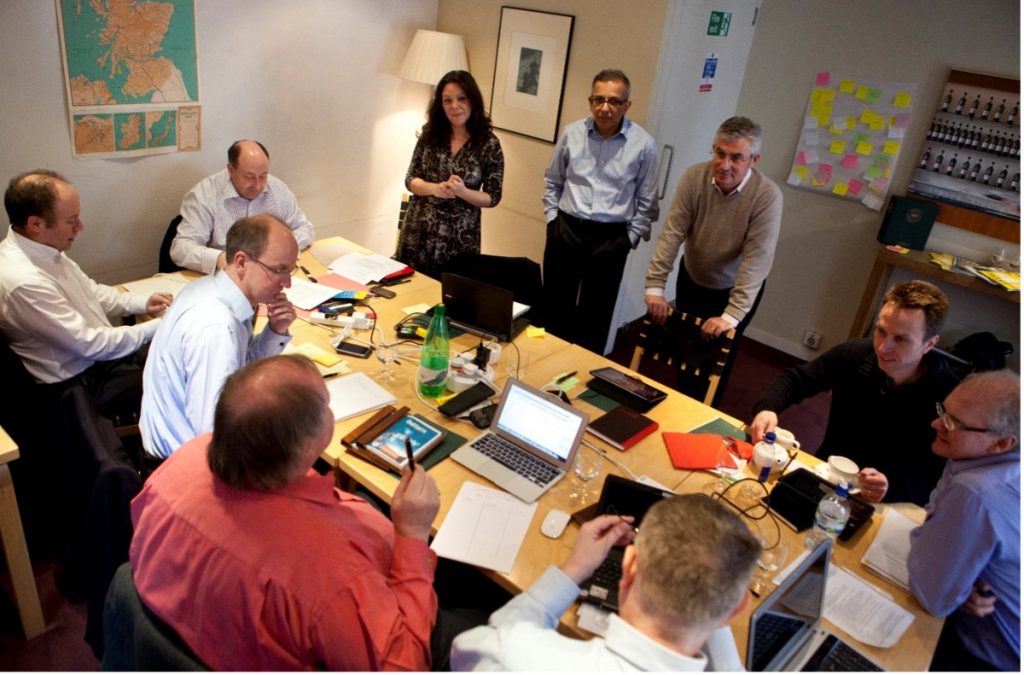
    Our first ‘strategy’ session. The line-up has changed a bit over the years. This big question of the day being; what do we call ourselves!

    Our first think tank session was held above the Whisky Society in Greville Street, London. At this session we shaped the company and worked on how we would translate our beliefs into an operational company and also how we would brand ourselves. A lot of debate, but honestly no whisky, went into coming up with a strap line that, when all the other fancy options were discarded was simple enough, Mobile is our Thing. No getting away from it, if anyone wanted to know what we do, “mobile is our thing” was the answer. We decided against Mobile is our Thing Consulting Ltd though! Having gone through three complete packets of post-it notes we weren’t getting any closer to producing a company name that we all liked. 

    Progress was so slow that at one point we were remarkably close to calling ourselves Greville Associates simply because we were in Greville Street, but we knew we could do better, so we persevered.  We were looking for a name that was clean, elegant, short and memorable. We also favoured names as near to “A” as possible.  Out came the A to Z of London and despite the immediate feeling of trepidation from the sheer number of roads in London, Azenby quickly emerged as the name we had been seeking and the rest is history.  The choice was actually based on some solid thinking from our brand guru, but there were also a couple of nice coincidences that made it clear Azenby was right for us.  It turned out that our chairman knew Azenby Road as he told us: “It’s in Peckham – my son has a flat there.”  “Peckham?” said our newly elected CEO.  “I was born in Peckham”.  We couldn’t ignore these happy coincidences could we? 

    This is to simplify things somewhat and doesn’t do justice to the whole process our then brand Guru, Julia put us through. In fact, Julia insisted that the first blog we published should tell the story of our branding (and in a much better way than we just did above). For those interested in branding and marketing of tech companies the blog is here.

    2012

    10 years is a very, very long time in mobile. Looking back today and thinking  about the landscape in 2012, so much has changed and yet so much looks the same. Mobile World Congress was held at the Fira de Barcelona Montjuïc that year before the move to the Fira de Barcelona Gran Via, (without the much-promised metro link being ready). The move was all about providing more space and the new venue was 50 per cent larger which the GSMA had no problem filling out. Mobile was still booming in 2012 even though the economic backdrop was about downturns, credit crunches and declining mobile revenues. The theme of congress that year was Redefining Mobile. It was left to each of us to decide exactly what mobile was actually being redefined to or as some cynics – and there were many – were heard whispering: “redefining mobile – as a utility!” Although we felt that mobile was continually redefining itself and always will, there was a real feel of a wind-of-change in the air. 

    3G had been rolled out but the early, much hyped, optimism of new services and revenues had evaporated. It seemed the one lesson learnt above all else from 3G was the need for better, more thorough and more rigorous business cases behind technology upgrades. The talk in 2012 was then all about LTE, possibly because the mobile world wanted to forget 3G and hope that things would be different with LTE. There were also cold winds blowing into conference from the new exhibition hall called App World. It was the time Apps went mobile and the mobile operators were beginning to realise that if they were not careful, their shiny new LTE networks might turn out to be the ideal platform for those with the aspiration to eat the operators’ lunch. Would the Apps be the catalyst for growing mobile revenues?  Or would they bring new services over-the-top of the carrier and take the lion’s share of the new revenues that LTE promised. Indeed, Eric Schmidt announced at congress that “there will be an Android in every pocket.” The writing was on the wall but not all industry readers could decipher it.

    The focus on the device market had now fully moved to smartphones. Apple had only got as far as the iPhone 5, and there was no LTE in that, but this did mean that Nokia’s dominance of the phone market was already waning. In terms of overall global device market share, including feature phones and budget phones, Nokia were still the leaders. To bolster high-end device sales, Nokia launched the 808 PureView, a new phone with an impressive 41-megapixel camera. This was early in the era of a camera with a mobile phone included and at the time the iPhone 4 had a relatively paltry 5-megapixel camara. Where did it all go wrong for Nokia? Well, the Nokia device ran on Symbian if you need a clue.

    Meanwhile, although SMS was still the king of messaging, the mobile operators knew a refresh was required and a little late and with limited enthusiasm backed the Rich Communications Suite (version 5!) as the answer. Oh dear! Door left open; WhatsApp jumped in.

    To compound matters, the EU Commissioner for the Digital Agenda at the time, Neely Kroes, was certainly the bête noire of the MNOs and told operators in no uncertain terms that reducing roaming charges and termination rates are still the big issue for the industry. Vodafone CEO, Vittorio Colao, made a call for the EU to: “Get on board and help create jobs by supporting mobile in Europe.” 

    Kroes was unmoved and issued a robust statement in reply. Specifically called “A message to Vittorio and Vodafone,” she said that she was: “Calling Vodafone’s bluff,” “Takes the side of the Vodafone customer” and “Doesn’t respond well to threats.” We all know who won this battle – roaming rates continued to be driven down to the delight of consumers but leaving the operators scratching their heads and wondering how to make their sums add up.

    To summarise the mood of the times, MNOs were concerned about falling revenues and the cost base of networks being too high, putting pressure on margins and EBITDA. Some could see that the business cases for LTE were being threatened by regulation, OTT services and painful spectrum charges. Many operators knew that the time had come for radical measures to reduce operating costs and future capex. Active RAN sharing was gaining momentum and that was exceptionally good news indeed for Azenby because our Chairman, Emin Gürdenli, had been the driving force for the world’s first large-scale active RAN share (between T-Mobile and Three) in the UK. Other operators looked at this experiment and saw not only a massive saving in network costs but also a big uplift in network coverage by picking the best sites from two networks. The world was ready for network sharing and Azenby was ready to help. We cut our early consulting teeth on RAN-share assignments, and this took us all over the world. We were up and running!

    Our work over the last ten years

    We’ve done a lot of varied work over the last ten years and our assignments have taken us around the world, from Australia to the Middle East, Africa, the USA, India, and Kazakhstan to name just a few countries. We have worked with mobile Service Providers, MVNOs, equipment manufacturers, regulators, transport authorities, law firms, trade associations and even government agencies. We have surprised ourselves sometimes how varied our client base became.

    To increase our depth and breadth of capabilities, we have also been proud to assemble a group of Associates who we have been able to call upon when needed to provide additional specialist expertise and capacity when needed. This has allowed us to cover even more bases and to give better language and geographical reach. We are honoured to list our Associates as part of our valued team. 

    We have given our passports a good pounding having worked now in thirty different countries, and we have hit the half-century of clients as well. What is it that has kept us so busy? It’s been a mixture of things. We certainly have a rich vein of expertise and experience across the mobile network space, but we wouldn’t ever contemplate telling a client we know more about their business than they do. If we were to put our finger on why our customers came to us and returned to us, we would sum it up along these lines. 

    Over the last 20 years the industry has been through some severe right sizing of staffing needs and part of this process has included the outsourcing of many disciplines, particularly in engineering and operations. 

    Consolidations have occurred from initiatives such as infrastructure sharing right through to complete mergers. Mobile operators in particular have optimised their in-house resources around their strategic imperatives including dealing with new technology upgrades. What we have found over the years is that some have underestimated  resource requirements needed to deal with the more routine operational and engineering processes and projects. Often these are one-off pieces of work, like a RAN share project, an outsourcing process, a renewal of an outsourcing contract for example. 

    Getting these done efficiently, reliably, and affordably, has been a central plank of the value we have brought to the industry. Filling a gap to enable  an urgent piece of work is part of our value proposition.

    That’s not to say that all our work has been in this category. Far from it. We are very proud of the work we did with one European based broadband and ISP who wanted to enter the mobile market from scratch. This client had a lot of business expertise and entrepreneurial drive but, not surprisingly, they had no mobile networking expertise. We were trusted to help this client produce a rigorous and robust business plan that had to be approved by a very active and inquisitive board. Having decided to proceed we were central in the engineering design, selection of host MNO and contracting of services. Knowledge transfer was an important part of our remit and as the client started to bring on their own resources we worked very closely with them for a successful hand over. This MVNO is now one of the largest is Europe and growing at an impressive rate. We are very proud to have been an important part of its early development.

    As we mentioned earlier, Network sharing agreements around the world have been one of our main specialities over the last 10 years. Two, three and even four-way sharing with a range of technologies and commercial models have produced numerous challenges, but it is always good to see projects mature that we helped direct and set off on the right path. We have also been asked to get involved with sharing arrangements that have already gone wrong, helping to tackle the tricky issues and get things back on track. 

    Procurement of technical equipment and services is always fraught with danger for operators. You would have thought that as mobile networks mature around the world, a consistent model for the purchasing of equipment and services would have emerged. That it hasn’t, is testimony to the fact that whilst the ingredients necessary to set up and run a mobile network are well known, the procurement process used by each mobile operator tends to be different for a whole range of reasons that need to be understood on a case-by-case basis. The Azenby approach of working closely with operator teams to enhance and support the decision making and execution has proved highly successful across multiple markets. 

    Without a doubt, one aspect of Mobile Operators’ business that has been a constant over the last 10 years has been to outsource various aspects of engineering and operations. These outsourcing arrangements have been another area in which we have been particularly active.  Sometimes it has been an all-new outsourcing initiative where our client has previously performed the function itself using in-house personnel. On other occasions, it has been a 2nd, 3rd or even 4th generation outsourcing arrangement where an existing contract is coming to an end.  In this latter case, the decision to renew or replace is important, but even more important is the need to use that moment to strengthen and improve the fundamental approach taken to the outsourcing.  In our experience, we have found more operators dissatisfied with the outcome of their earlier outsourcings, whether it be performance or costs or both, than satisfied. 

     We all know, mobile networks are complicated beasts, and the various vendors offering services have sales teams that can sometimes seem particularly skilled at telling a good story when they are pitching for work, but a totally different picture emerges  when the legal documentation appears, or the actual outsourced activity starts.  Often our role has been to hold vendors to account so that the pitch and the contract are consistent.  Beauty parades, rigorous site visits, detailed statements of requirements, and careful evaluation of written responses, have all been grist to our mill as we have helped various clients cut a clean path through the outsourcing jungle.  In recent years we have supported large European operators outsource and/or offshore various aspects of their operations activities from drafting tender documents, through vendor selection to transition of services.

    We have also recently had some success in supporting government projects to improve rural coverage and helping to negotiate agreements between MNOs on how to deploy and operate shared networks to these areas.

    Keeping an eye on the industry

    We have posted frequent blogs on our web site over the years. Some of our blogs have been quite radical, others even foresaw the future, although most didn’t. In a very polite way, we disagreed with the way that moving the emergency services from TETRA to a public mobile system was being done. It’s been interesting to see from our original blog on the topic just how things have moved on in various countries in the last five years. I guess it is fair to say the UK is still using TETRA and looks like it will continue to do so until 2026!

    We also couldn’t help blowing our own trumpet when one of founders received an OBE or for that matter when he also became a Fellow at ETSI. Then there is the small part we played in the mobile exhibition at the Science Museum in London.

    The next 10 years

    We have enjoyed our trip down memory lane but looking forward is what we do best. There is a good reason that car windscreens are large and rear-view mirrors are small. The important stuff is in front of us. Expecting the unexpected is something the mobile industry has always had to deal with but in today’s ultra-competitive fight for customers, new revenues and growth, there are often crucial tasks to be handled yet limited in-house resource available to get the jobs done. 

    A trusted, independent, high expertise outfit like Azenby can be just what the doctor ordered – or CTO, COO, CFO or CEO come to that. Getting “must do” jobs done reliably and affordably is our trademark so if you have a problem, and you need it fixed quickly, you need the Azenby team. 

    We’d love to hear from you so why not get in touch.

  • What do we want from telecoms in a liberated Brexit era?

    In the beginning, telephone service was very simple. A monopoly service provider provided us with dial tone, and we could call another subscriber (not customer in those days) and talk. Things have changed a lot since then of course, mainly in the last 37 years since telecommunication services were liberated and BT privatised. Another major change is looming. Openreach (the access network arm of BT) tell us that they will switch off the Public Switched Telephone Network (PSTN) in 2025*. That’s nice of them to let us know and be quiet you cynics who say they thought it had already been switched off. Really this has been coming for years and it just means technology dictates that we no longer need a telephone exchange controlling and switching calls between fixed (wired) devices and – as we all hope – we see old copper wires replaced with fibre optic glass. We read that as many as 40% of people in the UK no longer even use their ‘old’ wired phone preferring to use their mobile device or an internet-based voice application. The internet will be the platform for all telecoms in the future and the future is here right now. 

    All this is driven by economics as that old telephone exchange isn’t cheap to maintain and operate and although engineers have worked minor miracles in ‘stretching’ copper to increase bandwidth for data applications, a step function change was needed, and fibre optics fits the bill. Now any licensed operator can provide telecoms services but the cost of putting fibre into homes and businesses isn’t cheap. Without direct financial support from governments (as we seen happening in many parts of the world) the pace of the switch from copper can be slow as a plc has to make the finances work and the capital bill is very high indeed. This is perhaps one reason why the UK lags the rest of the developed world in fibre access. The recent decision by Ofcom to allow Openreach to charge other service providers what they like for wholesale access  – as opposed to the previous capped rate – seems to have given BT a new lease of life and appetite to finally go big on fibre.

    So, this got us thinking at Azenby about what we want from a new modern, liberated, open telecommunications market and from a UK perspective, how will Global Britain shape up outside of the EU?

    I think we need to start by remembering that it was, somewhat perversely, a European collaborative programme largely lead by the UK that led to the first real paradigm shift in global communications, GSM or 2G as it later become known. That all seems like ancient history in the Brexit world, but GSM became the first global standard for mobile communications and is still the bedrock of all mobile services today. 5G can trace it roots right back to GSM. The formation of GSM included the specification of the services to be carried over the technology. That seemed a very natural thing to do for the forefathers of GSM as they were – all bar one – existing PTTs with very much a carrier mindset. 

    The services were simple enough, voice calls, call forwarding, call barring, call waiting, but enough to kick-start the mobile market. There was data service as well called short message service which very few in the mobile operator world believed in at the time and perhaps tells us much about how PTTs viewed new services (or didn’t in this case!). 

    Then the revolution happened. We are still not sure if it was intended or a victim of the laws of unintended consequences. When the work for specifying the next generation of mobile services began, a coming together of global standards bodies happened to create the Third Generation Project Partnership (3GPP). A very good thing it was with an ambition to drive economy of scale in network equipment and devices, both of which were paramount to making mobile affordable and globally accepted. 

    One thing that 3GPP also did though was to decide that the standards group would specify only at the bearer level and that services would be left to the service providers to decide on. This had some merits as it was intended to lead to innovation in new services and allow service providers to differentiate themselves in the marketplace which it clearly did but not from the Mobile Operators.  

     It also meant that no one even thought about how 3G would deal with something as simple as a voice call, after all, a voice call is a service! Cue mass panic in the operator environment and a scramble to try and get voice over IP working.

    Whether this ditching of services was a result of MNOs sleeping on the job at the standards body or part of a greater master plan of which we still haven’t seem come to fruition, the genie was out of the bottle and mobile operators slowly became the dreaded dumb pipe and services were applications provided by others and the rest is history.

    Coming right up to date now our mobile usage is made up of three components. Buying a cellular access bundle, getting hold of a device, and using applications for services. Voice is an application supplied by the mobile carrier but also available through many other apps as well, the mobile device can use other wireless connections and for some users, WiFi is the default as it’s often regarded as free, and with this the relevance of the mobile operator diminishes.

    So, what does all this tell us about what will happen after the great PSTN switch off? Most likely our internet service provider is probably just the access provider, and we use whatever devices and applications we chose. Fixed wireless conversion finally happens. They are both simple transparent access technologies which isn’t how mobile operators and Telcos planned it.

    The big question is what do we, the customer, want from this new era of telecommunications if anyone bothered to ask us? We’ve been thinking about this at Azenby and accepted that the market will continue to be the ‘over-the-top’ model with carriers fighting an access battle and application providers fighting for services and gaining the lion’s share of the revenues. Given the money follows through the services, not the access, it’s no wonder that we are now in the era of the tech giant, and the once almighty PTTs are a way off the top of the food chain. For access we want speed (actually we seem to want to more speed from our broadband than we know what to do with), reliability, universal coverage, and a low price. Access is a commodity following the utility model. We take access for granted because what’s important is the services (apps) we want to use.

    There are millions of apps out there and we are free to pick and choose whatever ones we want. What’s wrong with that? Well, nothing until some become so dominant that they are the de facto supplier of a service and create barriers of entry to new players. The app market also has one very significant trait. We expect apps to be free and herein lies the danger. Free apps come at a price and the price is ticking that box that says we have read the terms and conditions and accept them. Who amongst us actually reads these terms? Have a go; they are often written in legalise, run to thirty pages, and contain links to all sorts of other policies such as the privacy notice. And what if we don’t like the terms? They’re non negotiable so tough luck if you don’t want every search entry indexed, if you don’t want to be profiled and have whatever you do on the app spied on and details about you sold to any old third party. This is the cost of free apps and a whole generation have grown up used to this model, even if few truly understand the implications of it.

    We also see the emergence of the tech giants, who stray into political influence and policy, having little effective regulation. An example of this is the banning of users that expound views which apparently are against the policies of the tech giants, the most notable being ex US president Donald Trump. It may well be that you don’t agree with Trump’s publications (I use that word deliberately to represent a tweet) but equally do you agree with a random set of unelected, executives who are not answerable to anyone being able to muzzle him ? It seems that China has recognised this and is reigning in the power of the Chinese tech giants as we speak. Perhaps this is one case where the West should take a lead from China.

    So, in thinking about what we want in the new era, a trusted, private, and safe environment seems first and foremost but in a market made up of so many players, how will that come about? Maybe the market will evolve or maybe regulators will intervene. We have doubts about both of these either happening or being effective. Perhaps a new type of application provider emerges. Ones with simpler, old fashioned business models that ask us for pay for the service we use rather than making their money from data mining and what they learn about us. Perhaps these players will be more open and honest about the data they want to compile about ourselves, and what they want to do with it. That almost seems like where were before the internet came along but we don’t for one moment suggest we abandon the new technology; we just suggest that the technology be a little more subservient to us the user rather than app developer.

    Covid has shone a bright light on this whole area with internet access and remote working being suddenly thrust into the mainstream, speeding up a longer-term trend and probably knocking 10 years or more off the evolution of flexible working. This accelerates change, not only of the mobile networks who have become essential services providers for increasing numbers of customers but also the over-the-top services providers who are being pulled into the world of controls, responsibilities and regulation that have previously been noticeably absent from their business models. 

    If you would like to spend some time thinking through how we can help you find new revenues in the mobile internet era, why not give is a call.

    * A note for those worrying about the phone in the hall. Old landline phones will still work after the network changes, and no one will need to change their phone number after the switch off. Get ready to plug your phone into your router though. If you have no internet connection (you won’t be alone) Ofcom has told us that you will to be able to buy a ‘simple connection’. We may all need to buy a new battery back-up though because whereas our old PSTN carried on working in a power cut out router at home will not.

  • Are your Network Performance and Quality KPIs really helping your business?

    This is a scene familiar to many a heroic Network Operations Director/VP – and I speak from experience.

    Your boss, maybe the CTO, maybe the COO or CEO even, is setting your departments objectives for the coming year which translate into your own personal objectives and most likely the criteria for an annual bonus. Your boss has done a bit of reading on this, maybe spoken to the Head of Marketing, and decided that network availability should be 99%, dropped calls <2%, average network throughput per customer X and latency Y (fill them in yourselves).

    There are three responses our heroic head of Network Ops can come up with.

    The meek – ‘thank you sir/madam, I’ll do my best…………………’

    The subjective – ‘yes, they seem about right’

    The objective – ‘hang on a minute’

    The objective response is perhaps the brave or foolhardy response career wise, but it is the right one, nonetheless. And the reason is simple enough. A critical question needs to be asked. ‘Who else in the organisation is sharing these network KPIs?’ 

    Now just maybe you are working in an enlightened MNO/MVNO, and the business Key Performance Indicators have been holistically derived and there is evidence of a lot of joined up writing between the various directorates and departments. If you are, you have my congratulations, but my experience tells me that you are in a minority. During my time I have had many meetings and encounters with CTOs, and Network Ops Directors/VP  around the world and one consistent theme I have heard from so many is that network performance metrics are applied only to Tail End Charlie, the long-suffering head of Network Ops. Quite often this assignment, should they decide to accept it, is indeed mission impossible because the true network performance has been set in concrete long before the ops guys and girls get their hands on it.  Here is common mistake number one, network performance comes through design, procurement, and implementation. 

    Ops can only maintain the network to the standard it has been designed and built to. Determining the right network performance indicators need to be the start of the network quality journey, not the end of it. Deciding them last means that the resulting measurements tell you how good the engineering design and build quality is and not a lot about the operational excellence of your Ops team.

    I think that there are three steps to having a set of KPIs that work for a  Mobile Network Operator and Service Provider. One, get them right up front, two, make sure the whole company is signed up to them and thirdly, monitor and report them correctly, taking corrective action when necessary.

    So, what does best practice look like? It does exist and I’ve seen it on my travels (but just not often enough). It should start with the Sales and Marketing department(s). This is step one. They should answer  questions like these:

    • What quality of network do we need to be competitive in our marketplace? This applies to new customer acquisition as well as churn prevention.
    • What price points do we need to hit for profitability? This determines the size and quality of network that the Service Provider can afford to build.
    • What sort of customer experience are we looking for? Cheap and cheerful or Rolls Royce? What does “good enough” really look like?
    • How many customers over what time are we shooting for and what will their various user profiles look like? What do those customers really focus on? This will help with the correct dimensioning of the network which is a crucial component of the end-user experience.
    • Do we want in-building coverage as standard, and what sort of rural coverage is required and how extensive should the footprint be?
    • What services do we want to offer customers now and in the future?
    • This is then all baked into the company business plan and costed accordingly.

    Using the wrong KPI’s can even damage your profits and business, as the outcome may be completely inappropriate!

    I’ll talk more about setting the right targets later in this blog.

    Another common mistake is to adopt what I have often heard  as being called industry best practice and/or a set of performance indicators derived from standards body recommendations. Whilst these are useful they are not a one-hat-fits-all set of KPIs that work for every MNO and in every market. I worked with an operator in a developing market who was the third entrant in the marketplace. The business wasn’t performing very well, and this was put down to the network performance and I was asked to come in and do a review. I discovered that they had adopted a gold standard set of network performance KPIs and they were indeed falling a long way short of achieving them. It was a tough operating environment, many base stations were off-grid, subject to power outages and theft and vandalism, and all the back haul needed to be self-provided. 

    Even the world’s best Ops team were never going to meet the KPI targets that had been set for the Ops team. Here is the relevant point though. The market leader by some distance had network availability of 70%. The target for my client was 98%. Standard textbook target! Although they were well short of their own target they were still outperforming the market leader by some distance. This wasn’t translating into new customer sales though. The market leader was streets ahead in branding, channels, tariffing, and distribution. They were regarded as having poor customer service and people accepted that they were not the best network nor the cheapest, but they were still the dominant market leader. No amount of network performance KPI tinkering was ever going to solve their true market problem.

    The lesson is to make sure your network performance KPI targets are right for your market and not out of a textbook. Marketing should have defined the product, and this should be the standard required for the business to succeed. Having the wrong KPI targets identified from the beginning is a common mistake, as is having too many performance indicators and what makes some of them ‘key’.

    Working through the process for getting the network that the business needs, the Network Engineering department now need to design and dimension it. Here we often hit common mistake number two. The Engineering department gets down to designing the network in detail and before too long is attracting the attention of the CFO and Financial Controller because it looks like its going to cost a bit more to build than the business plan can take. There are three fixes. Downgrade the design (and tell Marketing, who immediately reduce their revenue targets), tell Procurement to get better pricing, and finally take out the luxury items like operating tools and systems and maybe a few less spares (but don’t tell Ops). 

    After an often-tortuous process, a network design emerges, and mistake number two needs to be avoided at this stage before it’s too late. Can the Engineers demonstrate, at least in theory, that the network they have designed can meet the KPI targets – assuming they have been pre-set and agreed. In the case where they haven’t been  set and will be ordained  when the head of network ops arrives on the scene, it doesn’t matter anyway because it’s going to be his or her problem but in a best-in-class scenario, Engineering should be able to show all the link budgets and equipment MTBFs (Mean Time Between Failures) that demonstrate their design will deliver what’s needed. Include in this resilience and  N+1 of critical nodes. I can’t stress strongly enough, the foundations of network performance is by design, not by operation.

    Let us move on the next step in the process and identify another common failing. Procurement. The US astronaut John Glenn, who sadly died recently, was often quoted as saying ‘I felt exactly how you would feel if you were getting ready to launch and knew you were sitting on top of 2 million parts — all built by the lowest bidder……’ 

    Its procurement’s job to get best value for money. They are usually incentivised by how much money they can save in every product and service they buy. They’re generally quite good at it as well. What I rarely see is a procurement department incentivised equally to own part of the network performance – and they need to be. It’s too easy to cut essential operating functions from the procurement specification to reduce the bill but it is a false economy. We know of one Operator who thought that they could the halve costs of infrastructure compared to their competitor, until they discovered that they had built in no redundancy.

    There are at least two other big departments at work in delivering the network. The Property Group who need to acquire the sites for base stations and the Implementation department who build the sites. You’ll will have guessed what comes next. How are they incentivised? Generally speaking, on speed and costs. The property people have a difficult job for sure, we all know that. Acquisition of sites is tough and getting tougher in some markets. Nonetheless, they also have a crucial role in helping network availably. In many MNOs I have worked with, the biggest cause of failure to hit network targets is inability to access sites quickly for repair. How may times have I seen a KPI specifying that faults must be attended to within four hours at a site with no weekend access? Lots is the answer. Next is climb to repair where permits and supervision is required and both take days to arrange. I do know that these are sometimes conditional restrictions in a site lease but let’s at least factor this into a network availability target.

    Meanwhile, as soon as a site is acquired, the implementation teams need to get in and build and install the equipment. Speed is of the essence. Construction quality is often treated as nice to have but lack of it creates problems downstream. Inadequate antenna mountings, microwave dishes that go out of alignment in the wind, poor connectors, badly aligned antenna. Take your pick. Could the Ops team get a credit for every network outage caused by poor build quality? Nice to try! In many cases these activities are outsourced or contracted out to specialists in this field which is often a very sensible and pragmatic solution. In doing this though, make sure the contracts are written so as to achieve the required elements contributing to network performance targets and, crucially, make sure top class contract management is in place.

    At this stage we are approaching the point of hand-over to Operations to bring the sites on stream. In realty they have little choice but to fire up the site because who wants that investment sitting there not earning money. In an ideal world there would be a comprehensive test of the site and some quality controls carried out on build and access. In a lot of networks this is done on a random basis – if at all. I have rarely seen a site sign-off that says this site will perform according to the Company agreed network performance targets. Isn’t that exactly what the testing regime should be all about before  a site is brought into service?

    By now you may think I am letting the Ops team off lightly but they also have a big role to play. Operations is an overlooked science and requires mastery of logistics, mobilisation of staff and third parties, really good people, a great understanding of the network design (well documented in an ideal world) and a good understanding of all the interdependencies when things do go wrong. Yes, network faults happen but rarely is it due to misoperation but no excuses when it is. An essential part of operations is to identify immediately, and before the customer does, any network failure. This is largely the responsibility of a Network Operations Centre and in todays multi technology generation and sophisticated networks having the right and tools and systems is essential. I would say that this is part of the network engineering. Its very hard to retrospectively integrate tools and systems if they are not designed in from day one.

    I do fully appreciate that in many business models some or all of the above functions are outsourced. Today we see virtual networks operators emerging with the complete design, build and operate of the network outsourced – often to the vendor supplying the equipment. In some cases they also supply the financing, so we move into a tricky area here. How much control can the Service Provider exert on a major vendor when that vendor is both gamekeeper and poacher? In scenarios where some or all of the network disciplines are outsourced, links with the design and deployment activities become more remote and more difficult to rectify. This makes the need for a common, and right set of KPIs even more important. The outsourced supplier(s) need to be tied into delivering the performance targets that the business needs.

    I hope I have made the point that response number three from the Head of Network Ops I made right at the beginning, is the right one. Their job is to maintain the network to the quality level it has been designed and built to achieve. No one  can operate it at a higher level no matter what objectives are given to the Ops people. Setting network KPIs are crucial but they only work for the organisation when they are used correctly so let’s move on to what happens next and assume that we do have an across the board set of network performance indicators, and that we have selected the key ones and now we want to use them to monitor company (not just network ops) performance.

    How we use the KPIs to improve business performance is important because surely that is the whole point of having KPIs. I started by saying the performance targets needed to be baked into the whole company ethos. This is true and for this to work it is necessary that each KPI has a detailed definition and explanation. I have seen the same network performance metric measured in five different ways in a single network and different results sent to different parts of the audience. I have even heard it said that Finance need network availability measured this way and Marketing want it measured a different way and the regulator wants is measure in yet another way. Quite extraordinary when you think about it. Get the definitions of each KPI well documented and the methods used for measuring them. It’s never too late to do this, even if you have been running a network for many years this is a good health check. This is important because not only does bad reporting of KPIs trip a business up in terms of its perceived performance versus the customer reported experience, it also can drive opex and capex spend in the wrong places and that is really not what any business wants.

    Examples of this are applying the same KPIs to the busy hour as are used in the night-time low traffic periods. Including planned outages in the availability result when these are done out of hours. Reduced capacity outside the busy hour being included. Do you need the same level of network performance in all cells as opposed to the 20% of cells carrying 80% of your traffic ? Does deep rural coverage need the same performance level as city centres? All of these can result in a lowering of the overall 24-hour network availability, but do you really want to be spending money on the network to improve out of hour performance or very rural coverage when it is hardly noticeable to customers? There is a level of sophistication in the definition of KPIs that is essential to being able to make them work to identify the areas for  business improvement.

    Once the KPIs are the right ones for the business and they are being measured accurately, the last element is the call to action when they are falling below design targets. This only happens when the KPIs are owned by the CEO/COO as they should be. It is no good leaving the KPIs to Ops to manage. This goes right back to where we started. The diligent Head of Network Operations will have persuaded his boss that that these are business targets, not just Ops targets, and that the business needs C level monitoring and ordering of improvement programmes when missed targets are identified.

    Finally, KPIs need to be living metrics. They should evolve with new technology, with network growth and expansion, with new services and last but definitely not least, changing market and customer expectations. If you have the same basic set of network KPIs as you had 10 years ago, maybe with a few new data related ones thrown in, I suspect they are in need of a serious overhaul! Network KPIs need an annual review as part of the annual setting of the company operation plan. When was the last time your company did a comprehensive review of  your KPIs? Be honest!

    At Azenby we can help. It does sometimes help to have an independent third eye looking at the network  KPIs being used in a business, how they are defined, monitored and used. We believe that network performance KPIs are a force for good and should be helping a mobile operator to produce the best network performance that it can, but we have also seen them damage a business because they are not the right ones, are badly monitored and poorly reported. We have 300-man years of experience in engineering and operating mobile networks and if you think you could do with an MOT of your network KPIs, why not get in touch and we’d like to talk it through  with you.

  • Mobile Coverage Wars are back again

    Those of you with long memories will remember that back in the 1990s the walls in all mobile phone shops were plastered with coverage maps. Coverage was king and the mobile operators all wanted to show the extent of their own mobile coverage and that theirs was the best, widest, deepest, most extensive. Coverage maps are long since gone of course and these days you pop your post code into the operator’s website to see what the predicted coverage will be. Predicted being the operative word here, especially when it comes to indoor coverage. It’s a handy guide but really doesn’t help when what you need to know is how well the mobile device will work in all the places that it will be used.

    We tend to think that coverage is a given these days and we accept that some networks work better than others in some places and not so good in others. This process of self-optimisation tends to teach us the best network for where we use our device the most. The mobile operator advertising pitch has long since moved on from coverage to the latest technology, the data rates, and how much data you can get for your money. But is that all about to change? At Azenby, we think it is.

    5G is here. Hooray. Gosh, the new shiny 5G devices don’t come cheap though do they. £75 per month on two-year contracts or the best part of one thousand pounds for a top end Apple or Samsung device. What do we want for all that money? As consumers we want even faster data rates, we think. We want a better data bundle. What we probably need though is to stream high quality video and not be staring at the spinning circle of hell. We also want this to work inside buildings, whether it be in the home, the office, the coffee shop, the train and bus, or the pub. And here lies the new coverage challenge for mobile operators. 5G has to work inside buildings. Not just for the consumer but also for the business user, the enterprise user and crucially, for IoT applications.

    In building coverage has always been the big challenge for mobile operators but now in the 5G world it is the new battleground where customers will be won and lost. Mobile Operators have hitherto largely relied on their radio coverage prediction tools to estimate in-building coverage but they have done so in the full knowledge that this is an unreliable method as the construction and internal dimensions of buildings vary greatly and therefore the true in building coverage can be very different to that predicted. That is a problem for 5G services buyers. The only way to really know how good in building coverage is means getting into buildings and testing, which is not a cheap exercise and also has logistical problems to overcome as well.

    At Azenby we think the winners and losers in 5G will be determined by who succeeds in providing the best in-building coverage. Not just the best, but really fit-for-purpose 5G coverage. This is not a simple challenge for mobile operators, and some may even leave the in-building problem to others to solve or to rely on WiFi piggyback. We believe those that chose this route will be in the loser’s camp. The new coverage wars, the battle for in-building supremacy, will require new strategies and a new mix of macro and micro layer coverage. It will also require more spectrum of course and in this regard the 5G spectrum at 3.4-3.8 GHz and in the 26 GHz band is a mixed blessing. Yes, it enables services requiring wider bandwidth and for ultra-dense very high capacity networks respectively, but – and this is a very big but – neither band is well suited for penetrating buildings and providing good coverage from the macro network. True, there is some spectrum at 700 MHz and operators can re-farm some of their existing 900 MHz and 1800 MHz spectrum for 5G but 700 MHz is not plentiful and existing spectrum has be managed very carefully to maintain legacy technologies which is where the vast majority of customers are today.

    We have all read the about the exciting prospects for 5G and the new use cases which include not only enhanced consumer experience (enhanced mobile broadband eMBB) but crucially, for 5G investment business cases to stack up, the new IoT applications, Massive Machine type Communications (mMTC) and Ultra-reliable and low latency communications (uRLLC). Not exclusively by any means but certainly the need for rock solid inbuilding coverage will be a mandatory requirement for these devices to have universal appeal and ubiquitous availability.

    That’s not to say that 5G stand-alone outdoor coverage is a cinch either. Working with our sister company SignalScore, we have been looking at early 5G coverage at 3.4GHz and the results show that it is almost line-of-sight (between base station and device), Whereas that should come as no surprise to radio engineers, it does emphasise that working with 5G spectrum presents a whole new range of challenges for mobile operators.

    walk roundIn a simple walk round test in London, we found that 5G SA was available for only about 25% of our route and this was in close proximity to the serving cell. For most of the route the device was attached to a 4G bearer.

    Turning a corner was enough to lose 5G and for the device to drop back to 4G.  Although this was a simple outdoor walk test, we think it epitomizes the added difficulties in providing in-building coverage from the macro layer network for mobile operators.

    The dilemma extends beyond that of the quality of service that mobile operators can expect to deliver inside buildings. For us, the users and buyers of services, we really do need to know that the 5G coverage we need for our own use case is going to be provided where we need it. With top end devices, as we mentioned earlier, coming in at £1k and the need for high end IoT applications to work as intended, knowing what the coverage quality really is in the buildings we want to use the services is paramount. Coverage prediction is no longer fit for purpose. Decisions need to be made on IoT and 5G device investment with the complete confidence that the services will be usable where we want to use them.

    How do we decide on whether the 5G coverage we need is up to scratch? Well first up it is no longer just about the radio signal power level. That is still important, as is the signal quality but there are two other crucial factors that have to be taken into account. One is the data rate, both uplink and downlink, and the other is the responsiveness of the service which is the lag and latency aspect. Our friends at SignalScore have worked on a service that combines these crucial elements into one single score which can be modified for the particular use case in question. We think that this is a major breakthrough for users to be able to go and get a SignalScore for one or all of the buildings that the service is needed for.

    SignalScore has developed an easy-to-use service which allows anybody to walk test 5G coverage in their own office, factory, warehouse, mall, shop, restaurant, pub. Knowing the signal score allows more educating buying by understanding which service provider is proving the coverage you need in the building you need to use it in. It is perhaps most valuable though for those people investing in high end expensive IoT services being used for e-health, transport and logistics, smart networks, robotic, retailing, and smart manufacturing. Of course, outdoor coverage is equally important and SignalScore will measure that too.

    The concept is simple, anyone with no training can walk around the site and instantly see this scored for the three main attributes required for good 5G services.

    walk round 2

    Operators themselves can do the same testing as well and this will help them make investment decisions on how to provide excellent in building 5G coverage to their most valuable customers. The main benefit for operators is that this service can be used as an effective filter to help them decide when a full inbuilding survey may be necessary, saving many thousands of pounds per year on unnecessary full engineering surveys.

    To go back to where we started, coverage wars are back again, and the battlefield has already been defined. We don’t think we will be seeing the return of coverage maps but we do expect to see a more demanding and better educated buyer of 5G services emerging, putting pressure on service providers to up their game and to rise to the new challenge of 5G in building excellence.

    If we can help you get to grips with making sure the 5G coverage you need is fit for purpose why not get in touch with us here.

    About SignalScore

    SignalScore has a vision to enable competitive and secure wireless experiences for consumers and businesses around the world.

    Find out all about it here.

  • Review of the Raging Twenties (The 2020s!)

    It’s been customary for Azenby to write a year-end review of the mobile world but just for a change we are leaping forward to December 31st, 2029 to review the last decade. No, we haven’t found a way of time travel. We just thought that it would be stimulating to gaze into our Crystal Ball for a change instead of looking in the rear-view mirror and have a go at predicting what the mobile world might look like come 2030. Of course, it is pure fiction. Maybe!

    Standards Development Organisations

    Azenby-HT-MagGlass

    Geopolitical fallout at the beginning of the decade continued with the US imposing ever more restrictions on the use of technology from China in critical communication infrastructure and all underlying technology. An already fractious relationship between the two super-powers was intensified with the outbreak of the Coronavirus virus and the Covid-19 disease which changed the blueprint irrevocably for the decade to come. An argument that started with digital security concerns had become a full-blown new cold war on health and human security and that ramped up the stakes considerably.

    The US persuaded more allies in the west, beyond just the Five Eyes, to follow suit and similarly ban the use of Chinese vendors from their national infrastructure. The ban extended to the use of any software code used in any product by any OEM where the code was written in China. Similarly, any component from China met with the same restriction. Indeed, the restriction extended from China to include other countries thought to be hostile to western interests including Russia, North Korea, and Iran.

    The inevitable fall out from this was a realisation in the west that they had fallen behind China in this area of technology and there was a gap to bridge if they were to deliver to consumers and to industry the sort of communication services that 5G had promised at the dawn of the decade. This also brought home to roost that it was not only the manufacturing capability that was absent, which for too long had been blamed solely on the impact of the China price for 4G and 5G equipment eradicating incumbent traditional vendor market share, but also a gap in expertise and Intellectual Property had developed.

    Western governments pondered on this and came to the conclusion that their major Communication Service Providers (CSPs) and their home based OEMs, had more or less abandoned serious participation in the standard body behind 5G (and 3G and 4G before that) and left the development of the crucial standards – and the ownership of critical IP – to Chinese manufacturers who had swamped 3GPP for a number of years and completed a peaceful ‘coups d’état’. Operators and manufacturers alike had sleepwalked into this position. Regulators and governments hadn’t seen it coming; indeed, some had been actively courting better relationships and internal investment from China since the start of the new millennium. The unintended consequences of this had come home to roost.

    The answer, they decided, was to start a new standards body for communication standards to replace 3GPP. Led by hawks in the USA, determined to ensure that US-based manufacturing would be able to rebuild and gain a dominant position, they created the new 6th Generation SDO called ATIS6G and invited partners in the West to join. The first thing they did, which in hindsight was a master stroke, was to end backward compatibility. Controversial as this seemed at the time, it did take out a lot of complexity from the standard, reduced development cost and had a dramatic effect on the time to bring the standard to the market. It also meant the engineers could spend more time and focus on the major goals and benefits that had been identified and not to worry themselves about hard to resolve backward compatibility issues. The goals were identified as ever faster data speeds, lower latency, spectral efficiency, dispersed data storage, broadcast, one Operating System for device and network, and enhanced cyber security built in. They also followed up with an IoT variant of the standard but ignored the 5G URLCC option, believing at the time that it was fairly pointless in practice. Removing the complexity in the new standard caused by the need for backward compatibility, resulted in lower costs of wireless access points and together with the merging of mobile and fixed cores, meant the inevitable amalgamation of the new standards body with IEEE, and the consolidation of WiFi and Cellular standards.

    Meanwhile the EU bloc, sensing it could be vulnerable to the new standard, was also aware of the need to create an industrial advantage for its own manufacturing base and, hankering after the glory era of GSM, was determined to recreate the environment that made GSM a global success story and resulted in Nokia, Ericsson, Siemens, and Alcatel becoming dominant suppliers to Europe and beyond. The schism that emerged between France and Germany was inevitable as the French were determined that ETSI should be the SDO responsible for a new standard as they still regarded ETSI as their baby. But with ETSI still at the time being a part of 3GPP before its disintegration, that just wasn’t possible.

    Germany and the Nordic countries saw the need for a new dedicated European mobile standard and created the EU7G Programme. They agreed that backward compatibility would end at 6G and that ETSI would remain the standards body for 2G through 5G but have no involvement beyond that. One thing that both the new European and US standards bodies did agree upon was that there would be no IP carried forward from 2G-5G in the new standards. This was to encourage the industry to get radical about technology and be more inventive. They went even further and – taking a leaf out of the early days of Chinese OEM development book – ignored any Chinese patent claims for infringement of IP. This did inevitably mean of course that there was no hope for a vendor’s products in the Far East. In this way, the world Telecoms standards fragmented into regional systems.

    With 3GPP now falling apart as the organisational partners split, it was inevitable that the Chinese body, CCSA, would break away and focus on its own standards developments. That left a dilemma for TDA (Korea) and TTC (Japan) on where to go. Many doubted that they could work together in unison and would seek to cooperate as partners in both ATIS6G and EU7G but the realization that creating industrial capability was paramount, and as we were at the beginning of new standard wars, they concluded that they would instead have to work together and independently of other new and existing SDOs. That just left TSDSI and all the world focused on what India would do. It was seen as a vital jigsaw piece needed by all the new SDOs as India was the world’s second largest market for telecoms.

    The new SDOs were courting, persuading, even bribing India to join with them. Political pressure was being exerted. India pondered long and hard about going it alone and create an Indian Sub-Continent sphere of influence of its own but as that would have needed to include Pakistan it was seen as a step too far. So, given assurances from the USA about pooling and sharing IP, India decided to join forces with ATSI6G with the agreement that at least 30% of the standards development work would be done in India. And so, the stage was set for the battle to commence now between four standards bodies all determined to move the fastest and provide the most advanced and economical efficient communications infrastructure.

    Azenby-Mobiles-LoResIt took time for other countries and regions to decide what to do. Russia decided it was too weak to go it alone, despite failed attempts to do so, and threw its hand in with China to create what came to be known as the Red Standard. Latin America decided against tying itself to its historic relationships and most Lat Am countries, but not all, joined the Red Standard. Africa went more or less with the Red Block as well, making it the largest of the new SDOs, at least in terms of addressable market.

    The new SDOs did at least agree to work together on interoperability and interworking standards. This was driven by a forlorn hope from the dominant device and operating system owners that a single global market for them could be retained. Interoperability, however, was at the very heart of why the 3rd Generation Partnership Project was conceived in the first place and brought the leading SDOs together to create 3G. Consequently, it always looked impossible to achieve any significant degree of interoperability whilst the new four standards bodies were internally focused and also saw the need to be moving fast and certainly moving faster than the other SDOs. They didn’t want the handbrake effect of sorting out interworking. This would have seemed inconceivable in 2019 but in 2020 the world had stopped travelling and didn’t know when it would start again. A mobile device that worked everywhere in the world didn’t seem to be a priority at that time.

    We know now that this fragmentation ended the existence of a global standard for communications and device compatibility between different zones became limited to a small sub-set of functions and capability. Can we say that this was offset by the enhancements made in telecommunication technologies as various standard bodies competed with each other to produce the best in class? At the beginning of this decade a 5G device cost $1k and at the end of it a 7G device has been launched in three markets for less than $200 (at 2020 equivalent pricing).

    Device incompatibility has been overcome by content and data being separated from access to the extent that any device can access a user’s data and this, with the advent of cheap devices, meant that people no longer travel with their own devices and simply use freely available devices wherever they go, inserting their profiles into them with the click of a QR code. How we view devices now is so different from when the decade began, and nobody really sees the way it all happens today as a problem.

    We now see that effective competition between standards bodies increases the pace of technological change and that new technologies overcome the old interworking restrictions we encountered which lead the drive for a global single standard, 90% of compatibility is now provided by OTT apps which let the inter standard interworking happen at a very low ‘access’ level which proved to be relatively simple.

    Coverage
    Azenby-Router-LoRes

    The dichotomy between why a Wi-Fi access point was so cheap (and which users bought and installed themselves) and the cost of cellular access was suddenly becoming front of mind for the industry at the beginning of the decade. Different deployment models underpinned by different business models were becoming increasingly more difficult for customers to fathom. Other factors were also at play in why the two ways of access wireless communications were so different. One of these was the ‘gift’ of an abundance of licensed spectrum at 3.5GHz and that was turning out to be more of a headache to mobile operators. Getting devices to behave consistently over such a wide spectrum range from 700Mhz to 3.5Ghz was one issue but the real issue MNOs were grappling with was indoor coverage. Penetration of 5G and then 6G signals in higher frequency bands into buildings was causing a whole new wave of coverage issues for Communication Providers that they thought were something from a distant past.

    It became clear that cellular radio inside buildings had to be provided by radio access points on the inside. In fact, the industry had known this for some time but chose to ignore it. This could no longer be the case as something happened in the early part of the decade that they were just not expecting. Fibre in the ground was becoming prevalent with a number of players now exercising new business models and investing in putting fibre direct to homes and businesses in urban and suburban environments. The new economy of scale meant that broadband over fibre was competitive and it certainly had better performance characteristics. Consumers and businesses were quite prepared to pay for wireless distribution inside the building and with WiFi sharing becoming commonplace, were becoming less dependent on cellular macro coverage outdoors. The emergence of very cheap Wi-Fi only devices was fueling this.

    The market was changing and for CPs, selling 6G indoor access points to the customers who then sorted out their own backhaul had become the way to go.  Self-provision of cellular access points is now as common as buying a WiFi wireless router was at the start of the decade.

    So, the new era of CP mergers had begun and would reshape the industry for the decade to come. MNOs were buying into or merging with fixed broadband players and fixed broadband players were equally keen to buy cellular properties. As we have now seen, the most successful of this new breed of CPs were the ones that also knew they had to include content in their product offering. Content is where customers perceived the most value and it was content that they were more likely to spend their money on, rather than access. The way they accessed the content they wanted had become commoditized and they just wanted a low price, high bandwidth and no latency.

    This still left an issue for rural coverage. The problem being that although it often made up as much as 80% of the landmass of a market, it only equated to 10% of the population. It was a commercial problem for CPs and also a political problem for administrators and regulators who felt compelled to act to ensure this problem was addressed. Spectrum made available at 400Mhz helped enormously as range was increased from each base station meaning only one 400MHz base station was required to replace eight 800/1900 base stations but the amount of spectrum in this band was not enough to provide the capacity needed for the demand.

    Local ‘private’ 5G and 6G networks were built using newly deregulated frequency bands. These, then, became more widely accessible through neutral hosting in some cases and through national roaming in others. Nonetheless, the economics were still not working for effective competition in rural areas and regulatory intervention in the marketplace was going to be necessary to resolve this. Many differing yet similar schemes emerged around the world from having a state-owned infrastructure company provide the infrastructure through to dividing up areas between MNOs and enforcing national roaming in these areas.

    The bold experiment to use commercial networks for blue light services has been successful but not before going through birthing difficulties and early growing pains. Reserving and dedicating a relatively small amount of spectrum for blue light services together with more sophisticated prioritisation mechanisms proved to be an effective solution combined with commercial networks.

    From embedded SIM to software accreditation

    Azenby-Microchip-LoRes

    The evolution of the SIM has been closely coupled with developments in personal data privacy and security.

    Our accreditation to use services is no longer controlled by all the organisations we subscribe to or register with but is controlled from our personal keys that we keep in our trusted digital vaults and allow 3rd party access at our discretion. What used to be the SIM supplied and owned by the CP became subsumed by these personal keys. This means that we have gained access to services from all devices on one single authentication. Devices have become shareware and commodotised.

    Not only did this allow us to switch service providers quickly and simply but also to use our keys as our personal authentication to many other services, utilities, apps, financial services, and web sites.

    Software SIMs enabled a high degree of interoperability across the four SDO domains and networks deployed on different standards. Our profiles and personal keys are securely programmed into the software SIMs which one selects from a library depending on where in the world one is.

    The evolution of MNOs to Content Service Providers

    Azenby-PhoneChip-LoRes

    As we mentioned earlier the convergence of fixed and mobile kickstarted the search for the 3rd element, content. Since the advent of 2G there had been an uncomfortable juxtaposition of the operator and service provider roles. 2G did embed a set of services into the standard, voice calls, SMS, call forwarding etc. Nothing spectacular but a first set of essential services that 2G should support. Here the role of the operator and the service provider was clear and simple. Both the access to the services and the services themselves were provided by the operator of the network.

    One of the founding principles of 3GPP was that the standards body should only define the technology required to enable services. The Operators were very slow to see the long-term consequences of this and by the time they did, the services ship called OTT, had long since sailed. No services were defined in the emerging 3G standard. White Papers and examples of services were produced but it was decided that the Operators would devise their own services and the provision of services was where the competition should begin, and they would be determined by the operator.

    This meant that the operators now had two functions. To operate the network and also to now develop the services. The first aspect was part of their heritage and core competence. The latter was to be proven to be beyond them. The other crucial factor that 3GPP brought about was the opening up of the network interfaces to allow third parties to provide services. This followed the internet business model of the time. Operators thought that they would be able to control who offered services on their network, but this was just fallacy. The cat was out of the bag and the slippery slope to dumb pipe providers had begun.

    Customer money followed the services, predominantly though the application layer which was totally beyond the control of the network operator. This, for the first time, broke the dependency between revenues from services (or mainly subscriptions) and the investment required to build the networks and create the capacity required for the services being carried. We saw between 2000 and 2020 the impact this had on MNOs as the conventional business model was breaking and the need to dramatically reduce costs drove MNOs to share base station sites, sell towers, share RAN infrastructure and also participate on a round of consolidation and merges.

    In later stages of 4G and through 5G, technology evolution with software defined networks, network function virtualisation and network slicing led to most of the network being implemented in software and located in data centres and in the cloud. Apart from antennas, only RF generation and amplification remained at the physical cell sites.

    New spectrum bands up to millimetre waves, including shared and deregulated use of some of that spectrum in 5G, coupled with network virtualisation and slicing, drove a considerable level of diversity in the types of networks built and also a large degree of diversity in who operated them. There came a surge of private 5G networks for the Enterprise, as well as neutrally hosted local networks in rural areas.

    One thing was common in the 6G networks which emerged in the four SDO domains. Artificial Intelligence (AI) in network technology drove a huge change in network architectures whereby physical boundaries of networks disappeared and were replaced by logical boundaries. Conventional base stations disappeared and were replaced by self-managing devices. Content is now obtained and delivered locally. Devices negotiate amongst themselves the configuration and control of the ‘virtual’ 6G networks and the routing of content from source to destination a bit like how internet traffic is routed. This was the case for human users as well as ‘things’ which existed in the 6G world shaped by IoE, Internet of Everything.

    6G development, the self-provisioning of connectivity, and the fixed mobile convergence of infrastructure, changed the economics of the operator to be much more aligned to that of ISPs in the 1990s. Investment priorities moved more to fibre and backhaul. This also resulted in the operator becoming more involved in the service experience and buying into content that formed the major revenue generator. Content as part of the subscription bundle or sold as pay-per-view on top of the bundle became the major generator of revenues. This forced the second great shake out in the MNO sector. Those with access to content thrived and those that didn’t wilted and died. Markets were getting used to three or four dominant service providers supplying their mobile, broadband, internet and content. Independent content providers began to realise that to provide their own streaming services, they were going to have cooperate and work with carriers unless they wanted to invest in infrastructure themselves.

    The App Market Revolution

    Azenby-FIst-LoRes

    Why Android and iOS were unsustainable

    Once the US prevented Google and Apple from licensing Android and iOS to Chinese device manufacturers, China had no option but to develop their own operating system. In fact, the development of the OS became one of the key objectives of all the new SDOs. The OS was more than just the necessary firmware to allow a device to function, they were the gateway to the App eco system and the app eco system was where the money is generated.

    The unintended consequence of the US decision on iOS and Android, was that China did something it had only dabbled with previously, the need for its own OS that not only supported a very Far East centric App eco system including payment methods, but by the use of its soft power and political influence, ensured that much of Africa and Lat Am adopted this. The other clever thing they did was couple device OS with network OS and thus were able to dominate both the infrastructure and device markets.

    The new OS also meant it could produce 6G devices for $100 and this gave it extreme dominance in the developing and emerging markets. This badly wounded Google and Apple and broke their global supremacy of the App market. In Europe Symbian-2 failed badly and its own OS was seen as slow, cumbersome, expensive and costly and was eventually abandoned.

    Privacy and Data
    Azenby-Security-LoResThe advent of personal vaults in which we keep our data and we make it available to others at a price i.e. a complete reversal of the current situation.

    Solid was viewed by many as a pipe dream and some said that vested interest parties would lobby hard to destroy it. But Tim Berners Lee had one vital advantage. The trust of two generations who had grown up in the internet age. The concept of us all deciding where to store our data and who to allow access to it was probably the biggest game changer of the decade. As a new generation of users took much more interest in who had access to their data, where they were browsing, what they were searching, how they were being profiled and then decided that they should be the guardians of all this, the very business models that had made the Tech Giants, well, giants, was crumbling.

    Users chose what data to make available to third parties, on what conditions and what price. Tech Giants and Social Media service providers were now unable to mine data for free and sell it on at great profit. A new balance existed between the data owner and the data seller. The biggest users of personal data, advertisers, then discovered that people truly opting into what data they could access, actually gave them better results and more of their advertising expenditure was better targeted and yielded better responses and conversions to buy from consumers.

    Thus the business model of tech giants offering hitherto free use of search engines, blog sites, messaging and social media in return for unfettered access to customer data was seriously under threat and depended on their users agreeing to make available to them, at prices they could afford, the very data that they built their businesses on.

    The New Internet Age

    Azenby-WebCamera-LoResIt would have seemed implausible, even incredulous, at the beginning of the decade that by the end of it we would see a regulated internet. The uncontrolled, no rules and no holds-barred approach to how the internet existed and flourished became unsustainable. Partly due to interventions, attacks and destabilization by sovereign actors and partly due to the need for increased quality of service controls, the need for a ‘clean’ and safe internet became a necessity.

    The early moves by Roskomnazor (the Russia regulator) to successfully close down the internet in Russia except for internal communications was the first step towards a segregated internet. The official rationale was that Russia said it needed to ‘switch off’ the global internet to defend itself against Cyber-attacks from foreign agencies and all traffic was routed to their ‘eye’ for evaluation.

    Others saw this as an experiment to see if after cutting off the outside world, would web pages that are often made up of content that comes from scores of different sources and places and perhaps even from other jurisdictions, still work? Would crucial financial services, aviation systems, defense systems stop working in this scenario? Some say that this paved the way for those that believed the only sustainable way forward for internet services to continue was to have in effect two internets. The wild west version that it had become and a new regulated internet.

    And so, WWW 2.0 came into existence where only registered people and organisations could use it. This was the much-needed safe haven for financial transactions, health care systems, traffic and aviation systems could be deployed. Users are now safe from hackers and from manipulation and we now all feel confident that our data is not compromised.

    The wild west internet (v1) still exists though it is smaller, and very unreliable as those that do try and do business there are frequently subject to DDOS attacks, which make it feel like ‘the shops are closed 1 day out of three’.

    30th December 2029

    Azenby-RobotThinker-LoResWe’ll give ourselves marks out of ten at the end of the decade. Whether any of this comes to pass only time will tell. One thing we at Azenby are pretty sure about is that we will see a lot of changes over the next ten years and the pace of change in the ICT world is accelerating fast and maybe there will be new disrupters we have not even envisaged yet. One hope we have above all else is that Mobile Operators and other Communication Service Providers re-engage with the standards body work and exert more influence on making sure we focus on technology changes with firm financial business cases attached and end the mad rush for the next ‘G’ before we ever get near to payback on the last one. Without a doubt Service Providers also need to be a lot more careful about what they wish for as our industry has a tendency to throw up a lot of unintended consequences along the way.

    We hope you have enjoyed reading our review of the 2020 decade before it happened as much as we have enjoyed writing. Get in touch and give us your thoughts on the comments section here.

  • 2019 and all that

    It’s time for the customary Azenby annual review of all things good and the not so good in our mobile world. So where to start? February and MWC19 seems like a good place. I know, that misses out January, but who cares? Depressingly horrible month, January. Get rid of it from the Calendar.

    MWC 19 was, inevitably, all about 5G and for sure 5G hype is 5x all previous release hype! More on that later. We also talked a lot about AI, VR, IoT and of course Intelligent Connectivity in between the buffering and the call drops. Amongst all the chatter and the vendor presentations we are still searching for business cases but perhaps the mobile industry, that so often ploughs its own furrow, is a trend setter in this regard too. Yah Boo sucks to business cases, just get it out there. Those with better memories than I will recall the much-heralded launch of the foldable device from Samsung. A bit later than we were led to believe at MWC, it was finally launched in the late summer and Huawei followed on quickly, as they do, with their own version a couple of months later. You never know, you might find one in your Christmas stocking this year, but don’t bet on it and don’t, whatever you do, fold it.

    We mentioned in our review of MWC 2019 that Huawei came out all guns blazing defending security concerns about their equipment. Since then, one would have to say it’s not panned out to be a good year for the omnipresent Chinese manufacturer. Depending on your point of view, Huawei are either a chess piece in larger trade-deal talks, or there are real and genuine concerns about ‘back-doors’ and ’kill switches’ in their deployments. What is not in doubt is that the USA did put Huawei telecoms equipment on a blacklist and the impact was immediate and severe. The USA then exerted pressure on its allies to do the same and the “No Entry” signs were going up all over the world for Huawei. Meng Wanzhou, Huawei’s Chief Financial Officer and founder Ren Zhengfei’s daughter, has been under house arrest in Canada at the behest of the USA for over one year awaiting extradition to the USA to face charges related to conspiracy to commit bank and wire fraud in relation to skirting USA sanctions on Iran. . One wonders what the reaction in the West would be to the CFO of say, Cisco or Google being held under house arrest for one year in Shenzhen with an ankle monitor attached. These are the times we live in.

    At Azenby we have been thinking about the longer-term consequences of Huawei being on the trade blacklist and we can see a scenario playing out that may not be in the best interests of the USA. Deprived of US chip-sets and components and being given very restricted access to the Android OS, Huawei have no option but to now develop and build their own home made technology and OS and become more self-sufficient . Potentially a big export market for US component manufacturers dries up, followed by equipment and device sales for OEMS. Worse still Huawei devices will come with their own OS and their own App eco-system. This might not have a big impact in the West, but it could be massive in Asia and Africa and overtake Google Play Store and the Apple App Store in those markets. It could also herald the arrival of much lower cost smartphones flooding the Western markets. It could be a case of the USA needing to beware of the unintended consequences of trade embargos.

    On a bright note, mobile operators backed the GSMA initiative to lower the carbon footprint of their networks and their businesses. Climate Change can’t be ignored. Then almost immediately the industry was in trouble for cheap labour and dangerous working practices used to mine those vital and rare precious metals needed to make our smartphones. We know there’s gold in them there phones but there are also 16 of the most rare and precious metals as well. Maybe we have further to go on sustainability then we thought.

    We all like a good wedding and the long engagement between Sprint and T-Mobile US seemed to be finally heading down the altar only for numerous States to raise their own objections and put the merger back on the long and winding legal road. Still, Vodafone and CityFibre who were almost in bed before gooseberry Corbyn decided to give everyone in the UK free fibre and their courtship went on hold. The good news is that we will all have to pay for our broadband! (as Labour lost at the polls) and Vodafone and CityFibre are back in the sack. Well, almost. This does herald another significant sea change that 2019 has brought about. Wireless, be it macro cellular or fixed wireless access, and fibre in the ground, are becoming integral not only to the delivery of true broadband to the business premises and to the home (if you live in a city) but also in the backhaul for mobile networks. So, are we really on the verge of fixed mobile convergence? It’s been a long time coming!

    In Germany, the 5G mobile spectrum auctions ended in the eye watering license cost of €6.5bn from four operators. Despite legal challenges beforehand and cries of disaster afterwards, we see that spectrum, albeit mindbogglingly expensive, is still the lifeblood for MNOs and a barrier to entry for new players, both of which seem to us to be not so good for the mobile market, operators, competition and the prices we pay as consumers for mobile services. None of this is new of course, ever since four operators paid £22.5 billion (€ 36.9 billion) for 3G spectrum in 2000 in the UK, MNOs and the wider mobile eco-system have had to bear the costs for spectrum dictated by regulators and Treasuries all over the world. Now, what was I saying about business cases? The German blueprint is proving to be very familiar in many other countries as well with Operators crying foul but still writing the cheques. 5G does not come cheap, even before investing in the networks.

    A contributing factor is of course that radio spectrum that is fit for purpose for mobile communications is even scarcer than some of those precious metals in our devices. In fact, a lot of it is not exactly prime spectrum for cellular purposes but it is still commanding top prices. As we have more frequency bands in use, the need for MNOs to step up their surveillance of their spectrum is becoming ever more challenging. Add to that the advent of cheap SDR radios as new and potentially very annoying interference sources and the deregulation of local enhancers, it seems operators will have their work cut out in the next decade to ensure the integrity of their very expensive asset and to prevent illicit use of it. At Azenby, we think the management of spectrum will become a major focus of attention in the next decade.

    Going back to the to the 5G hype. It has been sort of launched and if you can afford a $1,000 device you too can experience super-fast download speeds in some parts of the world. Countries that worked together like South Korea and China, where collaborative joint launches were held, seemed to be first to make the 5G claim. It’s hard to get a real count of the number of live 5G networks worldwide but it looks to be in the order of 80 operators claiming a 3GPP compliant release. We don’t want to be party poopers at Azenby, especially at this is the time of goodwill to all, but we can’t help feeling that real 5G comes only when R16 is with us and that looks like something for us to talk about in our 2020 year-end report.

    We wanted to finish on a few things we didn’t see in 2019. Improved network and access security for one. It seems we need endless patience here! Blockchain remains in the shadows in more than one way. Making the internet care more about our privacy still seems to be an aspiration rather than a reality. The end of fake news. There are some things we would certainly like to see our industry tackle head-on in 2020.

    Whatever your business goal and drivers for 2020, we wish you all the best and success after success in your ventures and if we can help you navigate your way to increased revenues in 2020, then we would love to hear from you. Why not get in touch.